In the Bachelor Degree, students must complete 144 Semester Credit Units (SKS) which can be taken in 8 semesters (4 years). However, students may be able to graduate more quickly by following the courses beyond the standard load that is in accordance with the capacity of each student in each semester.
In the 6th semester, students can take elective courses in accordance with the desired areas of interest. Elective courses can come from one interest group only to further deepen students' knowledge in a particular field, or can come from a group of different fields of interest to expand their knowledges.
The curriculum for the Bachelor Degree that is now used in Department of Informatics is a new curriculum that has been enacted starting in 2023/2024 until 2028/2029 the academic years. In this curriculum, the total number of normal Semester Credit Units (SKS) that must be taken by students is 144 SKS. Lecture expenses of 144 credits can be completed for 8 semesters. A total of 144 credits are grouped into 2 groups of subjects, that is:
Mandatory Course
:
126 SKS (87.5%)
Expertise Courses
:
18 SKS (12.5%)
The Bachelor of Informatics Engineering Study Program has designed the course structure per semester. Department of Informatics offers eight areas of expertise, which are gathered in the Course of Study , namely
Program Studi Sarjana (S1) Departemen Teknik Informatika telah dinyatakan sebagai program studi dengan akreditasi unggul (akreditasi tertinggi) oleh LAM INFOKOM pada tahun 2025 sampai 2030.
Sertifikat-Akreditasi-Prodi-S1-Teknik-Informatika
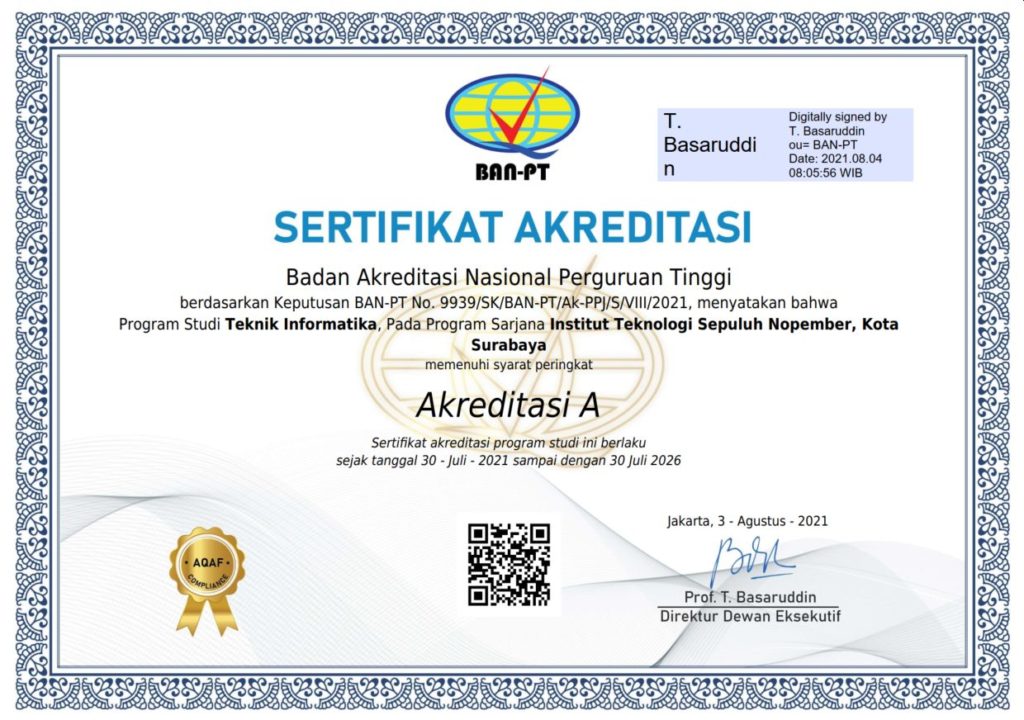
A Accreditation (2021 - 2026)
Program Studi Sarjana (S1) Departemen Teknik Informatika telah dinyatakan sebagai progam studi dengan akreditasi A (akreditasi tertinggi) oleh BAN-PT Indonesia pada tahun 2021 sampai 2026.
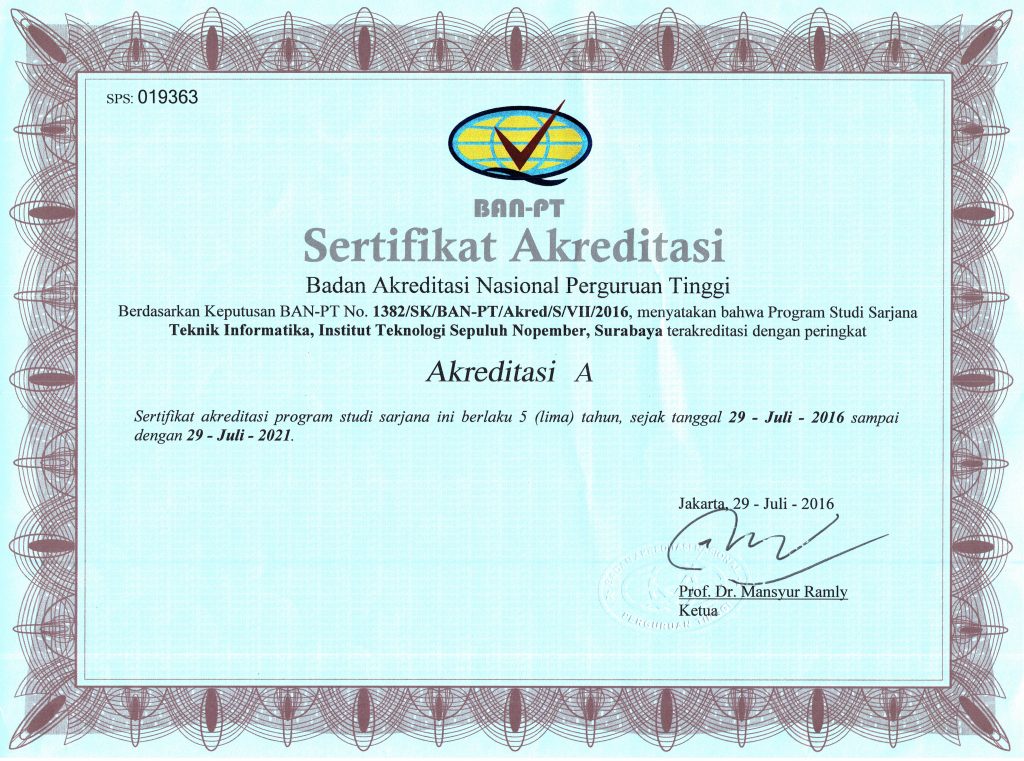
A Accreditation (2016 - 2021)
Program Studi Sarjana (S1) Departemen Teknik Informatika telah dinyatakan sebagai program studi dengan akreditasi A (akreditasi tertinggi) oleh BAN-PT Indonesia pada tahun 2016 sampai 2021.
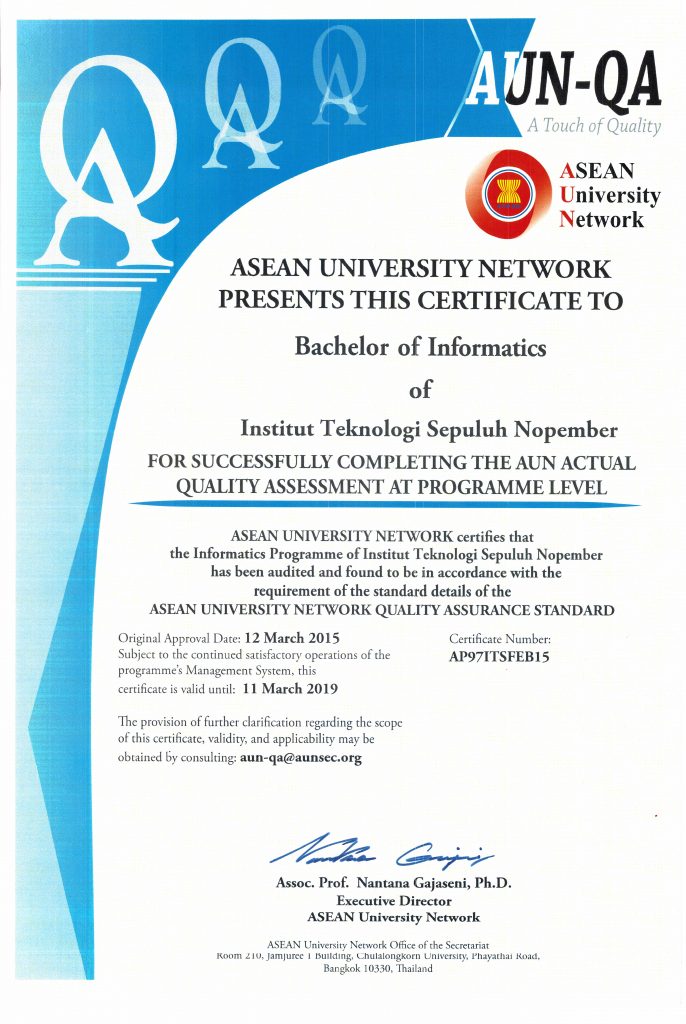
Departemen Informatika telah diakui oleh ASEAN University Network (AUN-QA) pada tahun 2015. Pengakuan tersebut berarti kualitas pendidikan Departemen Informatika setara dengan universitas-universitas lain yang diakui AUN-QA di ASEAN.
SPMI 2022
SPMI Program Studi Sarjana Teknik Informatika 2022
Pemenang-SPMI-S1
Graduate Learning Outcomes
1. Demonstrate attitudes and character reflecting: devotion to God Almighty; ethics and integrity; noble character; sensitivity and concern for social and environmental issues; respect for cultural diversity and pluralism; commitment to the rule of law; prioritization of national and public interests through creativity, innovation, excellence, strong leadership, and synergy; and the utilization of personal potential to achieve optimal results.
2. Analyze and utilize science and technology for application in the field of informatics—including computer networks, cybersecurity, information management, and modeling and simulation—and make sound decisions based on individual or group work (such as final projects or equivalent learning activities) through logical, critical, systematic, and innovative thinking.
3. Manage self-directed learning and personal development as a lifelong learner to compete at national and international levels, thereby making tangible contributions to problem-solving while adhering to sustainability principles.
4. Master the concepts and principles of intelligent systems and computational science, and design and build applications by applying these principles to create intelligent software products across various fields. 5. Master the concepts and principles of architecture, systems, and logic-based computer network fundamentals, and be able to apply these principles to design, implement, and manage high-performance, secure, and efficient network systems.
6. Master theoretical concepts and principles regarding network-based computing and related cutting-edge technologies, and be able to apply these concepts to analyze and design algorithms for solving computational problems across various fields.
7. Master the principles of algorithm design and various programming language concepts, and be able to design and analyze algorithms to solve problems effectively and efficiently based on sound programming practices, as well as apply them to software development based on software engineering concepts and principles.
8. Master the principles of graphics and interaction, and be able to develop and evaluate application and/or game user interfaces based on these principles.
9. Master problem-solving principles and techniques using calculus, matrices, statistics, approximation, linear optimization, modeling, and simulation, and be able to solve computational and mathematical modeling problems effectively and efficiently through exact, stochastic, probabilistic, and numerical approaches.
10. Master the concepts and principles of information capture, processing, and storage in various formats, and be able to collect, digitize, and process data into useful new information using effective and efficient data modeling and storage methods.
Curriculum and Syllabus
Kurikulum untuk program studi S1 yang sekarang digunakan di Departemen Teknik Informatika merupakan kurikulum baru yang telah diberlakukan mulai tahun akedemik 2023/2024 hingga tahun akademik 2028/2029. Dalam kurikulum ini, total Satuan Kredit Semester (SKS) normal yang harus ditempuh oleh mahasiswa adalah 144 SKS. Beban perkuliahan sebesar 144 SKS ini dapat diselesaikan selama delapan semester.
Keterangan lebih detil beserta Buku Petunjuk tentang Kurikulum, dapat dilihat dibawah ini:
Module-Handbook-Bachelor-of-Informatics-Program-ITS
catatan, Apabila pdf tidak tampil, coba matikan Aplikasi Downloader (seperti IDM), atau masukkan domain its.ac.id/* kedalam exclude list
Dalam kurikulum 2023-2028 ini, tidak ada pemisahan antara mata kuliah dan praktikum. Kegiatan perkuliahan dan kegiatan praktikum dilakukan dalam satu mata kuliah dengan bobot 3 – 4 sks. Kegiatan dapat berlangsung di kelas maupun di laboratorium. Kegiatan perkuliahan dilaksanakan untuk membekali mahasiwa dengan pemahaman konsep pengetahuan/teknologi. Kegiatan praktikum digunakan untuk membekali mahasiswa dengan ketrampilan praktis.
Pengalaman praktis lainnya yang wajib diikuti oleh mahasiswa adalah Kerja Praktek di industri selama minimal tiga bulan dengan beban 4 sks. Kegiatan ini untuk memperluas wawasan mahasiswa tentang penerapan teori yang diperoleh dari perkuliahan. Pada tahap akhir, mahasiswa menempuh Tugas Akhir dengan bobot 5 sks. Tugas Akhir ditujukan untuk memberikan kemampuan bagi mahasiswa untuk menyelesaikan topik permasalahan tertentu sesuai bidang keahlian dan menyusun laporan ilmiah. Tugas akhir ini bersifat komprehensif, ditulis sesuai dengan kaidah ilmiah dan harus dipertanggungjawabkan pada ujian tugas akhir yang bersifat tertutup di hadapan tim penguji
Independent Personal Profile
The Department of Informatics has defined the following graduate profiles:
1. Software Developer: Applies extensive knowledge of programming languages, software development, and computer operating systems to create software.
2. Systems Analyst/Developer: Translates user requests or requirements into technical design specifications and acts as a liaison between clients/IT professionals and technology vendors.
3. Web Developer: Builds websites, including writing well-designed, testable, and efficient code using software development best practices.
4. Computer Network Specialist: Maintains network system integrity by overseeing support systems, server capacity, and installed software.
5. Database Specialist: Maintains databases by planning, monitoring, and optimizing performance.
6. IT Consultant: Integrates information technology into business operations and advises clients on using IT more efficiently to achieve goals and targets.
7. IT Trainer: Trains IT staff in the use of various computer programming languages and specialized applications.
8. Game Technician/Developer: Develops game programs and networks for third-party use, designs games, and creates game mechanics that align with the narrative.
9. Mobile Application Developer: Develops and maintains mobile applications, including coding and designing new apps based on the latest concepts, best practices, and terminology in mobile app development.
10. Security Specialist: Prevents cyberattacks on information systems and stops unauthorized actors from accessing financial information, military secrets, and other confidential data.
11. Data Analyst: Identifies and communicates data-driven insights that enable managers, stakeholders, and executives within an organization to make more informed decisions.
12. Software Project Manager: project planning and monitoring, including writing project proposals, estimating project costs, scheduling, project staffing, software process tailoring, project monitoring and control, software configuration management, risk management, writing and presenting managerial reports, and client interaction.
Acara ini menghadirkan dua sesi talkshow inspiratif yang diisi oleh para alumni terkemuka. Sesi pertama, “Building Tomorrow Indonesia”, dimoderatori oleh Ir. Ari Novan Setiono, S.Kom, MBA (SVP IT Pupuk Indonesia), menampilkan karya-karya digital membanggakan dari para alumni seperti Prof. Dr. Diana Purwitasari, S.Kom., M.Sc. (Dekan FT-EIC ITS), Seno Hardijanto, S.Kom (Business Development Director ASEAN Cohesive – Bentley Systems), Roy Nugroho, S.Kom (Direktur Komersial Grab Indonesia), dan Yetty Endarwati, S.Kom (SVP Digitalisasi dan Data Science Pupuk Indonesia).
Sesi kedua yang tidak kalah menarik, “From Code to Leadership”, membedah perjalanan karier para alumni dari seorang teknisi menjadi pemimpin strategis. Dipandu dengan hangat oleh Billtraviano Ferian Harda, S.Kom, MBIS (Group CEO DOT Indonesia Group), sesi ini menghadirkan Sugianto Halim, S.Kom (Founder & CEO SEVIMA), Prof. Dr. Ir. Richardus Eko Indrajit, M.Sc., M.B.A. (Rektor Universitas Pradita), Ir. Dwi Kurniawan, MBA (Direktur Eksekutif Departemen Pengembangan Aplikasi OJK), Roy Hendy Perdana, S.Kom (Executive Director – Digital and Data Strategy DBS Bank Singapore), dan Ir. Lucky Esa, S.Kom, MBA (Knowledge Management Expert & Startup Mentor).
 Acara ini menghadirkan dua sesi talkshow inspiratif yang diisi oleh para alumni terkemuka. Sesi pertama, “Building Tomorrow Indonesia”, dimoderatori oleh Ir. Ari Novan Setiono, S.Kom, MBA (SVP IT Pupuk Indonesia), menampilkan karya-karya digital membanggakan dari para alumni seperti Prof. Dr. Diana Purwitasari, S.Kom., M.Sc. (Dekan FT-EIC ITS), Seno Hardijanto, S.Kom (Business Development Director ASEAN Cohesive – Bentley Systems), Roy Nugroho, S.Kom (Direktur Komersial Grab Indonesia), dan Yetty Endarwati, S.Kom (SVP Digitalisasi dan Data Science Pupuk Indonesia).
Sesi kedua yang tidak kalah menarik, “From Code to Leadership”, membedah perjalanan karier para alumni dari seorang teknisi menjadi pemimpin strategis. Dipandu dengan hangat oleh Billtraviano Ferian Harda, S.Kom, MBIS (Group CEO DOT Indonesia Group), sesi ini menghadirkan Sugianto Halim, S.Kom (Founder & CEO SEVIMA), Prof. Dr. Ir. Richardus Eko Indrajit, M.Sc., M.B.A. (Rektor Universitas Pradita), Ir. Dwi Kurniawan, MBA (Direktur Eksekutif Departemen Pengembangan Aplikasi OJK), Roy Hendy Perdana, S.Kom (Executive Director – Digital and Data Strategy DBS Bank Singapore), dan Ir. Lucky Esa, S.Kom, MBA (Knowledge Management Expert & Startup Mentor).