The Computer Science Doctoral Program (PDIK) Department of Informatics, FTEIC-ITS, was established with Decree Number 95/E/O/2011, accredited by LAM-INFOKOM with a Superior Rating according to SK N0. 023/SK/LAM-INFOKOM/Ak/D/III/2023 and is valid until March 29 2028. Up to the 129th Graduation, 60 doctorates in the field of computer science have been graduated at home and abroad with professions as university lecturers, researchers , industrial practitioners, IT developers, government employees, and others.
PDIK Department of Informatics – ITS is supported by 20 teaching staff with Doctoral degrees with 10 Professors and 10 Associate Professors.
Studies at PDIK are carried out over 6 semesters (3 years), with a credit load of 42 credits. The total credits are divided into 3 groups, namely 14 credits of preparatory stage courses in the first year, 19 credits of dissertation research courses and 9 credits of publication courses. New student admissions are carried out before the new academic year in accordance with the selection schedule from the postgraduate directorate.
Prospective PDIK students can choose the regular route or research route in accordance with the specified requirements, the study funding scheme can take part in the LPDP, BPI, Fresh-Graduate, BIB, PMDSU scholarship selection, institutional collaboration scholarship scheme, or independent fees. PDIK holds regular classes and collaboration classes offline and online.
Prospective PDIK students before registering must have a dissertation proposal plan that is in accordance with one of the 8 research fields in the Department of Information, namely Software Engineering (RPL), Network Based Computing (KBJ), Intelligent Vision Computing (KCV), Network Technology and Intelligent Cyber Security (NETICS), Graphics, Interaction and Games (GIGa), Programming Algorithms (AP), Intelligent Management of Information (MCI), Modeling and Applied Computing (PKT).
Doctoral (S3) Study Program - Computer Science has been declared a study program with superior accreditation (the highest accreditation) by LAM INFOKOM from 2023 to 2028.
akreditasi-s3-ilmu-komputer-its
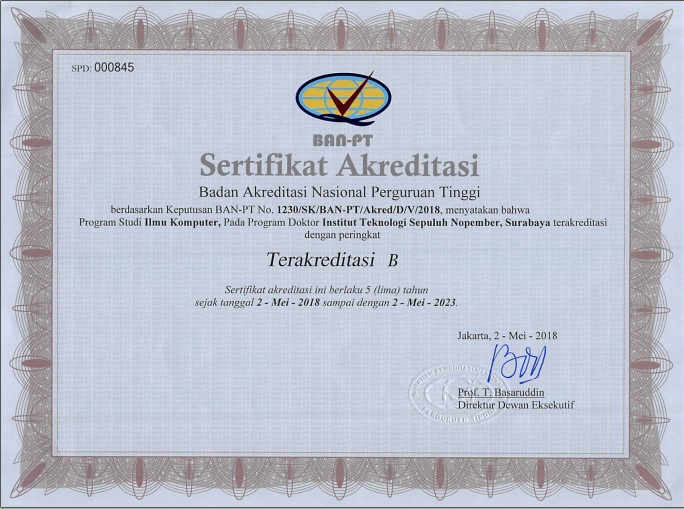
Accreditation B (2019 - 2023)
Doctoral Study Program – Computer Science Department of Informatics has been declared a department with B accreditation by BAN-PT Indonesia in 2019 and 2023.
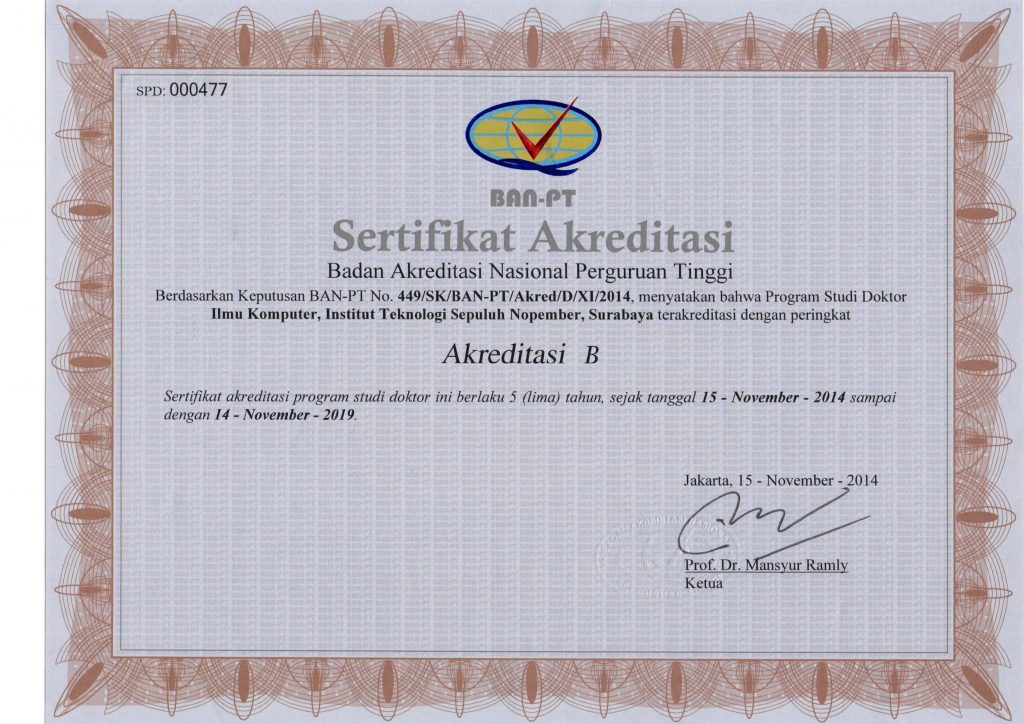
Accreditation B (2014 - 2019)
Doctoral Study Program – Computer Science Department of Informatics has been declared a department with B accreditation by BAN-PT Indonesia in 2014 and 2019.
Graduate Learning Outcome
1. Demonstrate attitudes and character reflecting: devotion to God Almighty; ethics and integrity; noble character; sensitivity and concern for social and environmental issues; respect for cultural diversity and pluralism; commitment to the rule of law; prioritization of national and public interests through creativity, innovation, excellence, strong leadership, and synergy; and the utilization of personal potential to achieve optimal results.
2. Analyze and utilize science and technology for application in the field of informatics—including computer networks, cybersecurity, information management, and modeling and simulation—and make sound decisions based on individual or group work (such as final projects or equivalent learning activities) through logical, critical, systematic, and innovative thinking.
3. Manage self-directed learning and personal development as a lifelong learner to compete at national and international levels, thereby making tangible contributions to problem-solving while adhering to sustainability principles.
4. Master the concepts and principles of intelligent systems and computational science, and design and build applications by applying these principles to create intelligent software products across various fields. 5. Master the concepts and principles of architecture, systems, and logic-based computer network fundamentals, and be able to apply these principles to design, implement, and manage high-performance, secure, and efficient network systems.
6. Master theoretical concepts and principles regarding network-based computing and related cutting-edge technologies, and be able to apply these concepts to analyze and design algorithms for solving computational problems across various fields.
7. Master the principles of algorithm design and various programming language concepts, and be able to design and analyze algorithms to solve problems effectively and efficiently based on sound programming practices, as well as apply them to software development based on software engineering concepts and principles.
8. Master the principles of graphics and interaction, and be able to develop and evaluate application and/or game user interfaces based on these principles.
9. Master problem-solving principles and techniques using calculus, matrices, statistics, approximation, linear optimization, modeling, and simulation, and be able to solve computational and mathematical modeling problems effectively and efficiently through exact, stochastic, probabilistic, and numerical approaches.
10. Master the concepts and principles of information capture, processing, and storage in various formats, and be able to collect, digitize, and process data into useful new information using effective and efficient data modeling and storage methods.
Curriculum
JALUR REGULER
SEMESTER 1
SEMESTER 2
Filsafat Ilmu (3 sks)
MK Pilihan 1 (3 sks)
MK Pilihan 2 (3 sks)
Disertasi 1(4 sks)
Metode Penelitian (3 sks)
Penulisan Ilmiah (2 sks)
Literasi Digital, AI, dan Etika Riset (2 sks)
SEMESTER 3
SEMESTER 4
Disertasi 2 (3 sks)
Publikasi 1 (3 sks)
Bahasa Inggris (2 sks)
Disertasi 3 (3 sks)
Publikasi 2 (3 sks)
SEMESTER 5
SEMESTER 6
Disertasi 4 (3 sks)
Publikasi 3 (3 sks)
Disertasi 5 (6 sks)
Mata Kuliah Pilihan
Topik Dalam Jaringan Multimedia
Topik Dalam Sistem Terdistribusi
Topik Dalam Forensik Digital
Topik Dalam Pengaman Jaringan
Topik Dalam Komputasi Bergerak
Topik Dalam Komputasi Awan
Topik Dalam Jaringan Nirkabel
Topik Dalam Desain dan Audit Jaringan
Topik Dalam Pemodelan dan Simulasi
Topik Dalam Analisis Data Deret Waktu
Topik Dalam Interaksi Manusia dan Komputer
Topik Dalam Pengembangan Gim, dan Realitas X
Topik Dalam Grafika Komputer
Topik Dalam Audit Sistem
Topik Dalam Rekayasa Sistem Berbasis Pengetahuan
Topik Dalam Analisis Data Geospasial
Topik Dalam Evolusi Perangkat Lunak
Topik Dalam Manajemen Proyek Perangkat Lunak
Topik Dalam Rekayasa Kebutuhan
Topik Dalam Penjaminan Kualitas Perangkat Lunak
Topik Dalam Pengujian Perangkat Lunak
Topik Dalam Data Mining
Topik Dalam Text Mining
Topik Dalam Pengolahan Citra
Topik Dalam Visi Komputer
Topik Dalam Komputasi Biomedik
Topik Dalam Big Data
Topik Dalam Komputasi Kuantum
Topik Dalam Tata Kelola Teknologi Informasi
Topik dalam Analisis Data Multivariat
DOKUMEN-KURIKULUM-S3-2018-2023-hal33
catatan, Apabila pdf tidak tampil, coba matikan Aplikasi Downloader (seperti IDM), atau masukkan domain its.ac.id/* kedalam exclude list
SILABUS-KURIKULUM-S3-2018-2023-1
catatan, Apabila pdf tidak tampil, coba matikan Aplikasi Downloader (seperti IDM), atau masukkan domain its.ac.id/* kedalam exclude list