About SEATRANS


Study Program
Facilities
Academic

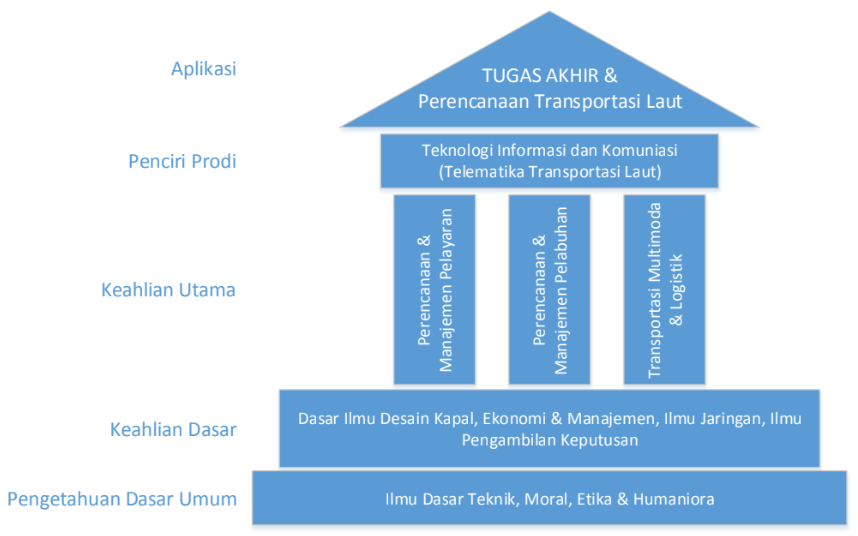
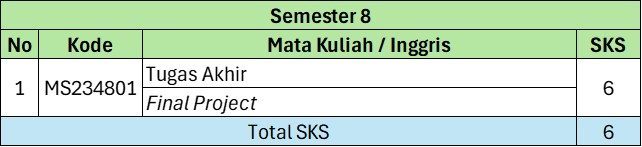
In accordance with the applicable regulations, the Bachelor’s Degree Program is designed to be completed within 8 semesters (4 years) with a total academic load of 144 credit units (Semester Credit Units/SCU). The study period of eight semesters is divided into two stages, namely the Preparatory Stage and the Bachelor Stage.
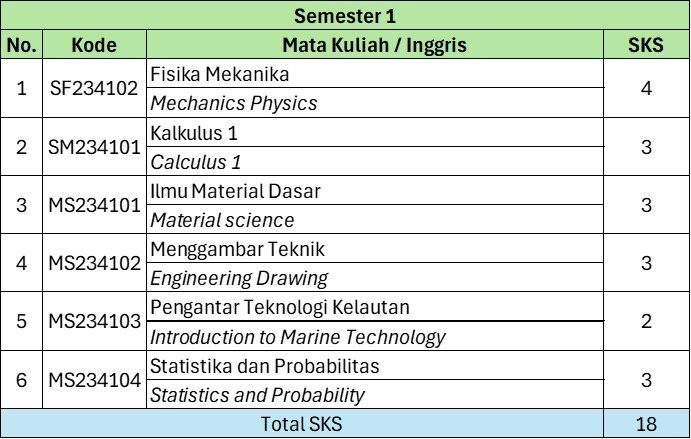
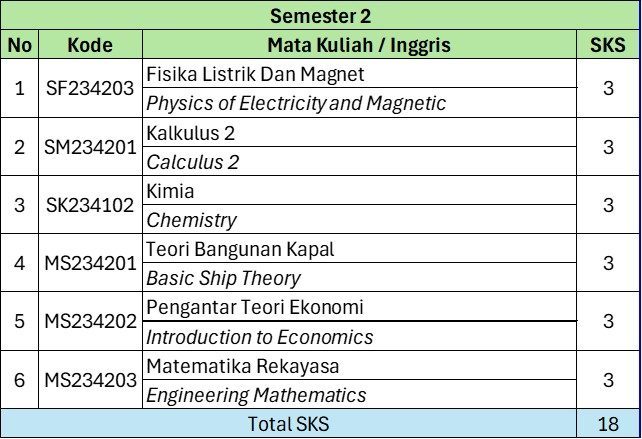
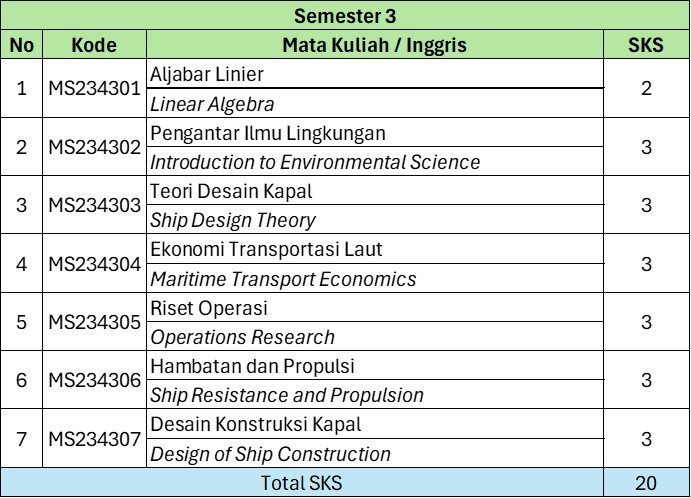
The Preparatory Stage covers Semesters 1 and 2 with a total load of 36 credit units, while the Bachelor Stage covers Semesters 3 to 8 with a total load of 108 credit units.
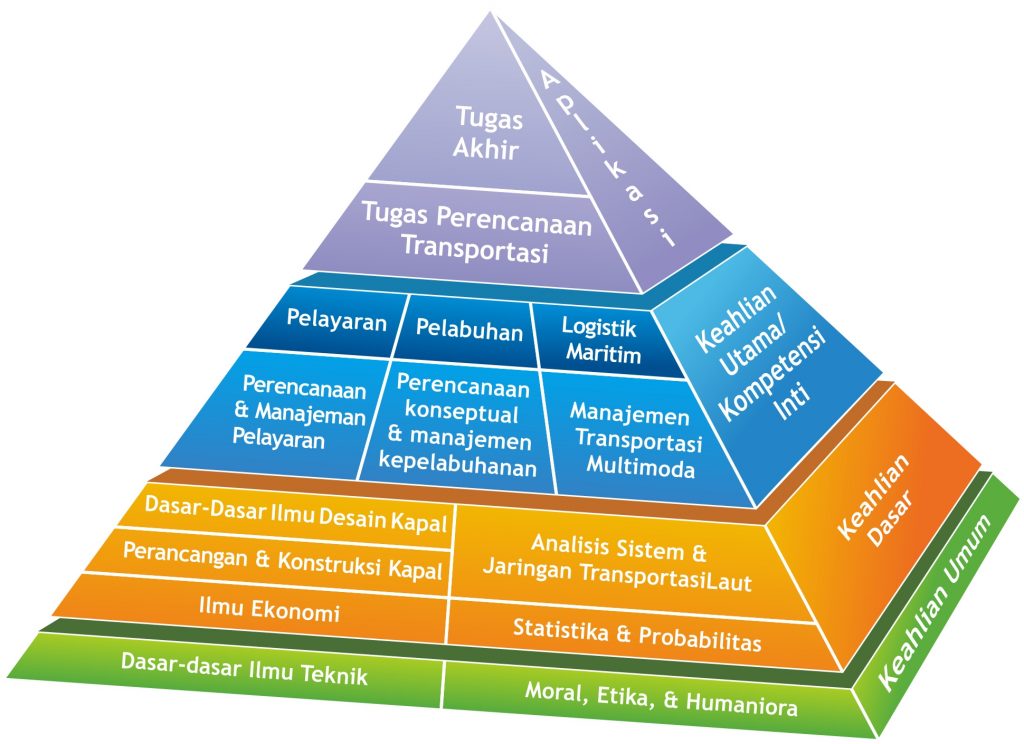
During the Preparatory Stage, students are equipped with general basic courses, basic science courses, fundamental naval architecture courses, and basic economics courses. Meanwhile, in the Bachelor Stage, students are provided with fundamental knowledge of maritime transportation engineering, as well as specialized courses and professional competencies that characterize the core field of maritime transportation.
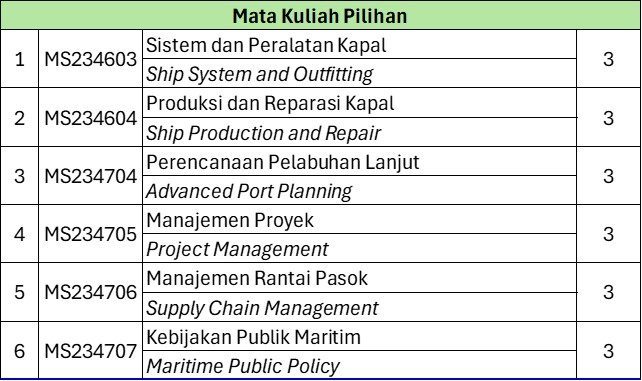
In addition to classroom-based courses, the curriculum also includes assignment-based and practical courses, as well as elective courses in the fields of Shipping, Ports, and Maritime Logistics.
The Marine Transportation Engineering Undergraduate Study Program (S1) has been declared a study program with Superior Accreditation (Highest Accreditation) by LAM TEKNIK in 2024 to 2029.
Level: National Validity Period: December 21, 2024–December 20, 2029.
Based on the results of the assessment and evaluation of the IABEE Evaluation Team, the curriculum and learning system of the Department of Marine Transportation Engineering received full IABEE Accreditation for 3 (three) years (2026-2029) in accordance with Accreditation Certificate No. 000305.AI issued by IABEE.
Level: International Expiration Date: March 31, 2029
The Marine Transportation Engineering Undergraduate Study Program (S1) has been declared a study program with Superior Accreditation (Highest Accreditation) by BAN-PT Indonesia in 2017 to 2019.
Level: National Validity Period: December 27, 2017 – December 27, 2022

The Marine Transportation Engineering Undergraduate Study Program (S1) has been declared as a study program with A Accreditation (Highest Accreditation) by BAN-PT Indonesia from 2017 to 2022.
Level: National Validity Period: December 27, 2017 – December 27, 2022
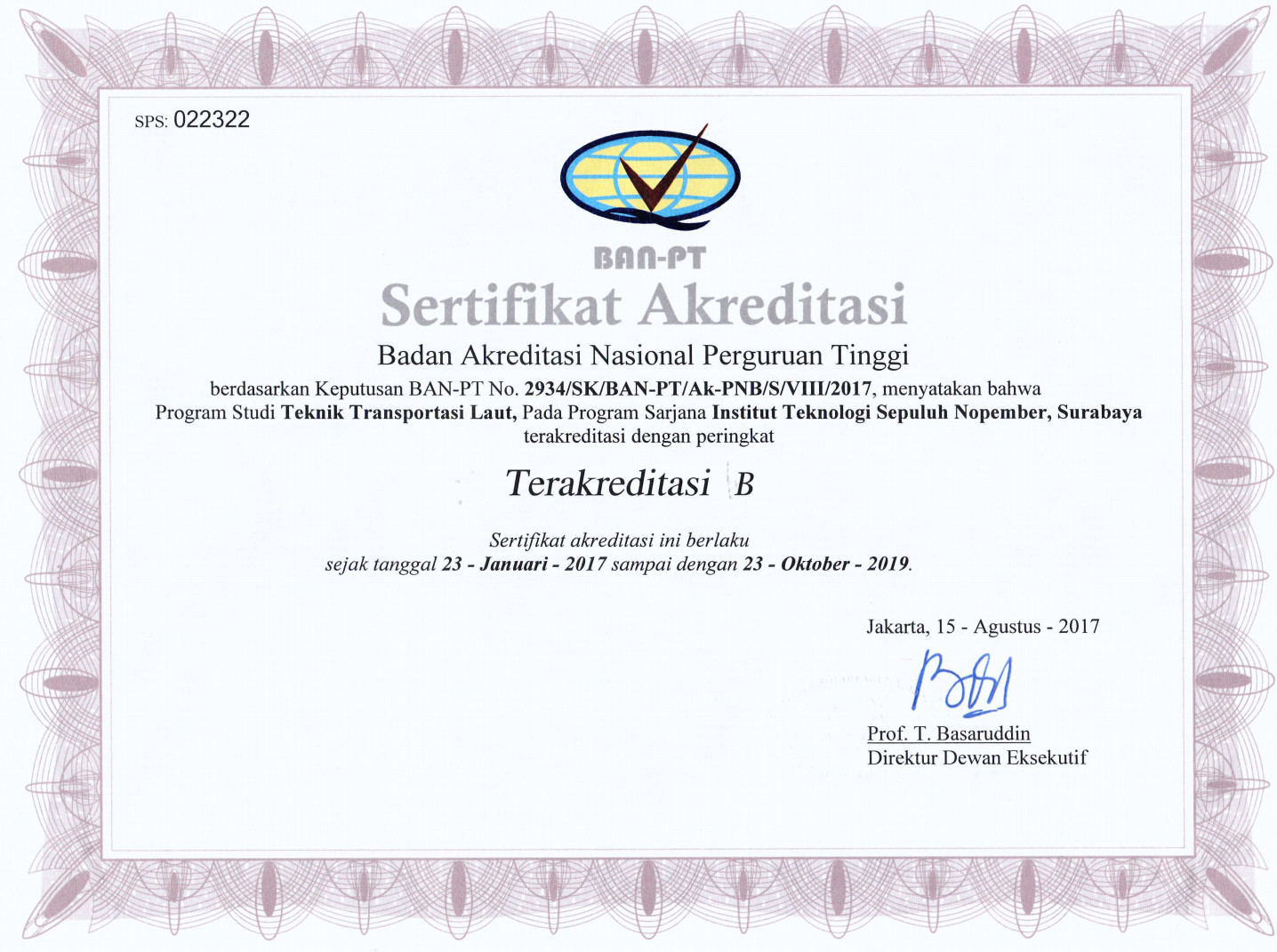
The Marine Transportation Engineering Undergraduate Study Program (S1) has been declared a study program with B Accreditation by BAN-PT Indonesia in 2017 to 2019.
Level: National Validity Period: 23 January 2017 – 23 October 2019
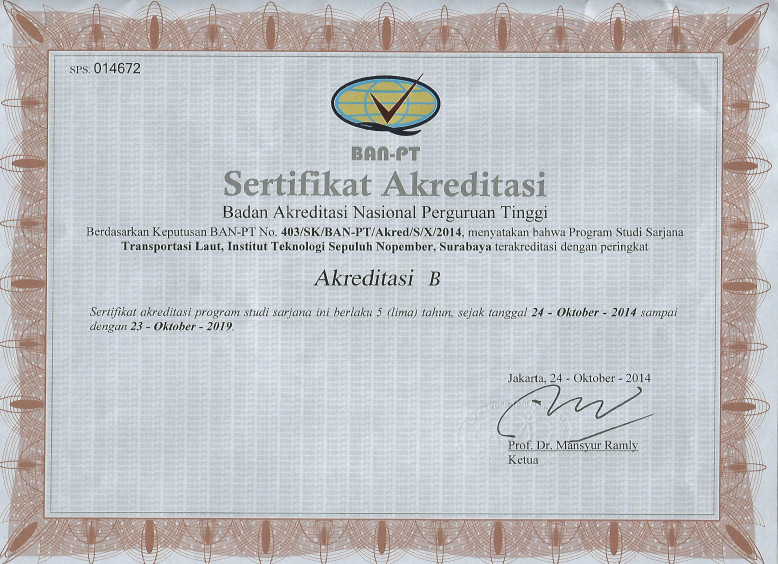
The Marine Transportation Engineering Undergraduate Study Program (S1) has been declared a study program with B Accreditation by BAN-PT Indonesia from 2014 to 2019.
Level: National Validity Period: October 24, 2014 - October 23, 2019
| Kode | Deskripsi Capaian Pembelajaran Lulusan (CPL) |
|---|---|
| CPL-1 | Mampu menunjukkan sikap dan karakter yang mencerminkan: ketakwaan kepada Tuhan Yang Maha Esa, etika dan integritas, berbudi pekerti luhur, peka dan peduli terhadap masalah sosial dan lingkungan, menghargai perbedaan budaya dan kemajemukan, menjunjung tinggi penegakan hukum mendahulukan kepentingan bangsa dan masyarakat luas, melalui kreatifitas dan inovasi, ekselensi, kepemimpinan yang kuat, sinergi, dan potensi lain yang dimiliki untuk mencapai hasil yang maksimal. |
| CPL-2 | Mampu merencanakan, menyelesaikan dan mengevaluasi tugas serta berkomunikasi secara efektif baik lisan maupun tulisan baik individu maupun dalam tim. |
| CPL-3 | Mampu mengkaji dan memanfaatkan ilmu pengetahuan dan teknologi dalam rangka mengaplikasikannya pada bidang keahlian Transportasi Laut, serta mampu mengambil keputusan secara tepat dari hasil kerja sendiri maupun kerja kelompok dalam bentuk laporan tugas akhir atau bentuk kegiatan pembelajaran lain yang luarannya setara dengan tugas akhir melalui pemikiran logis, kritis, sistematis dan inovatif. |
| CPL-4 | Mampu mengelola pembelajaran diri sendiri, dan mengembangkan diri sebagai pribadi pembelajar sepanjang hayat untuk bersaing di tingkat nasional, maupun internasional, dalam rangka berkontribusi nyata untuk menyelesaikan masalah dengan mengimplementasikan teknologi informasi dan komunikasi dan memperhatikan prinsip keberlanjutan serta memahami kewirausahaan berbasis teknologi. |
| CPL-5 | Mampu mengidentifikasi, memformulasi, menganalisis dan menyelesaikan permasalahan rekayasa transportasi (pengangkutan) melalui matra laut dengan mempertimbangkan faktor ekonomis, keamanan, keselamatan, dan kelestarian lingkungan. |
| CPL-6 | Mampu merencanakan (planning) dan melaksanakan eksperimen laboratorium dan/atau lapangan: jaringan transportasi laut, armada kapal, pelabuhan, angkutan multimoda, layanan transportasi laut (services), serta telematika transportasi laut. |
| CPL-7 | Mampu merancang (design) desain konseptual dan sistem atau proses untuk kapal, pelabuhan dan logistik maritim (conceptual design and system for ships, ports and maritime logistics) dengan mempertimbangkan faktor keselamatan, keamanan, ekonomi, lingkungan dan keberlanjutan. |
| CPL-8 | Mampu melakukan kegiatan manajerial dalam hal: armada kapal, kepelabuhanan, angkutan multimoda, serta telematika transportasi laut. |
| CPL-9 | Mampu menerapkan metode dan piranti mutakhir (modern) untuk eksperimen dalam perencanaan, perancangan, analisis teknis dan manajerial di bidang rekayasa transportasi laut. |
| CPL-10 | Mampu menerapkan konsep ilmu dasar: matematika, ilmu pengetahuan alam, prinsip rekayasa, ekonomi dan informatika. |
| No | Profil Lulusan | Deskripsi Profil Lulusan |
|---|---|---|
| 1 | Ahli Teknik Transportasi Laut (PL-1) | Ahli teknik transportasi laut yang mampu menggunakan ilmu rekayasa dan manajemen untuk merencanakan dan mengelola jaringan transportasi laut, armada kapal, pelabuhan dan angkutan multimoda: 1. Fleet Planner 2. Transport Analyst 3. Port Planner 4. Logistic Planner |
| 2 | Profesional (PL-2) | Seorang profesional di bidang teknik transportasi laut yang mampu berfikir dan bertindak mandiri maupun dalam kelompok secara logis, sistematis, inovatif; 1. Peneliti bidang transportasi laut 2. Junior Researcher |
| 3 | Pengambil Keputusan (PL-3) | Individu yang berwawasan dalam bidang teknik transportasi laut dan mampu menggunakan metode maupun piranti mutakhir untuk eksperimen maupun analisis dalam suatu proses pengambilan keputusan dalam persepektif teknologi, ekonomi, keamanan, keselamatan, hingga kelestarian lingkungan; 1. Operator/ Yunior Enginer 2. HSE Officer |
| 4 | Wirausahawan (PL-4) | Individu yang berorientasi pada pembelajaran sepanjang hayat untuk mengembangkan diri dalam hal pengetahuan dan keahlian di bidang teknik transportasi laut secara berkesinambungan: 1. Konsultan di bidang transportasi laut 2. Wirausahawan di bidang transportasi laut |
In accordance with the applicable regulations, the Bachelor’s Degree Program is designed to be completed within 8 semesters (4 years) with a total academic load of 144 credit units (Semester Credit Units/SCU). The study period of eight semesters is divided into two stages, namely the Preparatory Stage and the Bachelor Stage.
The Preparatory Stage covers Semesters 1 and 2 with a total load of 36 credit units, while the Bachelor Stage covers Semesters 3 to 8 with a total load of 108 credit units.
During the Preparatory Stage, students are equipped with general basic courses, basic science courses, fundamental naval architecture courses, and basic economics courses. Meanwhile, in the Bachelor Stage, students are provided with fundamental knowledge of maritime transportation engineering, as well as specialized courses and professional competencies that characterize the core field of maritime transportation.
In addition to classroom-based courses, the curriculum also includes assignment-based and practical courses, as well as elective courses in the fields of Shipping, Ports, and Maritime Logistics.
Unlike other engineering programs that are more product-oriented, marine transportation engineering is more function- and demand-oriented. The functions that become the focus of marine transportation engineering are derived from the needs of service users in the process of maritime transport, both at the macro and micro levels.
Meanwhile, the products associated with the field of maritime transportation engineering include ships and ports. Therefore, there is a close interconnection between maritime transportation engineering and other engineering disciplines, particularly naval architecture and civil engineering.
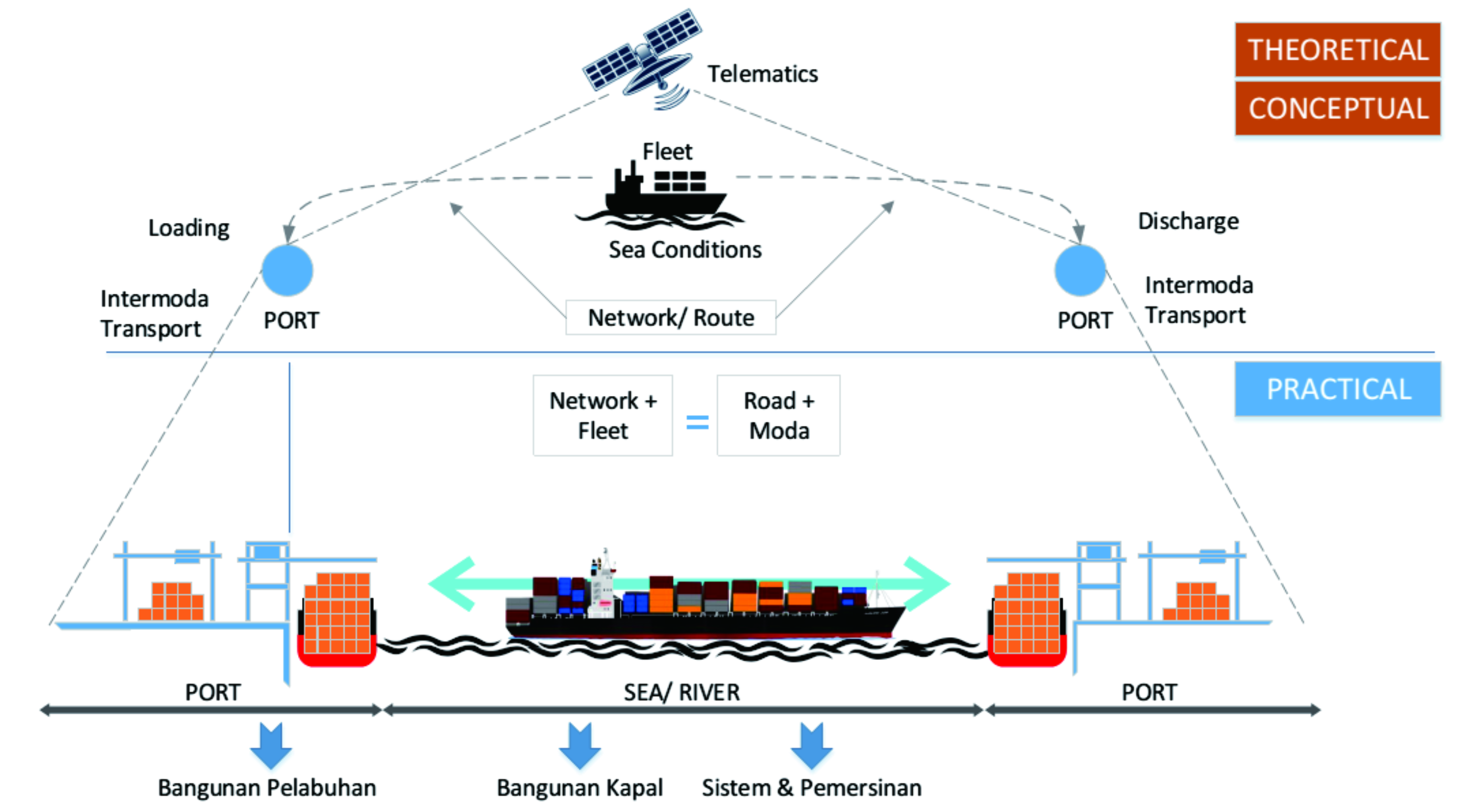
Therefore, the Bachelor’s Degree Program in Maritime Transportation Engineering was established with the objective of producing globally competent professionals who possess specialized expertise in the field of maritime transportation. It is expected that graduates will be able to manage and develop Indonesia’s maritime transportation sector in a more optimal and sustainable manner.
In general, there are three (3) major industrial sectors related to education in Maritime Transportation Engineering, namely: the shipping industry, the port industry, and freight forwarding services.
Students of Marine Transportation Engineering are prepared to become graduates who are capable of solving problems in the field of marine transportation engineering. This includes conceptual ship design, planning and management of maritime transportation networks, ship fleets, ports and terminals, as well as intermodal (multimodal) transportation systems.
At present, the Department of Marine Transportation Engineering offers only the Bachelor’s Degree Program (S1) and the Double Degree Master’s Program (S2). Meanwhile, the Doctoral Program (S3) is currently administered by the Department of Ocean Engineering, Faculty of Marine Technology (FTK) – ITS.
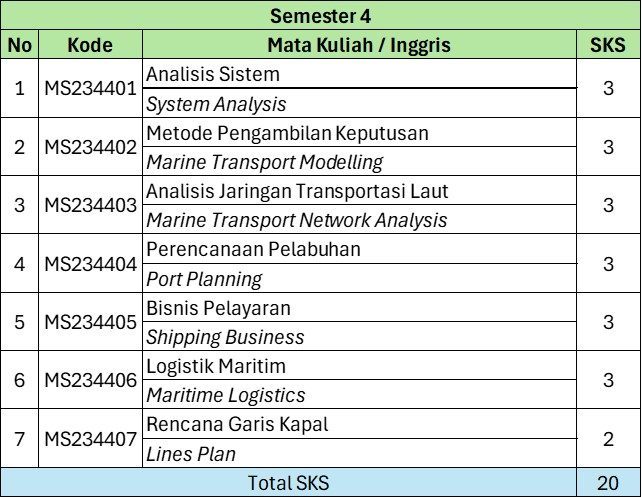
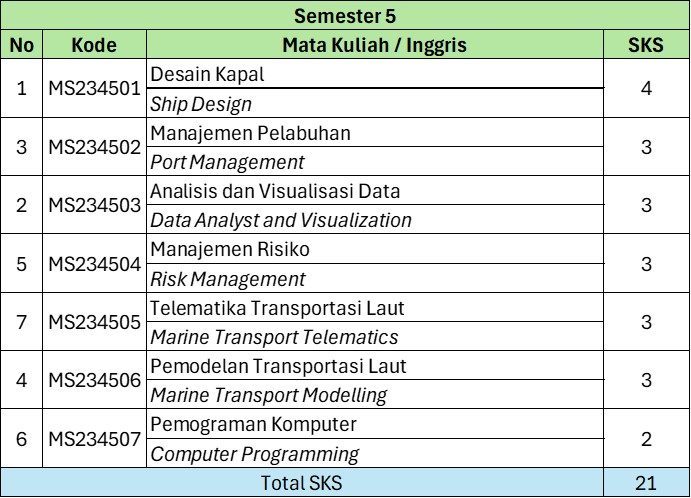
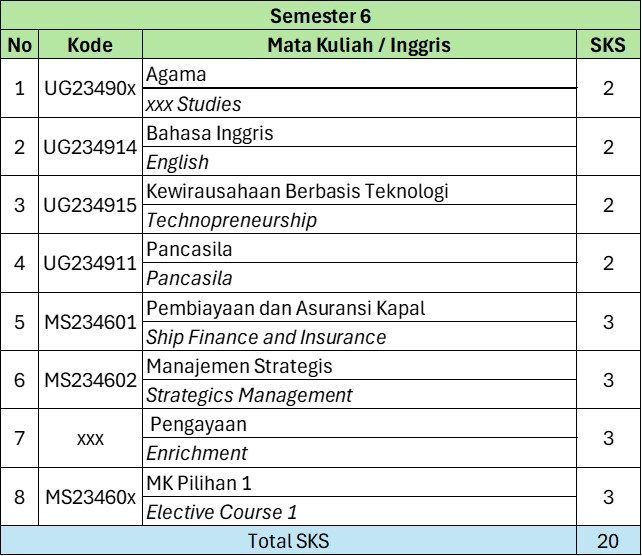
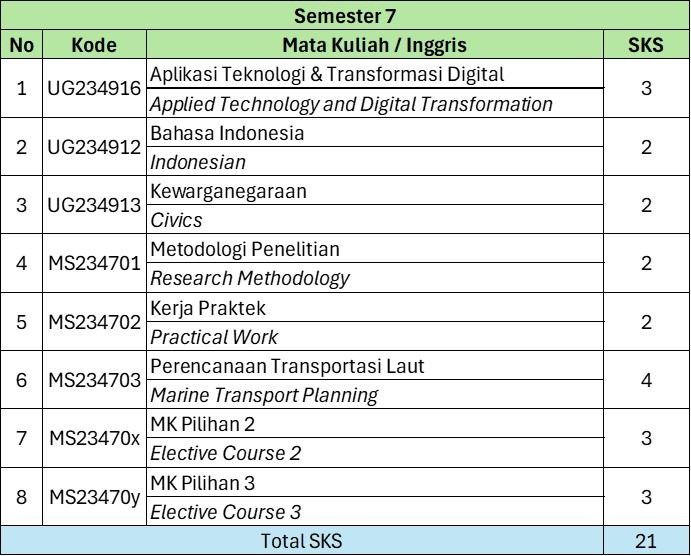
Rancangan kurikulum ini disusun dengan mengacu pada peraturan yang berlaku yaitu UU 12/2012 tentang Pendidikan Tinggi, Permendikbud 03/2020 tentang Standar Nasional Pendidikan Tinggi (SN- Dikti) dan Keputusan Rektor ITS 888/IT2/T/HK.00.01/2022 tentang Pedoman Evaluasi dan Pengembangan Kurikulum ITS 2023-2028. Dokumen kurikulum ini diharapkan akan dapat menjadi pedoman dalam proses kegiatan pembelajaran di Progam Studi Sarjana Teknik Transportasi Laut Fakultas Teknologi Kelautan ITS. Berikut adalah struktur kurikulum yang disusun sedemikian rupa sehingga Capaian Pembelajaran Lulusan yang telah ditentukan dapat tercapai.
Detailed information on the curriculum development of the Bachelor’s Degree Program in the Department of Maritime Transportation Engineering, including the formulation of Graduate Learning Outcomes (GLOs), can be accessed here. Mata Kuliah

PTK 007 Certified Contract Specialist with experience in contract administration, tender processes, and procurement support within the Oil & Gas industry. Currently engaged in Contract and Procurement functions, supporting project execution by ensuring compliance with SKK Migas regulations, internal governance, and contractual best practices.
Consultant at Haskoning with deep expertise in maritime business advisory, port feasibility studies, shipping and trade analysis, and financial modelling across the Asia‑Pacific region.


Hello! My name is Aisyah and I am a bachelor of Marine Transportation Engineering Department at Institut Teknologi Sepuluh Nopember (ITS) with expertise in shipping, ports, and logistics.
A problem solver, result oriented, and people person with 7 years’ experience in shipping industry. Love to meet new people to keep up with market situation. I am a driven individual who isn’t afraid to face challenges or obstacles. I’m highly focus to achieve and deliver the best performance for the company.

Pelajari informasi lengkap mengenai beasiswa, biaya kuliah, dan penerimaan mahasiswa baru.