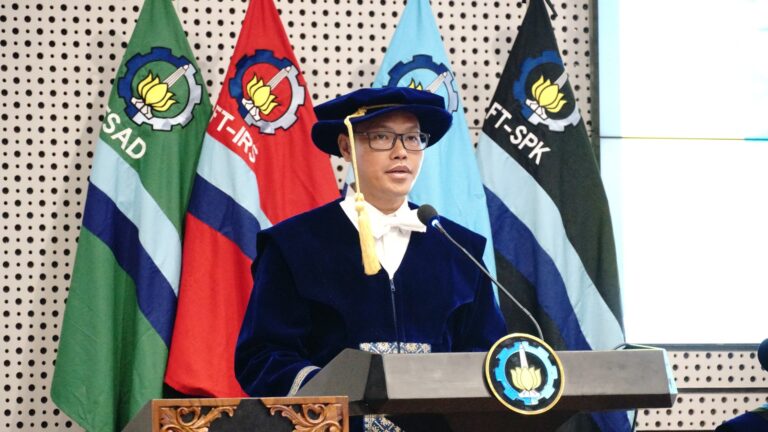
ITS Campus, ITS News — The rapid changes in data, human behavior, and cyber threats require Artificial Intelligence (AI) systems to be more than static. To address this challenge, Professor Ir. Ary Mazharuddin Shiddiqi, S.Kom., M.CompSc., Ph.D., Professor of the Department of Informatics Engineering at the Sepuluh Nopember Institute of Technology (ITS), developed the concept of adaptive artificial intelligence through continuous learning.
In his scientific oration, entitled “Adaptive Artificial Intelligence as the Foundation of Future Intelligent Systems,” Ary explained that AI needs to continuously learn from new data and experiences. He believes that AI systems that cannot adapt will quickly be left behind by change. “AI will become obsolete if it doesn’t adapt,” he explained.
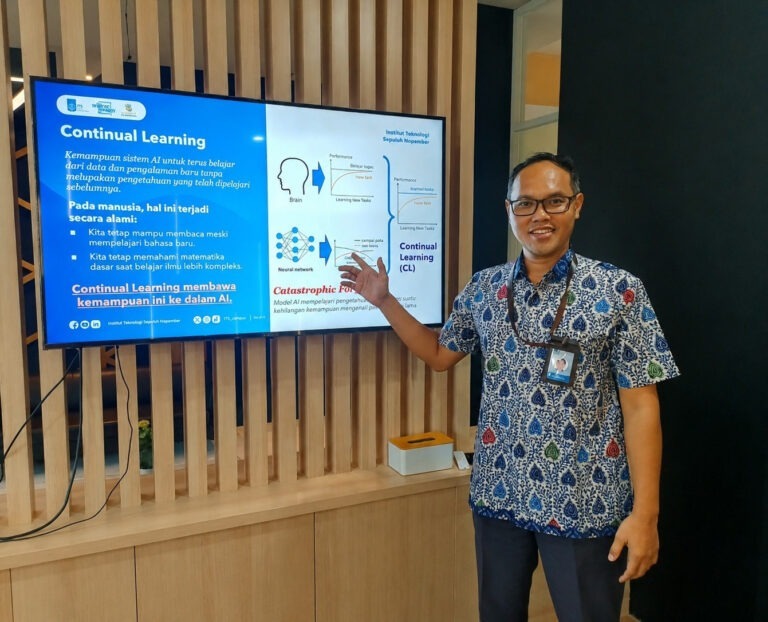
The man born in Kediri in 1981 explained that continuous learning adopts the human ability to learn continuously. With this concept, continued the 238th ITS Professor, AI is expected to be able to learn new knowledge without forgetting old knowledge.
However, Ary stated that the development of continuous learning still faces the challenge of catastrophic forgetting. This condition occurs when an AI model learns new things but loses the ability to recognize old knowledge. “AI models can understand new things but forget the old things they have learned,” explained the Head of the ITS Informatics Engineering Department.
In his scientific development, Ary explained the Adaptive Intelligence Framework for Distributed Systems. This framework consists of five stages: observing, learning, remembering, adapting, and acting, so that the system can observe new data, learn, remember, adapt, and make decisions.
Through this framework, Ary highlighted three new scientific directions: adaptive cyberdefense, adaptive AI infrastructure, and adaptive critical infrastructure. These three areas encompass intrusion detection, network anomalies, AI cluster management, and sensor placement strategies in critical infrastructure. “I want to create a dynamic system that can distribute loads based on availability and trends,” he explained.
The implementation of these ideas is evident in FusionNet-FR, a DualNet transformer architecture that combines frequency modeling and relational learning to improve broadcasting over long periods. Ary also presented SPARC as a sensor placement strategy for detecting contamination risks in air distribution networks.
This development is complemented by DiLLeMa as a framework for distributing large models and CloudX-Lab as a living laboratory for adaptive AI infrastructure. CloudX-Lab integrates GPU nodes, CPU nodes, and edge nodes in a single platform, supporting dynamic scheduling, load balancing, autoscaling, fault tolerance, and resource efficiency.
In terms of its benefits to the nation, adaptive AI is considered to support national cyber resilience, digital transformation, AI technological sovereignty, and the development of superior human resources. Ary believes that Indonesia cannot simply adopt AI but also needs to develop technology tailored to local needs.
Ethically, the ITS Informatics Engineering alumnus emphasized that AI is merely a tool, not a replacement for humans. “AI can be used as a tool, but not solely to replace us in building knowledge,” he cautioned.
Concluding his explanation, Ary expressed his hope that research into continual learning and adaptive AI can have a real impact on ITS and Indonesia. “I am committed to focusing on continuous learning research so that it can provide the greatest possible benefit to the ITS academic community in particular and Indonesia in general,” he concluded optimistically.
Furthermore, this initiative aligns with the Sustainable Development Goals (SDGs). These include point 4 on Quality Education, point 9 on Industry, Innovation, and Infrastructure, and point 17 on Partnerships to address the Goals. (ITS Public Relations)
Reporter: Asher Yedijah Hoesono
Link: https://www.its.ac.id/news/profesor-its-gagas-ai-adaptif-untuk-masa-depan-yang-dinamis/