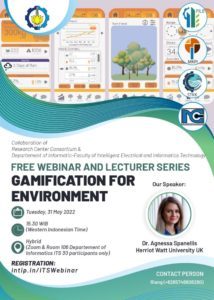
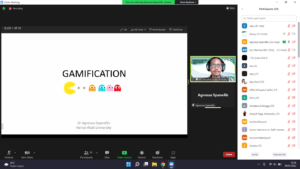
Some people might think that gamification is something related to games. In fact, it is the use of game elements in a non-gaming environment. Dr. Agnessa Spanellis (Edinburgh Business School, Heriot-Watt University) explained how the gamification concept works in a webinar held by the Department of Informatics ITS. The webinar, entitled “Gamification for Environment”, was held on May 31, 2022, via Zoom Meetings and was moderated by Dr. Ary Mazharuddin Shiddiqi. More than 70 online participants in the webinar were enthusiastic to know what and how gamification works.
Dr. Agnessa discusses the concept of gamification and its examples, theories supporting why it works, and several case studies in Indonesia. She also explains that the initial gamification was the games that stretched food stocks during the famine by the King of Lydia in 1200 BC. It was evidenced by soil layers indicating a long drought for more than a decade around that period.
Dr. Agnessa Spanellis explained that the gamification concept could be derived from several gamification characteristics, namely 1) process, 2) use of game elements, 3) non-game environment, 4) call for social action (optional), and 5) not a serious game. Gamification can be identified by its components, mechanisms, as well as dynamics. One of the most well-known is the reward system based on achievements and challenges that makes the user experience achieve something more engaging.
Several theories support gamification works, but the most referenced theory is the Self-Determination Theory (Ryan & Deci, 2000). This theory mainly discusses two types of motivation: extrinsic and intrinsic. Gamification design can be applied for various purposes. One of them is to increase community resilience after the eruption of Mount Merapi in 2010 through SIGAP (Merapi Adventure application). In the long term, gamification can change users’ habits, which can affect environmental sustainability.
After the presentation, there was a QnA session where participants actively participated in the discussion. At the end of the session, Ary Mazharuddin Shiddiqi, S.Kom., M.Sc., Ph.D. thanked Dr. Agnessa Spanesslis and gave the conclusion of the webinar. The session closed by taking photos together for documentation.


 Several theories support gamification works, but the most referenced theory is the Self-Determination Theory (Ryan & Deci, 2000). This theory mainly discusses two types of motivation: extrinsic and intrinsic. Gamification design can be applied for various purposes. One of them is to increase community resilience after the eruption of Mount Merapi in 2010 through SIGAP (Merapi Adventure application). In the long term, gamification can change users’ habits, which can affect environmental sustainability.