Academic
Facilities
Research & Collaborations
Published on
Wednesday, 25 November 2026
SURABAYA, November 24, 2026 — Ir. Dharma Arung Laby, S.Si., M.T., a lecturer at the Department of Geophysical Engineering, Faculty of Civil, Planning, and Geo Engineering (FTSPK), Institut Teknologi Sepuluh Nopember (ITS), has once again marked an international academic milestone through the Outbound Researcher Mobility 2026 grant funded by ITS.
Under this researcher mobility scheme, he carried out an academic visit from September 6 to 12, 2026, at the School of Physics, Universiti Sains Malaysia (USM), Penang, Malaysia. Throughout the program at the host institution, his academic and research activities were conducted under the supervision of Assoc. Prof. Dr. Andy Anderson Anak Bery.
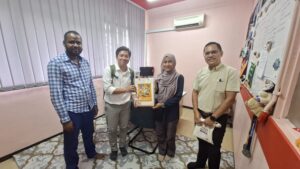
Welcome meeting from Faculties of School of Physics
During the visit, several strategic agendas were successfully executed to strengthen international networks and research synergy between ITS and USM, including:
Guest Talk: Delivering a scientific lecture before faculty members and students of the School of Physics, Universiti Sains Malaysia, sharing expertise and research insights in the field of geophysics.
Joint Research Scoping Discussion: Holding in-depth scoping discussions to initiate collaborative research activities with Assoc. Prof. Dr. Andy Anderson Anak Bery’s research group.
Campus and Laboratory Tour: Participating in a guided tour of academic facilities and research laboratories within the School of Physics, USM, to explore potential instrument utilization and joint research support.
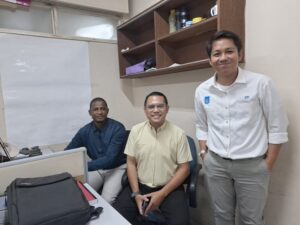
Ir. Dharma Arung Laby, S.Si., M.T. with research group led by Assoc. Prof. Dr. Andy Anderson Anak Bery.
Active participation in this international researcher mobility program represents a strategic step for the Department of Geophysical Engineering, ITS, in expanding its academic footprint across Southeast Asia, enhancing collaborative research productivity, and opening broader partnership opportunities for both faculty members and students in the future. Furthermore, this initiative underscores the department’s tangible commitment to advancing the Sustainable Development Goals (SDGs)—specifically SDG 4 (Quality Education), SDG 9 (Industry, Innovation, and Infrastructure), and SDG 17 (Partnerships for the Goals)—through geoscience research innovation and sustainable global higher education partnerships.