Academic
Facilities
Research & Collaborations
Published on
Tuesday, 24 November 2026
SURABAYA, November 20, 2026 — The Department of Geophysical Engineering (DTG), Faculty of Civil, Planning, and Geo Engineering (FTSPK), Institut Teknologi Sepuluh Nopember (ITS), in collaboration with the Indonesian Agency for Meteorology, Climatology, and Geophysics (BMKG), successfully hosted an International Session titled “Study Abroad at Vitus Bering Kamchatka State University, Russia” on Friday, November 20, 2026. Held at Classroom TG 305–306, the event featured Prof. Oleg Sulitsa from Vitus Bering Kamchatka State University, Russia, as the keynote speaker.
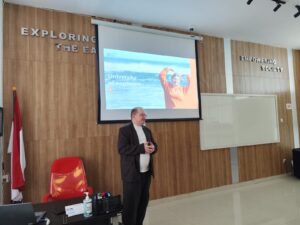
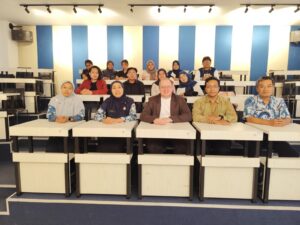
Running from 14:40 to 16:00 WIB, the session drew enthusiastic participation from Bachelor’s (S1) and Master’s (S2) students, Geophysical Engineering ITS alumni, as well as members of the general public keen on exploring postgraduate study opportunities and cross-border geoscience research collaborations.
During his presentation, Prof. Oleg Sulitsa introduced the academic profile of Vitus Bering Kamchatka State University, located on the Kamchatka Peninsula—one of the world’s most tectonically and volcanically active regions, serving as a premier natural laboratory for geoscience and geophysics research. He outlined various postgraduate study pathways, scholarship schemes for international students, and potential earth science research collaborations between higher education institutions and research agencies in Russia and Indonesia.
Following the classroom presentation and Q&A session, the event continued with a “Visit to the DTG Accelerometer Station”. During this brief field visit, the speaker and delegation representatives inspected the accelerometer station located at the Exhibition Room of the Department of Geophysical Engineering, ITS. This ground-motion and seismic monitoring facility stands as a tangible outcome of the strategic partnership between the Department of Geophysical Engineering ITS and BMKG in supporting geophysical disaster monitoring and research.
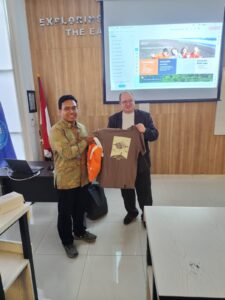
Through this synergy between a higher education institution and a government agency like BMKG, the event is expected not only to broaden global study perspectives for students and alumni, but also to strengthen research collaboration networks and the utilization of earth instrumentation infrastructure at the Department of Geophysical Engineering, ITS. Furthermore, organizing this session underscores the department’s commitment to advancing the Sustainable Development Goals (SDGs)—specifically SDG 4 (Quality Education), SDG 13 (Climate Action), and SDG 17 (Partnerships for the Goals)—through quality higher education, enhanced geophysical disaster monitoring, and sustainable global partnerships.