Study Program


Facilities
Research and Collaborations
Department of Engineering Physics ITS produces competitive graduates, proved by several parameters in the survey of ITS Student Advisory Center (SAC). The annual survey given to every alumnus during few years after their graduation. Total respondent from Engineering Physics is 108 respondent.
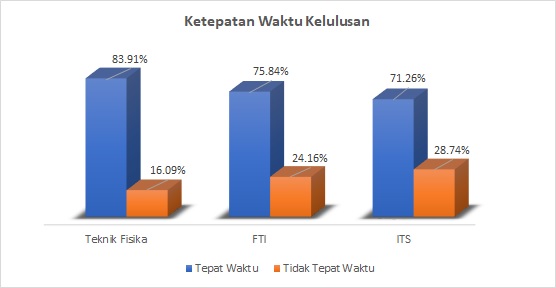
Approximately 83.91% of respondents graduated on time (8 semesters), while the remaining 16.09% did not graduate on time. The number of students graduating on time in the Department of Engineering Physics is relatively higher compared to the average of FTI and ITS students.
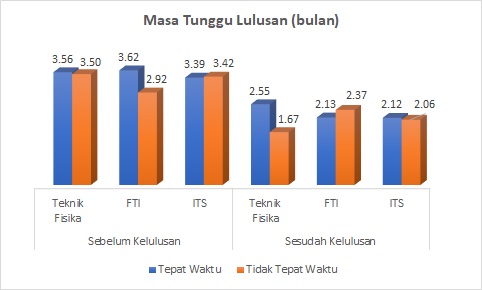
The following shows the average waiting time for Department of Engineering Physics respondents before securing their first job, with the job search process beginning either before or after graduation. The average waiting time for Engineering Physics, FTI, and ITS students seeking employment prior to graduation ranges from 2.9 to 3.5 months. For students who begin job hunting after graduation, the waiting time varies. Engineering Physics students have a relatively short waiting time of 2.5 months (on-time graduates) and 1.6 months (delayed graduates).
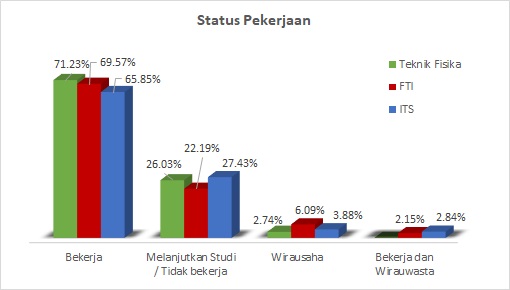
The average percentage of employed respondents from the Department of Engineering Physics, FTI, and ITS ranges from 66% to 72%. The proportion of employed Engineering Physics graduates is higher on average compared to overall ITS or FTI students. Respondents who choose to pursue further studies or are not working tend to be fewer, ranging between 22% and 27%, with 26% of total Engineering Physics graduates continuing their education. On the other hand, 2.74% of Engineering Physics graduates choose entrepreneurship.
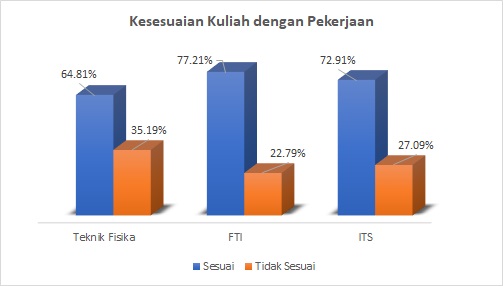
The job alignment percentage with the field of study in the Department of Engineering Physics reaches 64.81%, with the remainder not aligned with the field of study. This alignment rate is slightly lower compared to the average for FTI and ITS, which stand at 77.21% and 72.91% respectively.
The processing industry and electricity, gas, steam, and air supply sectors are chosen by most respondents from the Department of Engineering Physics, with percentages of 24.07% and 20.37% respectively. Other selected fields include construction and development, professional, scientific, and technical services, as well as educational services. Several of these sectors are also favored by FTI and ITS respondents.
The Department of Engineering Physics equips its students to work across various fields, as evidenced by graduates who also play active roles in forestry, mining and quarrying, financial and insurance services, as well as other service industries.
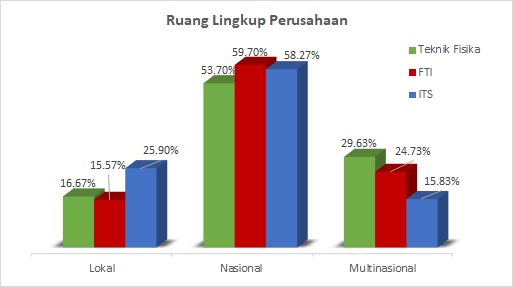
Engineering Physics respondents working in national companies account for 53.7%. This figure is not significantly different from the average percentage of FTI and ITS graduates. Multinational companies were chosen by 29.63% of Engineering Physics graduates, higher than the average for both FTI and ITS graduates. The remaining 16.67% of Engineering Physics graduates chose to work in local companies.
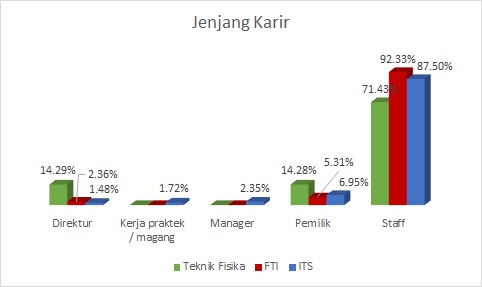
Respondents holding staff positions represent a significantly high percentage compared to other career levels. In the Department of Engineering Physics, 71.43% of graduates work as staff. Additionally, 14.29% of respondents hold career levels as directors, managers, or company owners.
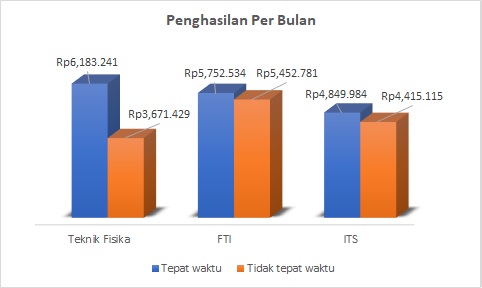
In general, respondents who complete their studies on time tend to earn higher incomes. The income earned by Department of Engineering Physics respondents who graduated on time reached IDR 6.1 million, higher than the average income of FTI and ITS respondents who graduated on time. Meanwhile, respondents who graduated late earned a significantly different income of IDR 3.6 million. The average income gap between on-time and delayed graduates is quite substantial, although the difference among FTI and ITS respondents is not as significant.