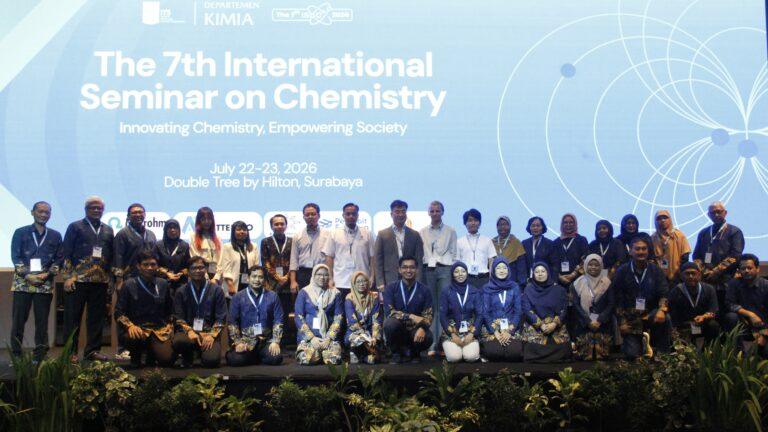
SURABAYA, ITS News — Institut Teknologi Sepuluh Nopember (ITS) continues to contribute solutions to both global and local challenges. The ITS Department of Chemistry realized this commitment through the 7th International Seminar on Chemistry (ISoC VII) 2026. The event, which featured speakers from multiple countries, took place at the DoubleTree by Hilton Hotel on Wednesday, July 22.
In his opening remarks, ITS Vice Rector I for Academic and Student Affairs, Professor Nurul Widiastuti, S.Si., M.Si., Ph.D., emphasized the importance of this scientific discussion forum. Professor Widiastuti explained that contemporary global issues cannot be resolved through a single discipline or by a single institution alone. “Therefore, collaboration serves as the key to producing knowledge that benefits society,” he stated.
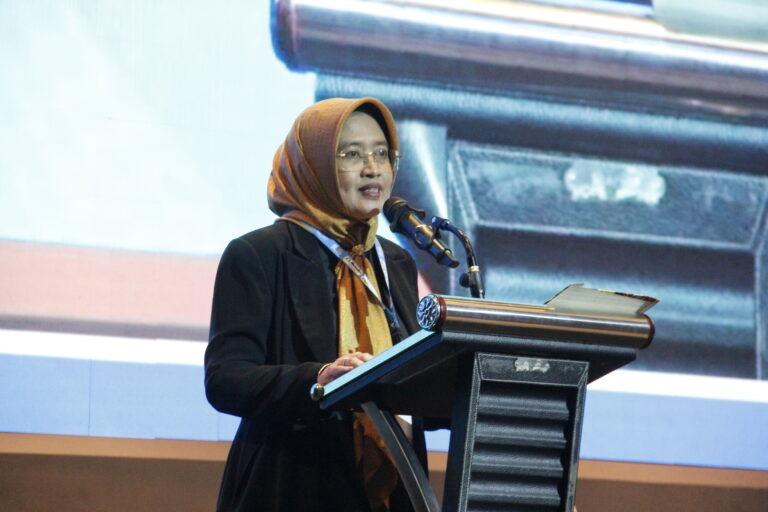
During the event, the Head of the ITS Department of Chemistry, Wahyu Prasetyo Utomo, M.Si., Ph.D., noted that chemistry currently stands as one of the primary scientific branches for studying global environmental challenges. The seminar, therefore, aims to provide a platform for exchanging ideas, sharing perspectives, and generating new concepts. He stressed that beyond written publications, the communication established among researchers and academics can serve as the foundation for meaningful collaboration.
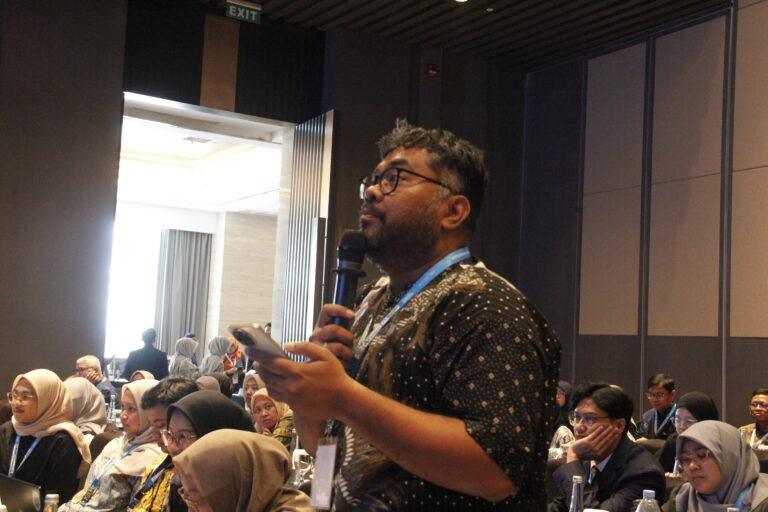
The seminar, themed *Innovating Chemistry, Empowering Society*, featured five main speakers with diverse academic backgrounds. These speakers, representing Indonesia, Australia, Japan, France, and Germany, delivered their presentations on July 22 and 23. In addition, the program included parallel sessions and a poster session to enrich the knowledge-sharing experience.
During the presentation series, one of the keynote speakers, Professor Long D. Nghiem from the University of Technology Sydney, addressed the topic of microalgae. He outlined global challenges, including climate change, the depletion of fossil reserves, and the increasing demand for renewable energy. In response, he proposed a low-cost microalgae harvesting method through polymer manipulation and self-cleaning catalytic membranes.
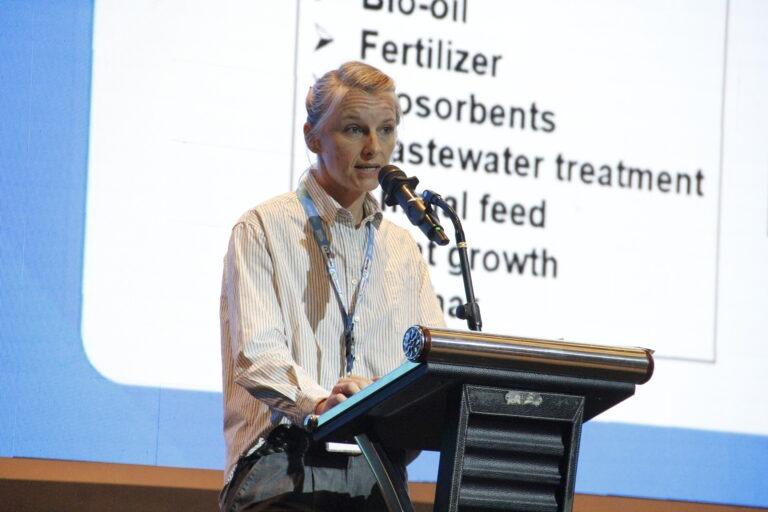
Furthermore, Professor Audrey Villot from IMT Atlantique France elaborated on the potential of biochar as a pillar of the bioeconomy and as a tool for climate change mitigation. She presented biochar as a highly promising material due to its ability to serve as an alternative to activated carbon, efficiently store carbon, function as a soil fertilizer, address soil erosion, and provide various other reuse applications.
The program will continue with three additional main speakers, each presenting topics aligned with the goal of advancing chemistry to create tangible societal impact. This initiative reflects ITS’s commitment to contributing to the Sustainable Development Goals (SDGs), particularly Goal 4 (Quality Education) and Goal 17 (Partnerships for the Goals). (*)
Reporter: Bella Ramadhani
Editor: Putu Calista Arthanti Dewi