“After water and food, energy is one of the key enablers of human life. Energy is central to nearly every major challenge and opportunity the world faces today and access to energy for all is essential. But energy needs to be available and affordable to all to allow future development, and it needs to be clean in order to ensure that the development can be sustainable.”
(THE Impact Rankings)
SDG 7: AFFORDABLE AND CLEAN ENERGY
University measures towards affordable and clean energy
ITS Embraces Energy-efficient Renovation and Building
ITS with its “Advancing Humanity” motto is committed to contributing to achieving SDGs by becoming a sustainable and environmentally friendly campus. The commitment is shown by establishing the Rector’s Circular Letter No. 9665/IT2/T/TU.00.08/V/2024 in achieving the Sustainable Development Goals. The goal of the Rector’s Circular Letter is to transform ITS into a campus that aligns with sustainable and eco-friendly principles, ultimately contributing to the realization of SDGs.
The Infrastructure chapter emphasizes building, managing, and renovating structures in accordance with green building standards, utilizing energy-efficient and environmentally friendly materials explained at point 2.
- Support innovation in education, research, and community service to foster sustainable infrastructure development.
- Build, manage, and renovate buildings according to green building standards using energy-efficient and environmentally friendly materials.
- Utilize renewable energy sources, such as solar and wind power, across campus activities.
- Ensure sustainable conservation, revitalization, and utilization of terrestrial ecosystems on campus, particularly forested, hilly, and dry land areas to preserve biodiversity, restore natural habitats, and support surrounding environmental sustainability.
- Maintain the ideal proportion of green open spaces relative to built-up areas.
- Create a comfortable environment by planting trees and organizing green spaces on campus.
Additionally, the Energy Efficiency and Conservation chapter mandates the application of energy efficiency and conservation principles in all new buildings and renovations points 2 and 9 provides policy for energy-efficient renovation and building. Here are the points in the regulation:
- Encourage technology utilization to improve energy efficiency.
- Implement energy efficiency programs by choosing and using energy-efficient and eco-friendly electrical equipment.
- Facilitate the transition to renewable energy for campus use.
- Ensure lights are used only in rooms lacking adequate natural light.
- Strategically place lights without compromising illumination function.
- Limit air conditioning use and maximize ventilation.
- Set air conditioners to a moderate 24-25°C.
- Reserve elevator use for essential needs, prioritize during peak hours and turn off elevators after office hours.
- Apply energy efficiency and conservation principles in all new buildings or renovations.
- Encourage a low-carbon lifestyle among the academic community.
Point (9) explicitly explains that ITS applies the principles of energy efficiency and conservation to all new buildings or renovations with some supported by point (2) that implements energy efficiency programs by selecting and using energy-efficient and environmentally friendly electrical equipment as well as several regulations from points (1 – 10) that ensure all renovations or new construction follow energy efficiency standards to support sustainability in campus environments.
Greener Buildings for a Greener Future: ITS Advances Campus Sustainability Through Building Quality Improvement
Upgrading existing buildings to higher energy efficiency is the way to address the pressing issues of climate change and sustainable resource utilization. Improved energy efficiency in buildings significantly reduces energy consumption, leading to a decrease in greenhouse gas emissions and a more responsible use of energy resources. This not only helps overcome environmental challenges but also leads to substantial cost savings for the university. Understand the situation, ITS through Rector’s Circular Letter No. 9665/IT2/T/TU.00.08/V/2024 Chapter Energy Efficiency and Conservation explained atpoints 1-10 endeavor to upgrade buildings to higher energy efficiency continuously. Here are the points in the regulation:
- Encourage technology utilization to improve energy efficiency.
- Implement energy efficiency programs by choosing and using energy-efficient and eco-friendly electrical equipment.
- Facilitate the transition to renewable energy for campus use.
- Ensure lights are used only in rooms lacking adequate natural light.
- Strategically place lights without compromising illumination function.
- Limit air conditioning use and maximize ventilation.
- Set air conditioners to a moderate 24-25°C.
- Reserve elevator use for essential needs, prioritize during peak hours and turn off elevators after office hours.
- Apply energy efficiency and conservation principles in all new buildings or renovations.
- Encourage a low-carbon lifestyle among the academic community.
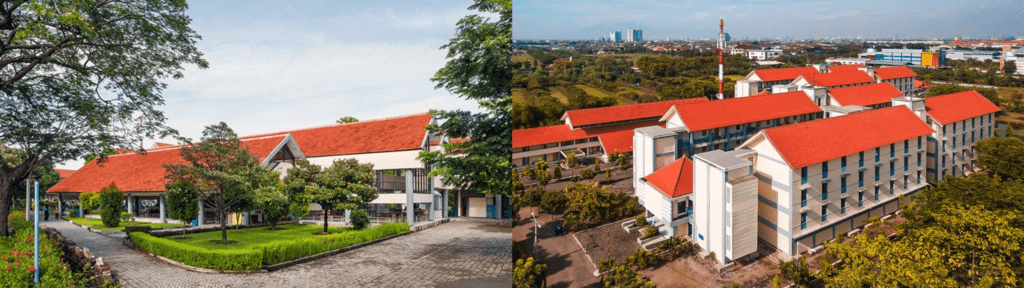
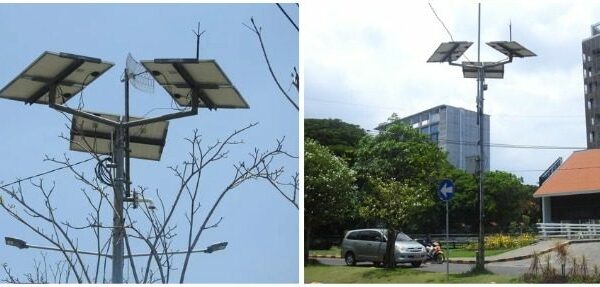
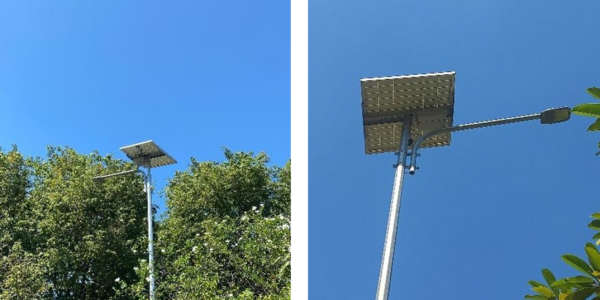
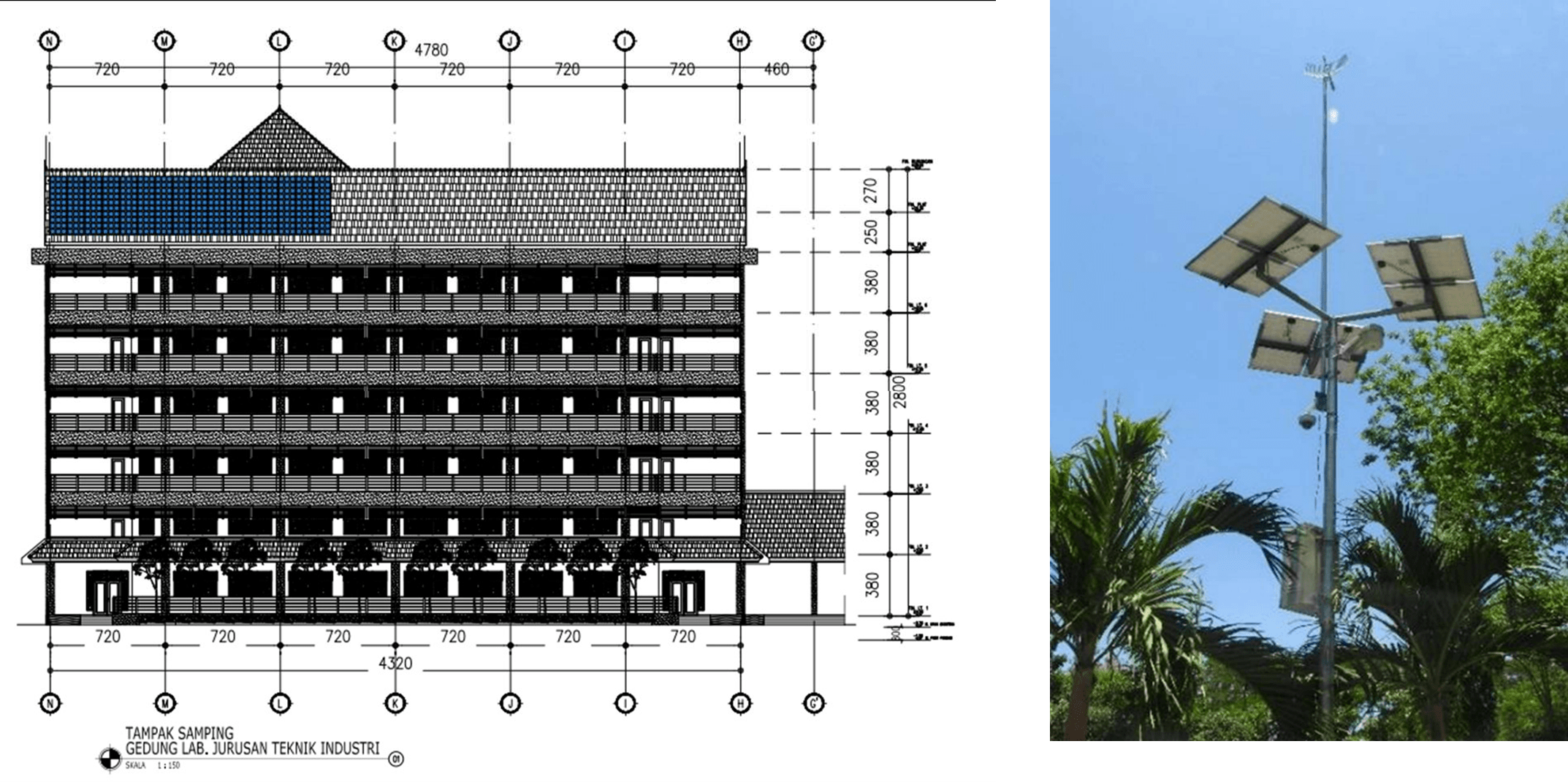
ITS implements Smart Building configuration with a Building Management System (BMS) in 40 buildings. This effort aims to provide effective control over indoor lighting and cooling. The area of buildings that implements this system reaches 246,333.20 m2 or 67.94% of the total area and ITS committed to increase the usage of BMS until 100% of all buildings to support sustainability especially energy efficiency buildings in campus. Some of those buildings are Rectorate Building, Research Center Building, Library Building, Graha 10 Nopember Building, Tower 2 ITS Building, Manarul Ilmi Mosque, Canteen, etc. Energy management systems with the usage of AC, refrigerators, dispensers, and laptop inverters have been implemented in several departments and units. In maintaining campus safety and comfort, solar panel-based CCTV has been installed along the way in the region of ITS.

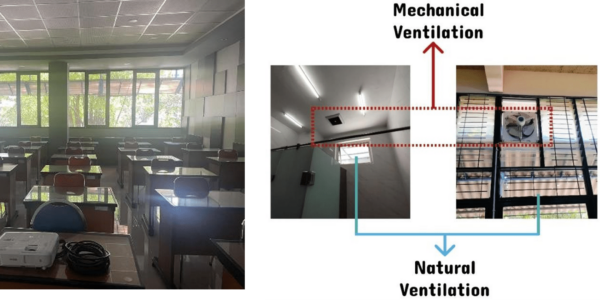
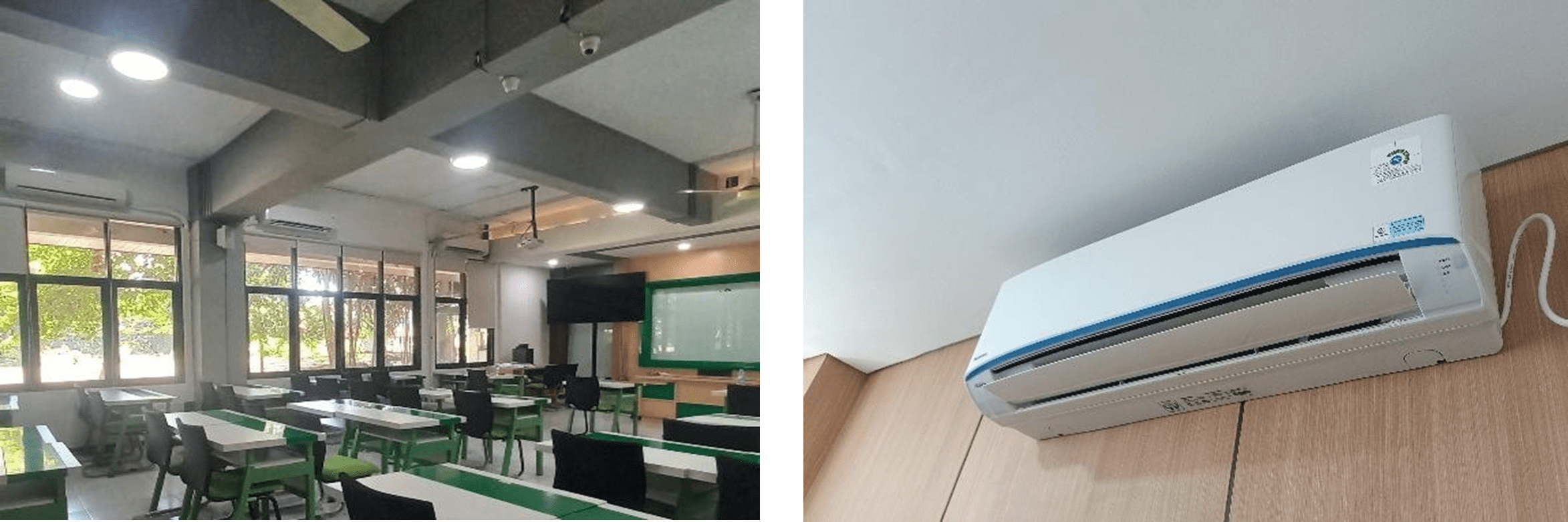
Another examples are using solar power plants to support environmentally friendly energy in several buildings that can generate in total 332.472,9 kWh/ year, using vertical building gardens to make the environment cooler which results in less use of inverter air conditioners, optimizing rooms so that they get full lighting from the sun to minimize the use of lights and using LED lights to support energy efficiency, using electrical equipment with motion sensor and time control technology for less electricity usage, implement natural and mechanical ventilation systems in every study room and smart rooms to ensure effective and comfortable air circulation and temperature control with innovative technology to address the challenges of green building configuration energy needs.

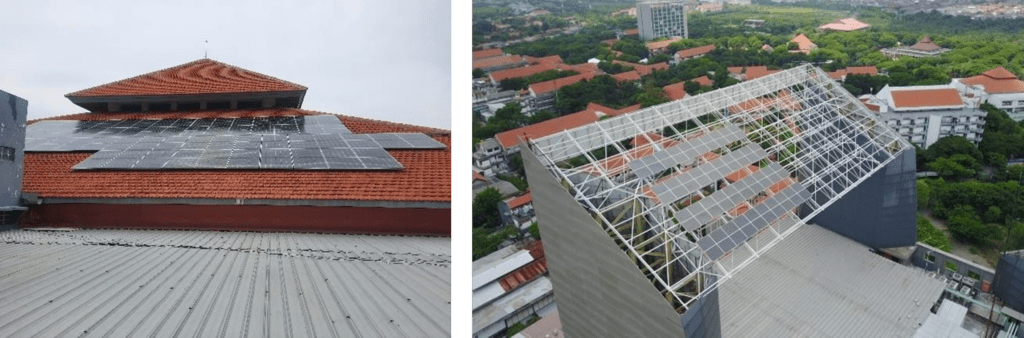
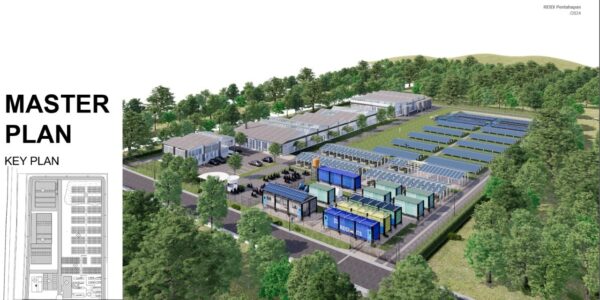
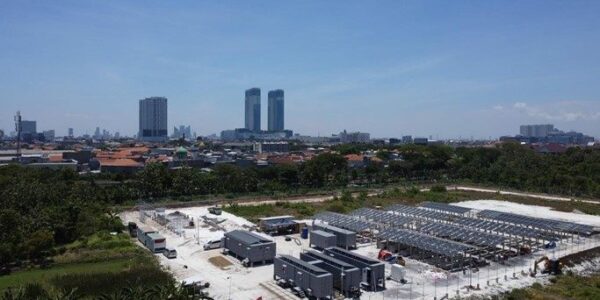
Furthermore, as a follow-up to continue ITS’ commitment to renewable energy Institut Teknologi Sepuluh Nopember (ITS) with Nanyang Technological University (NTU) Singapore plan to build Renewable Energy Integration Demonstrator of Indonesia (REIDI), the project under Institute of Research for Sustainability and Innovation (INSPIRASI). This collaboration will be ongoing for five years to develop living lab renewable energy and various research with students and researchers. ITS gets the privilege of being the first institute that owns REIDI in Indonesia.
REIDI will present innovations by developing electricity generators with renewable energy. These innovations are solar panels with 500 kV capacity, biomass with 50 kV capacity, and hydrogen with 10 kV capacity. The electricity will be optimized by ITS for a variety of purposes, either channeled to the electricity grid or stored as a battery supply.
ITS Tackles Climate Change with Comprehensive Carbon Emission Reduction and Sustainability Programs
Reducing carbon emissions is crucial to addressing the global challenge of climate change, which poses significant risks to ecosystems, economies, and human health. Excessive carbon dioxide and other greenhouse gasses released into the atmosphere primarily from fossil fuel use, deforestation, and industrial processes are driving global warming and extreme weather events. To mitigate these impacts, it is essential to transition to cleaner energy sources, improve energy efficiency, and adopt sustainable practices across industries. This process involves policy changes, technological advancements, and individual behavioral shifts to lower emissions and protect the planet for future generations. ITS through Rector’s Circular Letter No. 9665/IT2/T/TU.00.08/V/2024 Chapter Energy Efficiency and Conservation explained at points 1 – 10 endeavor to upgrade buildings to higher energy efficiency continuously that manage processes for carbon management and reducing carbon dioxide emission. Here are the points in the regulation:
- Encourage technology utilization to improve energy efficiency.
- Implement energy efficiency programs by choosing and using energy-efficient and eco-friendly electrical equipment.
- Facilitate the transition to renewable energy for campus use.
- Ensure lights are used only in rooms lacking adequate natural light.
- Strategically place lights without compromising illumination function.
- Limit air conditioning use and maximize ventilation.
- Set air conditioners to a moderate 24-25°C.
- Reserve elevator use for essential needs, prioritize during peak hours and turn off elevators after office hours.
- Apply energy efficiency and conservation principles in all new buildings or renovations.
- Encourage a low-carbon lifestyle among the academic community.
The program that ITS has in reducing Greenhouse Gas (GHG) emission consists of 3 scopes. Scope 1 accommodates Stationary Combustion, Mobile Combustion, Process Emissions, and Fugitive Emissions. Scope 2 is about Purchased Electricity. While Scope 3 talks about Waste, Purchased Waste, and Commuting. All of those scopes support ITS to reducing Greenhouse Gas emission in the campus area.
Scope 1
- Stationary Combustion
ITS strives to provide environmentally friendly electronic equipment by purchasing energy-efficient equipment that supports academic and office activities. In the procurements, ITS pays attention to the Minister of Environment and Forestry Regulation Number 5 of 2019 concerning Procedures for Applying Environmentally Friendly Labels for Procurement of Environmentally Friendly Goods and Services. Procurement of goods by e-catalogue, which provides energy-efficient equipment used such as inverter air conditioners, energy-saving labeled inverter laptops, solar panels, and automatic switches. For the procurement of lights, they are provided by Procurement of Goods and Services Work Unit (UKBPJ), which provides only LED lights that more efficient rather than the other.
2. Mobile Combustion
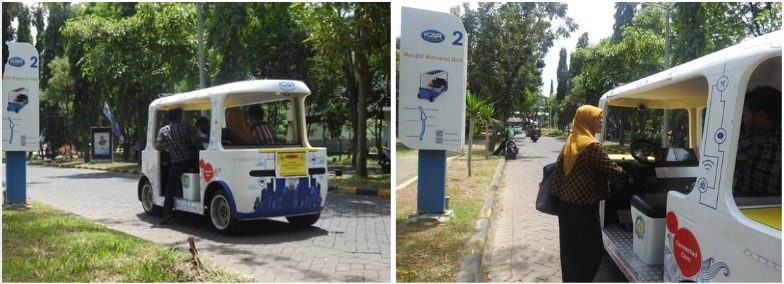
To reduce emissions on campus, ITS operates ecologically friendly vehicles, including bicycles, electric motorbikes, electric buses built by ITS and I-Car Smart autonomous cars. All these vehicles are free and operate everyday to support mobilization of peoples especially inside of campus. Successfully supporting the G20 Bali 2022 event with electric buses, ITS continues to produce electric buses, one of which is used by the Surabaya City Government for public transportation.
3. Process Emissions
ITS has several innovations that support the program to reduce greenhouse gas emissions directly from physical and chemical processes, such as the production of biodiesel, biomass as a renewable energy source, chemical reaction energy cars called Chem E-Cars, and the use of bioethanol and photovoltaics in environmentally friendly hybrid vehicles.
4. Fugitive Emissions
ITS promotes the use of air conditioners (AC) and freezers that do not use chlorofluorocarbons (CFCs) and are classified as energy efficient, making them ecologically friendly. In addition, ITS minimizes the use of air conditioners by averaging the temperature at 24-25 degrees Celsius.
Scope 2
- Electricity
ITS uses electrical automation procedures, such as automatic switches that will turn off automatically using setting time to save energy and assist the reduction of greenhouse gas emissions. Most of the switches are used to manage air conditioners and lights
Scope 3
- Waste
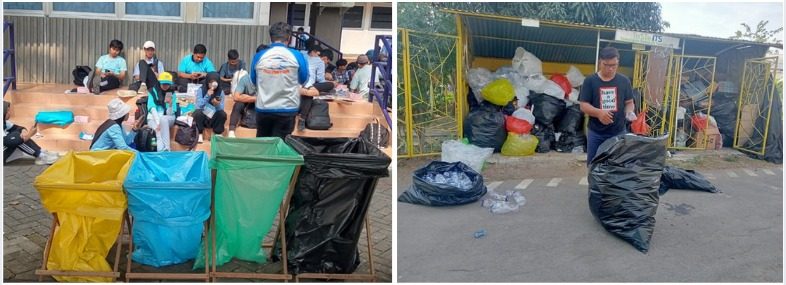
In order to decrease the quantity of waste created, ITS organizes campaigns and socialization events for all lecturers, employees, and students to reduce waste at the source and promote recycling and reuse. Efforts to decrease waste using the 3R strategy (Reuse, decrease, Recycle) must be implemented in each unit/department and serve as the unit’s performance indicator. The ITS Integrated Waste Savings (TaSTe) waste bank was established to absorb waste with a resale value. The ITS campus environment processes organic waste through composting. In addition, ITS works with TPS 3R Arief Rahman Hakim to turn organic waste into compost.
2. Purchased Waste
ITS has a policy through the Circular Letter of ITS Rector regarding the necessity to limit or reduce the use of plastic and paper in the campus area. In activities on campus, the provision of plates and cups as a substitute for plastic drinking bottles and the prohibition of using styrofoam in meetings and meetings are carried out. Socialization of the use of tumblers and non-disposable bags is carried out on campus.
3. Commuting
In order to limit motorized vehicles that can freely enter ITS without any interest, a vehicle inspection system is created that enters and exits the campus equipped with special signs for security. ITS has implemented automatic gates or vehicle barriers that are accessible only to registered vehicles and authorized personnel. This effort contributes to reducing vehicle density.
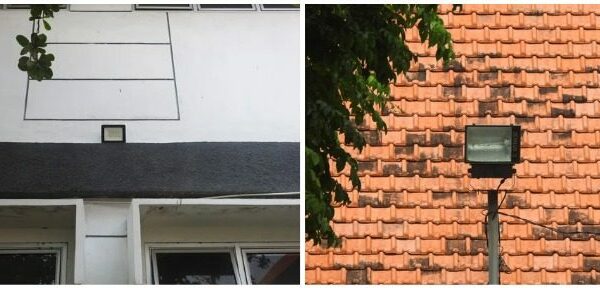
The points aim to reduce carbon emission reduction in institutions in general. This LED is completed with a smart system. It is a system to directly monitor the light condition. This feature is highly needed to provide the actual data on the energy usage of the light. This LED has been used in several locations such as the Rectorate Building, library, park, Research Center, toilets, etc.
ITS utilizes solar panels as an energy source to power CCTV systems across campus roads. This initiative aims to enhance campus security while simultaneously supporting the use of renewable energy and advancing the university’s commitment toward achieving Net Zero Emissions by 2030.
Integrated Energy Efficiency Plan toward a Sustainable and Low-Carbon Campus
Institut Teknologi Sepuluh Nopember (ITS) has formalized a comprehensive Energy Efficiency and Conservation Plan as part of its institutional policy to reduce overall energy consumption and accelerate the transition toward a low-carbon campus. This commitment is embedded within the ITS Declaration Letter Number T/38539/IT2/TU.00.08/2021 on Sustainable and Environmentally Conscious Campus Operations and further strengthened by the Rector’s Decree No. 439/IT2/T/HK.00.01/XII/2024 on Carbon Neutrality Commitment by 2030.
Under those policy, ITS integrates energy efficiency principles across every aspect of infrastructure, operations, and campus behavior. Chapter 9 of the declaration specifically outlines strategies to improve energy efficiency through technology adoption, renewable energy utilization, and behavioral transformation. The plan mandates the use of energy-efficient and eco-friendly electrical equipment, encourages the installation of lighting only in areas with limited natural light, and promotes optimal ventilation with limited air-conditioning use—standardized at 24–25°C to reduce electricity demand. Furthermore, elevator use is restricted to essential purposes, particularly outside peak hours, to minimize unnecessary energy consumption.
Energy reduction is further reinforced through water conservation (Chapter 7) and waste management (Chapter 8) programs that contribute to lowering overall resource and energy demand. These initiatives include rainwater harvesting, wastewater recycling, and the application of the 3R (Reduce, Reuse, Recycle) principles—reducing the need for energy-intensive resource processing and waste treatment. Through these cross-sectoral measures, ITS ensures a comprehensive and integrated approach to campus-wide energy efficiency.
In alignment with green building standards, ITS ensures that all new construction, renovation, and infrastructure development comply with environmentally sustainable and energy-efficient design principles. This initiative is further reinforced through the MoU between ITS and PT Wika Gedung Tbk, focusing on the implementation of green construction and modular building methodology, starting with the planned 20-story ITS Student Dormitory—the first of its kind in Indonesia to apply modular and energy-conscious design.
Beyond operational efficiency, ITS’s long-term energy reduction strategy is closely tied to its Net Zero Emission 2030 Roadmap, as stated in the 2024 Rector’s Decree. The university allocates human, financial, and material resources to support this vision, including promoting non-fossil-based mobility such as bicycles, electric vehicles, and campus shuttle buses, while designating specific areas as motor-free zones to minimize fuel consumption. Regular carbon inventory assessments and a comprehensive carbon balance report are prepared to monitor progress toward this target.
Complementing these policy measures, ITS advances renewable energy adoption through the Renewable Energy Integrated Development and Innovation (REIDI) Project—Indonesia’s largest living laboratory for sustainable energy. Conducted in collaboration with Nanyang Technological University (NTU) Singapore, REIDI integrates photovoltaic (PV), agrovoltaic, and biomass systems that are projected to supply sustainable electricity for campus operations, while also serving as an educational and research platform for renewable energy innovation. These innovations are solar panels with 500 kV capacity, biomass with 50 kV capacity, and hydrogen with 10 kV capacity. The electricity will be optimized by ITS for a variety of purposes, either channeled to the electricity grid or stored as a battery supply.
These collective efforts—spanning policy, infrastructure, technology, and behavioral transformation—illustrate ITS’s holistic approach to energy efficiency and conservation. By institutionalizing green standards, embracing renewable energy innovation, and committing to a carbon-neutral future, ITS ensures that its campus operations actively contribute to reducing national energy demand and advancing Indonesia’s sustainable development goals.

ITS Identifies Energy Wastage to Maintain and Improve Greener, Cost-Effective, and Sustainable Campus
Identifying energy wastage is crucial for improving efficiency, reducing costs, and minimizing environmental impact. Energy wastage occurs when resources are used inefficiently, leading to higher operational costs and unnecessary consumption of energy, often from fossil fuels. By pinpointing where energy is wasted, individuals and organizations can implement targeted measures to reduce consumption, cut costs, and lower their carbon footprint. This not only contributes to more sustainable energy use but also extends the lifespan of equipment and systems by optimizing their operation. Additionally, reducing energy wastage helps conserve natural resources, decreases harmful emissions, and supports global efforts to combat climate change. Identifying and addressing these inefficiencies is a key step in creating more responsible, cost-effective, and environmentally friendly energy practices.
ITS through Rector’s Circular Letter No. 9665/IT2/T/TU.00.08/V/2024 Energy Efficiency and Conservation explained at points 1-10 endeavors to improve energy efficiency. Here are the points in the regulation:
- Encourage technology utilization to improve energy efficiency.
- Implement energy efficiency programs by choosing and using energy-efficient and eco-friendly electrical equipment.
- Facilitate the transition to renewable energy for campus use.
- Ensure lights are used only in rooms lacking adequate natural light.
- Strategically place lights without compromising illumination function.
- Limit air conditioning use and maximize ventilation.
- Set air conditioners to a moderate 24-25°C.
- Reserve elevator use for essential needs, prioritize during peak hours and turn off elevators after office hours.
- Apply energy efficiency and conservation principles in all new buildings or renovations.
- Encourage a low-carbon lifestyle among the academic community.
ITS conducts energy consumption assessments to identify areas with the highest levels of energy waste, organized by cluster. Here is the usage of electricity consumption:
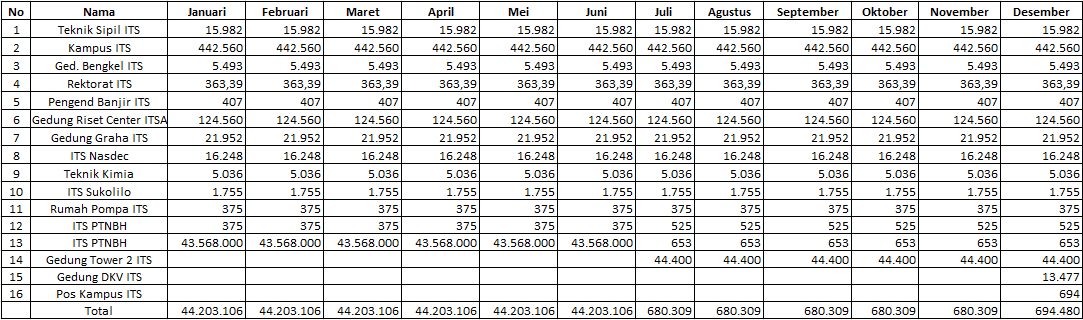
In addition, ITS calculate total carbon footprint on campus from several sources such as electricity, transportation from buses, cars, motorcycles. This monitoring will help ITS to easy identify of wastage energy. In total ITS produce 11,869.77 ton metric from those sources. This result may affect future plan and action to reduce the carbon footprint and to measure the energy wastage. Here are some details:
- CO2 (electricity) : 12,568 metric ton
- CO2 (buses) : 1.92 metric ton
- CO2 (cars) : 362.00 metric ton
- CO2 (motorcycles) : 698.40 metric ton
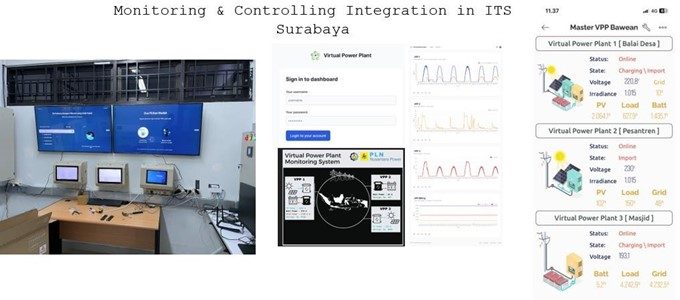
To reduce energy dependence from the National Electricity Company (PLN), most of which still comes from non-renewable energy, ITS seeks to produce its own through renewable energy with a total of 333,905 kWh/ year and monitors the use of electricity from renewable energy to optimize usage and to check if there is any wastage energy. Here are the details:
- Solar Power = 332,465 kWh/ year
- Biodiesel = 1,200 kWh/ year
- Clean Biomass = 240 kWh/ year
ITS Leads with Divestment Policy Against Carbon-Intensive Industries for a Sustainable Future
Having a policy on divesting investments from carbon-intensive energy industries, such as coal and oil, is essential for promoting environmental sustainability and aligning with global climate goals. As the world transitions to cleaner energy sources, continuing to invest in fossil fuels exacerbates climate change and prolongs dependence on harmful practices. Divestment policies not only send a strong signal that organizations are committed to reducing their environmental impact, but they also protect investors from potential financial risks associated with stranded assets as governments increasingly regulate carbon emissions. Realizing this important matter, ITS has a policy with the Rector’s Circular Letter No. 9699/IT2/B/TU.00.02/V/2024 Chapter Economy explained at No. 1 points 1, 2, 3, and 4 encourage collaboration with companies that support sustainability. Here are the points in the regulation:
- Encourage investments involving companies that prioritize renewable energy.
- Encourage investments involving building management companies that prioritize the principle of ecosystem stability.
- Encourage awareness among investors to engage in activities that prioritize environmentally friendly principles.
- Evaluate its investment portfolio and ensure that it is aligned with the university’s sustainability commitments.
This regulation has already been implemented by ITS, one the example is Procurement of Goods and Services Work Unit (UKPBJ) only provides environmentally friendly electronic goods such as LED lamps ITS has collaborated with PT Panasonic Gobel Life Solutions Manufacturing to produce light-emitting diode (LED) with smart systems that can monitor the light condition surrounding to reduce power usage and reduce electricity costs.
Energy and the community
Empowering Local Communities Through Clean Energy and Efficiency Innovations: ITS Community Outreach 2024
Educating local communities about clean energy and energy efficiency plays a crucial role in fostering sustainable development and reducing environmental impact. Recognizing this, Institut Teknologi Sepuluh Nopember (ITS) has continuously engaged with various rural and coastal communities across Indonesia through a series of research-based community service programs. In 2024, ITS deepened its outreach by combining technological innovation with community education, ensuring that local people not only benefit from renewable energy solutions but also understand how to sustain them independently.
Throughout the year, ITS teams implemented numerous initiatives introducing solar, wave, and micro-hydro technologies to address real challenges faced by local residents. In rural areas, farmers were supported through solar-powered irrigation systems that replaced diesel-based pumps, allowing them to reduce operational costs and maintain more efficient agricultural practices. In Tulungagung, ITS developed a solar grain dryer equipped with an IoT-based temperature control system, enabling farmers to monitor and optimize drying processes using the PARINDITS mobile app. Similar technological training helped Bojonegoro’s shallot farmers manage a solar-powered post-harvest storage facility equipped with humidity and temperature sensors, which ensured longer shelf life and reduced energy consumption. Other communities learned smart farming techniques, including IoT-based irrigation and pest control systems, fostering a broader understanding of how technology and energy efficiency can support sustainable agriculture.
Along coastal regions, ITS extended its efforts to empower fishermen through clean energy applications tailored to their livelihoods. In Desa Daun, Pulau Bawean, the installation of solar-powered freezers and cooling boxes replaced diesel-based systems, ensuring reliable cold storage for freshly caught fish and reducing fuel dependency. In Bringsang, Sumenep, villagers participated in hands-on training to operate solar freezers that helped overcome unstable electricity access. Meanwhile, a team in Probolinggo introduced a wave-powered energy system to supply electricity for fishing operations, proving that renewable energy can thrive even in marine environments. The Lamusa Bahari project, an energy-efficient LED-based lighting system for fishing boats, further enhanced these communities’ understanding of energy-saving principles while cutting electricity use by nearly half.
Beyond energy access, ITS also promoted renewable technologies to enhance rural resilience and entrepreneurship. In Gili Genting, students collaborated with the Karya Bahari community to build an IoT-driven photovoltaic reverse osmosis (PV-RO) system that simultaneously produced clean water and salt, showcasing how solar technology can support both environmental and economic sustainability. Another team developed a solar-powered waste crusher, educating waste workers about how renewable energy could improve productivity while lowering costs. In mountainous farming areas, ITS introduced solar feed choppers to ease livestock feed processing, while in Malang’s Sanan Village, cattle manure was converted into eco-friendly biobriquettes—turning waste into clean energy and inspiring residents to adopt circular economy principles.


Complementing these rural innovations, ITS also introduced solar-powered air quality monitors and aquaponics systems in Roomo Village, teaching residents to manage food production and environmental monitoring using renewable energy. At the same time, awareness of sustainable mobility was advanced through an Electric Vehicle (EV) Conversion Workshop at the ITS Science Techno Park, where mechanics and local entrepreneurs learned how to convert combustion motorcycles into electric ones, contributing to a broader culture of clean energy literacy and carbon reduction.


Through these multifaceted programs, ITS has demonstrated how community outreach can go beyond technological intervention to become a platform for education and empowerment. Farmers, fishermen, waste workers, and entrepreneurs alike gained practical knowledge and confidence in applying renewable energy solutions to their daily lives. The programs not only reduced costs and improved productivity but also nurtured a deeper understanding of sustainability principles, fostering energy literacy and independence at the grassroots level.
Extending ITS Commitment to 100% Renewable Energy Beyond Campus
Institut Teknologi Sepuluh Nopember (ITS) has made a public pledge to promote 100% renewable energy beyond the university, affirming its leadership in driving Indonesia’s clean energy transition. This pledge is not limited to internal campus operations but extends through public advocacy, research collaborations, and real-world applications that empower industries and communities alike. It aligns with ITS’s broader mission to accelerate Indonesia’s journey toward a sustainable and low-carbon future while supporting the national net-zero emission target by 2060.
Collaborative Seminars and Advocacy for Renewable Energy Transition
ITS actively engages in public discussions and collaborative events with various stakeholders to advocate for the adoption of renewable energy in multiple sectors. In collaboration with PT HIS, ITS hosted a seminar on Marine Sustainable Energy: A Practical Approach, Regulator Insight, and Potency of Use for Local Shipping Business to be Green Company. The event gathered representatives from government, academia, and industry to explore renewable energy use and green transformation in the maritime sector—particularly solar-powered tugboats and barges as practical steps toward low-emission marine operations.
Through these efforts, ITS reinforces its role as a national platform for public advocacy and dialogue that promotes collective commitment to renewable energy beyond the academic environment.
Community Empowerment through Renewable Energy Applications
ITS also translates its public pledge into tangible community impact through its KKN Abmas (Community Service Learning) initiatives.
In Bawean Island, ITS students developed an off-grid solar power system to ensure stable electricity for fishermen, supporting fish preservation and reducing greenhouse gas emissions. Similarly, in Malang’s Sanan Blimbing Village, an ITS team transformed cow manure into biogas and bio-briquettes—turning agricultural waste into renewable fuel while helping communities reduce environmental pollution.These initiatives illustrate how ITS extends its renewable energy advocacy to empower local communities, bridging technology, sustainability, and social well-being.
Research Leadership and the REIDI Renewable Energy Hub
At the institutional level, ITS established the Renewable Energy Integration Demonstrator of Indonesia (REIDI)—the largest renewable energy research, training, and testing facility in the country.
Located on a 1.5-hectare campus site, REIDI integrates a 500 kWp solar PV system, 400 kWh battery storage, 50 kW biomass, and 10 kW hydrogen generation systems. It also features agrivoltaic and eco-campus models that showcase renewable energy integration within sustainable environments. Projected to become a sustainable energy source for campus operations, REIDI also functions as a national hub for public engagement and knowledge transfer, demonstrating ITS’s commitment to promoting renewable energy solutions at broader scales.
Industry Partnerships and Low-Carbon Technology Development
Through its innovation arm, PT ITS Tekno Sains, ITS actively promotes green technology adoption within the industrial sector. In collaboration with PT Petrokimia Gresik, ITS delivered 160 units of Electric Vehicle ITS (EVITS)—energy-efficient motorcycles equipped with IoT-based monitoring systems—to support low-emission industrial mobility.
Meanwhile, ITS startups such as KEE Energy, Cleanic & B-Trap, DYNAMITS, and STRUM ID develop renewable and low-carbon technologies spanning solar and hydro systems, electric mobility, and carbon offsetting platforms. These innovations underscore ITS’s leadership in bringing renewable energy solutions from campus research to commercial and societal implementation.
Advancing National Energy Policy through Collaborative Research
ITS also works closely with PT PLN (Persero), the National Energy Council (DEN), and the Ministry of Energy and Mineral Resources (ESDM) to advance ocean energy projects. Through joint Focus Group Discussions, ITS contributes to the development of feasibility and engineering guidelines for wave, tidal, and ocean thermal energy plants. These collaborations ensure that ITS’s renewable energy expertise directly supports Indonesia’s policy frameworks and national sustainability targets.
Through a comprehensive approach that integrates research, education, public dialogue, community service, and policy collaboration, ITS’s public pledge toward 100% renewable energy extends well beyond its campus boundaries. This sustained advocacy and action not only demonstrate institutional leadership but also foster collective momentum across sectors—bridging academia, industry, and society in advancing Indonesia’s transition to a renewable, low-carbon future.


Driving Industrial Transformation: ITS Strengthens Energy Efficiency and Clean Energy Collaboration with Industry Partners
In 2024, Institut Teknologi Sepuluh Nopember (ITS) continued to expand its role as a catalyst for industrial transformation through direct collaborations with companies to accelerate the shift toward energy efficiency and clean energy. Through a series of joint research initiatives, technology development programs, and capacity-building projects, ITS demonstrated how academia can directly serve industry needs while driving Indonesia’s sustainable energy transition.
One major initiative began with the partnership between ITS and PT Vale Indonesia, focusing on the electrification of vehicles in Soroako, South Sulawesi. This collaboration followed the signing of a Memorandum of Understanding to advance green energy transition and energy efficiency across Vale’s operations. ITS experts worked closely with the company to establish Sulawesi’s first vehicle conversion workshop, enabling the transition from conventional fuel-powered vehicles to electric ones. Over a three-year collaboration (2024–2027), the project aims to not only convert vehicles within PT Vale and surrounding communities but also provide training and evaluation programs on electric vehicle performance. By integrating this facility into the Soroako Technical Academy, the partnership serves as both a technological and educational hub—building regional capacity in renewable mobility and sustainable industrial operations.
In the maritime sector, ITS collaborated with PT Adiluhung Sarana Segara Indonesia (ASSI) under the Kedaireka Matching Fund program to design the Wahana Apung Multiguna Navigasi, an innovative floating platform that generates renewable energy through solar panels and wind turbines. The multipurpose buoy, launched in Madura, produces up to 9,600 watts of clean electricity, functioning as a navigation aid and a renewable energy demonstrator. This partnership reflects ITS’s commitment to helping marine industries reduce fuel dependence while exploring the practical use of hybrid renewable systems for maritime navigation, monitoring, and safety infrastructure. The project also serves as a living laboratory for ITS researchers and industry engineers to assess energy efficiency applications in coastal and offshore environments.


Meanwhile, ITS strengthened its long-term collaboration with SKK Migas, Indonesia’s upstream oil and gas regulator, to enhance energy knowledge and technical innovation through the establishment of a Study Space and Migas Corner on campus. The facility is designed as a center for energy education, connecting academia, government, and industry to promote the efficient and sustainable use of gas energy. Through workshops, research exchanges, and knowledge-sharing sessions, the collaboration supports the development of cleaner and more cost-effective energy solutions.
ITS also took an active technical role in the Gendalo Gandang Deep-Sea Gas Project, a National Strategic Project led by SKK Migas in collaboration with ENI and Institut Teknologi Bandung (ITB). As a strategic partner, ITS contributed to the Front-End Engineering Design (FEED) review process and facilitated technology transfer from international experts to Indonesian students and faculty. The initiative not only supports national energy resilience but also strengthens domestic expertise in high-efficiency gas utilization—an essential step toward industrial decarbonization.
ITS’s commitment to energy-efficient mobility also reached industrial implementation through the EVITS (Electric Vehicle ITS) initiative with PT Petrokimia Gresik. In this collaboration, ITS Tekno Sains delivered 160 units of EVITS electric motorcycles to support the daily operations of Indonesia’s leading fertilizer company. Designed with lithium-ion batteries and IoT-based monitoring systems, EVITS vehicles can travel up to 110 kilometers per charge while enabling real-time performance tracking. The deployment of these electric vehicles reduces operational emissions, cuts fuel costs, and demonstrates how clean mobility can be integrated into industrial logistics. ITS engineers provided training and performance assessments to ensure optimal use and maintenance of the EV fleet, making it a hands-on model of industry-academia collaboration for sustainable technology adoption.


Integrating Innovation and Policy for Clean Energy Transition
ITS through Rector’s Circular Letter No. 9665/IT2/T/TU.00.08/V/2024 Chapter Energy Efficiency and Conservation No. 9 point (a – j) endeavor to promote policy development for clean energy technology. Here are the points in the regulation:
- Encourage technology utilization to improve energy efficiency.
- Implement energy efficiency programs by choosing and using energy-efficient and eco-friendly electrical equipment.
- Facilitate the transition to renewable energy for campus use.
- Ensure lights are used only in rooms lacking adequate natural light.
- Strategically place lights without compromising illumination function.
- Limit air conditioning use and maximize ventilation.
- Set air conditioners to a moderate 24-25°C.
- Reserve elevator use for essential needs, prioritize during peak hours and turn off elevators after office hours.
- Apply energy efficiency and conservation principles in all new buildings or renovations.
- Encourage a low-carbon lifestyle among the academic community.
ITS also extends its leadership in renewable energy development through international collaboration. In partnership with Nanyang Technological University (NTU) Singapore, ITS is establishing the Renewable Energy Integration Demonstrator of Indonesia (REIDI)—a pioneering “living lab” under the Institute of Research for Sustainability and Innovation (INSPIRASI) and funded by the Indonesia Endowment Fund for Education (LPDP). As Indonesia’s first university-based demonstrator of its kind, REIDI will serve as a role model for higher education institutions and industries across the nation, showcasing the application of clean energy technologies and supporting the broader national energy transition agenda.
ITS’s efforts to support clean energy policy development also extend to the national scale. Through close collaboration with PT PLN (Persero), ITS actively contributes to policy-oriented research and technical standardization in renewable energy development. Joint Focus Group Discussions (FGDs) involving PLN, the Ministry of Energy and Mineral Resources (ESDM), the National Energy Council (DEN), and several academic partners—such as Universitas Gadjah Mada (UGM), Politeknik Perkapalan Negeri Surabaya (PPNS), and Universitas Dharma Persada—were convened to formulate guidelines for marine-based renewable power generation. The discussions explored comprehensive frameworks for pre-feasibility, feasibility, and engineering design standards for ocean current (PLTAL), wave (PLTGL), and ocean thermal (PLTPL) power plants. The initiative strengthens the alignment between scientific expertise and policymaking, providing structured input that supports the government’s implementation of Presidential Regulation No. 112/2022 on renewable energy acceleration.
In parallel, ITS maintains its role as a national thought leader through the Seminar Nasional Teknologi dan Aplikasi Kelautan (SENTA) 2024, themed “Innovation in Marine Technology Toward Sustainable and Resilient Maritime Industry.” This academic forum deepened discussions on sustainable maritime technologies, including the adoption of alternative fuels, renewable energy for port infrastructure, and environmentally responsible industrial practices. The event concluded with the formation of the Forum Pendidikan Tinggi Maritim Indonesia, involving stakeholders such as Bappenas, the Coordinating Ministry for Maritime Affairs and Investment, the Indonesian Engineers Association (PII), and Badan Klasifikasi Indonesia (BKI)—underscoring ITS’s pivotal role in integrating research-based innovation into national policy dialogues.

Through these combined initiatives—ranging from institutional energy management and academic research to government consultation and international collaboration—ITS has positioned itself as a central actor in shaping Indonesia’s clean energy policy landscape. By bridging the gap between scientific research, technology development, and policymaking, ITS ensures that renewable energy initiatives are not only technically sound but also strategically aligned with national sustainability goals and global climate commitments.

Accelerating Low-Carbon Innovation through Startup Incubation and Green Technology Development at ITS
By 2024, Institut Teknologi Sepuluh Nopember (ITS) had solidified its position as a national leader in fostering innovation ecosystems that advance a low-carbon economy. Through the Inkubator dan Layanan Bisnis Inovatif ITS (ILBI), the university provides an integrated platform to nurture technology-based startups that contribute to sustainability, renewable energy, and carbon reduction.
ILBI ITS serves as a comprehensive business incubator open to students, alumni, faculty members, and external innovators. It offers extensive facilities such as co-working spaces, laboratories, workshops, studios, and meeting rooms, alongside business mentoring, consultation sessions, and access to a growing network of investors and industry partners. By 2024, the incubator had supported over 130 startups with a combined valuation exceeding IDR 60 billion, demonstrating its strong role in shaping Indonesia’s green innovation landscape.
Among the startups nurtured within ILBI ITS are several that directly promote low-carbon technologies and sustainable mobility:
- KEE Energy delivers renewable energy solutions across solar, wind, and hydro sectors, while,
- Cleanic & B-Trap (INS Energy) develops solar and hydrokinetic systems coupled with integrated maintenance services,
- The DYNAMITS electric motorcycle project offers an energy-efficient mobility alternative for logistics, and
- STRUM ID introduces a multi-functional electric golf cart designed for use in campuses, factories, tourist destinations, and green industrial areas,
- Meanwhile, Carbon Addons, a climate-tech initiative, provides an API enabling seamless carbon offsetting for online transactions, and
- BECATUR promotes sustainable urban tourism through low-carbon pedicab transport services in Yogyakarta.
ITS further expanded its support for green startups through a strategic collaboration with the Asian Development Bank (ADB) under the Higher Education for Technology and Innovation (HETI) program. This partnership facilitated intensive mentoring, prototype development, and investor engagement for selected startups. Participants received funding of IDR 150 million each from ADB HETI to advance their low-carbon business models, culminating in a pitch and exhibition event attended by investors from the ITS Alumni Entrepreneurs Association (HIPA ITS), the banking sector, and other innovation hubs.
By integrating research expertise, incubation support, and international collaboration, ITS ensures that emerging entrepreneurs are not only equipped with technological competence but also guided by environmental responsibility.