About
Published on
Monday, 4 May 2026
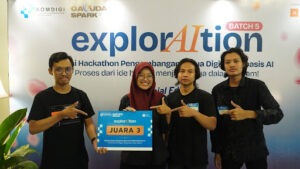
Image: Team Srawung after winning 3rd place at ExplorAItion Batch 5 through their AI-based project management innovation.
Surabaya, F-ELECTICS – Student innovation from ITS once again achieved recognition in the field of technology. This time, Team Srawung secured 3rd place in ExplorAItion Batch 5, an event organized by Garuda Spark under the Ministry of Communication and Digital Affairs (Komdigi) in collaboration with Jagoan Hosting. The competition serves as a platform for young generations to develop innovative digital solutions based on cutting-edge technologies.
Team Srawung consists of three students from the Department of Informatics Engineering at ITS: Berliana Sarlita Rahajeng from the Artificial Intelligence Engineering program as the Hustler, Muhammad Fatih Al Fawwaz from the Artificial Intelligence Engineering program as the Hacker, and Vityaz Ali Firdaus from the Informatics Engineering program as the Hipster.
“Our team was formed from a similar background as students of the Informatics Department who enjoy participating in various competitions. When the opportunity to join ExplorAItion Batch 5 came up, we used it as a platform to develop AI-based solutions that address real-life problems,” said Berliana Sarlita Rahajeng.
In the competition, Team Srawung introduced an AI-based platform called Srawung. The platform is designed to help users form project teams while automatically generating initial project planning.
“In our daily life as students, we often encounter challenges in the early stages of a project, such as defining roles, dividing tasks, and aligning team understanding. From this experience, we identified a common and relevant problem to solve,” explained Muhammad Fatih Al Fawwaz.
Through Srawung, users can obtain structured team role distribution, task assignment, and milestone planning. This allows the transition from idea to execution to become faster and more efficient. The main problem addressed by the team is the difficulty individuals and organizations face when starting a project. Many have great ideas but struggle with structuring teams, fairly distributing tasks, and placing members according to their competencies.
“This often leads to miscommunication from the beginning, which impacts the project’s progress. We chose this issue because it is very common, has a major impact on project success, and still lacks solutions that specifically focus on the initial stage,” added Vityaz Ali Firdaus.
The main advantage of Srawung lies in its ability to automate the early stages of project development comprehensively. The platform not only assists in creating work plans but also performs AI-based skill assessments to map team members’ capabilities, enabling more objective task distribution.
In addition, Srawung acts as a bridge between talent-matching platforms and project management tools that are currently still separated. This approach significantly reduces the time required for project initiation. During development, the team began by identifying problems from personal experiences. They then validated the idea through discussions and existing solution studies, designed user flow, and proceeded to prototype development.
“We built core features such as AI for generating project plans and an assessment system to map team skills. After the core features were ready, we integrated them with project management tools and refined the system for presentation,” said Muhammad Fatih Al Fawwaz.
The team also sees broad potential for Srawung’s implementation. It can be used by students, startups, and companies that require fast and effective team formation and project management. After the competition, the organizers also provided an opportunity for further development of the Srawung website. The team is currently discussing the next direction for product development.
“We want to ensure that the development steps not only improve technical aspects but also remain relevant to user needs, so that Srawung can grow into a truly usable product,” said Vityaz Ali Firdaus.
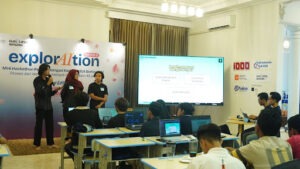
Image: Team Srawung presenting their AI innovation during the pitching session at ExplorAItion Batch 5.
For other students interested in joining similar competitions, Team Srawung advises starting from real problems close to everyday life. The ability to quickly build prototypes, form strong teams, and develop pitching skills are also crucial factors in competitions. This achievement demonstrates that collaboration, creativity, and the courage to solve real-world problems can lead to competitive innovation. Team Srawung hopes their work will not stop as a competition project, but continue to grow into a solution that provides broader impact for society.