
About

Published on
Friday, 8 May 2026
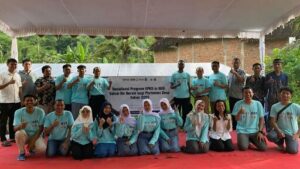
Image: The EPICS in IEEE 2026 team from ITS together with Telkom University Surabaya, local residents, and village officials during the program socialization activity in Cokrokembang Village.
Surabaya, F-ELECTICS ITS – The rice fields in Cokrokembang Village, Pacitan Regency, have faced serious challenges over the past few years. Despite abundant natural resources and the majority of residents working as farmers, clean water scarcity has become a major issue affecting agricultural productivity. Responding to these conditions, a multidisciplinary team from Institut Teknologi Sepuluh Nopember (ITS) and Telkom University introduced a technology-based solution through the EPICS in IEEE 2025–2026 program.
The program is led by ITS Information Systems lecturer, Mrs. Feby Artwodini Muqtadiroh, along with a team consisting of academics and students from various disciplines. By integrating solar power systems and Internet of Things (IoT) technology, the project was designed to help the community gain access to clean water while supporting sustainable agricultural irrigation.
Mrs. Feby explained that the program originated from her team’s previous experience receiving the Humanitarian Activities Committee and Special Interest Group on Humanitarian Technology (HAC-SIGHT) grant from IEEE in 2022–2023. After completing her doctoral studies in 2024, she and her team explored another scheme through EPICS in IEEE, which focuses on applying professional technology to create a direct impact on society.
“EPICS is more about how technical and professional capabilities can create an impact for communities,” said Mrs. Feby.
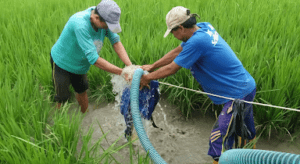
Image: Farmers in Cokrokembang Village utilizing the technology-supported irrigation system developed through the EPICS in IEEE 2026 program.
The selection of Cokrokembang Village as the implementation site began with a story shared by one of the team members who came from Pacitan. Based on information from residents, local farmers had difficulty accessing water for irrigation and were required to contribute monthly electricity fees to operate water pumps. In addition, the community also raised concerns regarding alleged environmental pollution caused by mining activities near the area, which was suspected to affect water quality and crop yields.
In response to these issues, the team conducted field surveys and directly approached residents, neighborhood leaders, and village officials to better understand community needs. Based on discussions and feasibility studies, the team decided to develop a solar power system consisting of four solar panels integrated with IoT technology to monitor water quality.
The technology enables water pumping from bore wells to approximately 20 rice field plots without relying on paid electricity. Furthermore, the IoT system regularly monitors water quality, allowing residents to track the condition of the water used for agriculture.
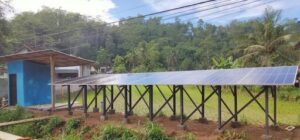
Image: Solar panel installations developed by the EPICS in IEEE 2026 team to support irrigation systems and clean water supply for residents of Cokrokembang Village, Pacitan.
During the implementation process, the team also constructed a 40-meter-deep bore well after the initial 20-meter drilling did not produce water of sufficient quality. In addition, a panel house was built to protect the solar power and IoT devices from damage and theft.
The program involved various parties, including ITS, Telkom University, the village government, and SMKN Ngadirojo. The involvement of the vocational school became an important part of the Science, Technology, Engineering, and Mathematics (STEM) approach promoted by EPICS. Around 65 vocational students participated in training sessions on operating and maintaining the system so that the technology could continue to be used independently by the community.
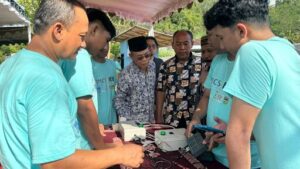
Image: The EPICS in IEEE 2026 team providing intensive assistance to residents of Cokrokembang Village regarding the operation and maintenance of the solar panel and IoT-based irrigation system.
The team not only focused on technological development but also provided intensive assistance to residents. They prepared learning modules, operational guide posters, and direct training sessions for farmers and vocational students before the handover process.
However, the implementation process was not without challenges. One of the biggest obstacles faced by the team was the geographical condition and rocky soil structure at the drilling site. The rocky terrain damaged the impeller equipment, causing the installation process, originally targeted for completion in December 2025, to be delayed until February 2026.
Besides technical challenges, the team also encountered social challenges, as some residents initially expected direct financial assistance from the program. Therefore, the team had to explain that the main goal of the project was to provide a long-term technological solution to help farmers reduce irrigation operational costs.
Despite various challenges, the community’s response to the program was highly positive. During the socialization and handover event held on March 30, 2026, residents enthusiastically attended alongside village officials and the local subdistrict head. The team also received appreciation from farmers who directly experienced the benefits of the irrigation system.
Mrs. Feby revealed that the program would not stop at the initial implementation stage. The team plans to conduct further monitoring in June to evaluate the effectiveness of the system based on data collected by the IoT devices. In addition, there are plans to develop a water filtration system if the water quality still requires improvement.
The team is also planning to develop a website-based monitoring system so that the condition of the solar power system and water quality in Pacitan can be monitored directly from Surabaya in real time. Through this system, potential damage or disruptions can be detected more quickly before affecting the community.
“We hope this technology can be expanded to other areas and provide long-term benefits for the community,” concluded Mrs. Feby.