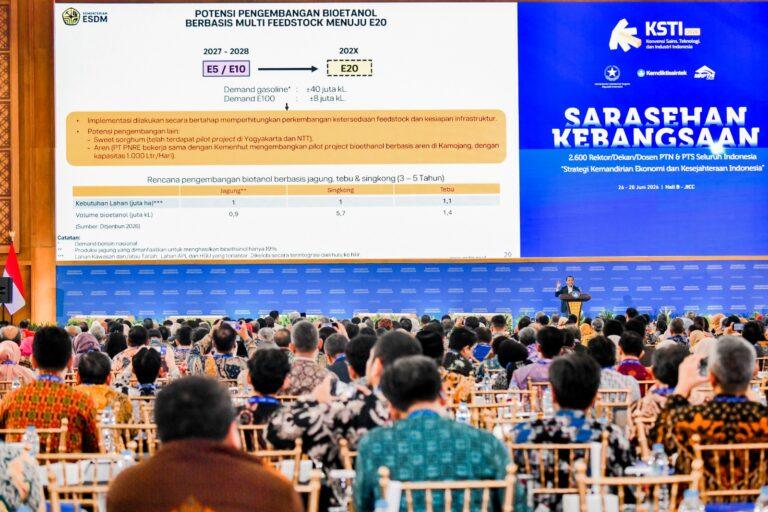
ITS Campus, ITS News — The Indonesian government continues to drive deregulation and technological innovation to accelerate Economic Independence and National Prosperity. This strategic issue took center stage at the National Dialogue of the 2026 Indonesian Convention on Science, Technology, and Industry (KSTI) in Jakarta on Saturday, June 27. The effort to realize national self-reliance also actively involves the Institut Teknologi Sepuluh Nopember (ITS) in a significant role.
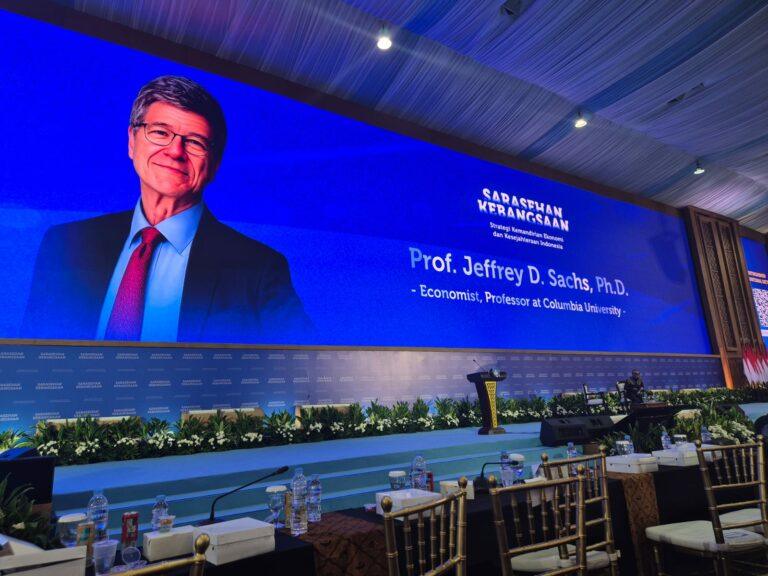
To solidify these measures, KSTI 2026 featured Columbia University economist Prof. Jeffrey D. Sachs, Ph.D., as a guest lecturer. He emphasized the critical importance of deregulation as the primary bridge to accelerating technological innovation and equitably improving public welfare. “The food sector stands as a priority for this deregulation because it directly affects people’s livelihoods and national resilience,” he explained.
Jeffrey elaborated that the simplification of 33 regulations that had previously hindered development has successfully established an agile and effective national economic governance system. This reform ensures that the governance process for agrarian commodities from upstream to downstream operates more efficiently. Through this reform, distribution chains have been shortened so that local farmers gain access to faster and more adequate logistics.
A tangible testament to the success of this policy simplification is the reduction of hundreds of fertilizer distribution regulations into just three regulatory frameworks. This extreme deregulation successfully increased national fertilizer absorption to 9.5 million tons by 2025. The impact became immediately evident in agricultural productivity, which experienced a growth surge of up to 8 percent.
Protection for farmers has also strengthened through government policies that raised the price of unhusked rice to Rp 6,500 per kilogram. This “any quality” scheme requires Bulog (the State Logistics Agency) to absorb harvests without using moisture content standards as a reason for rejection. This protective policy effectively curbs exploitative middleman practices while simultaneously strengthening farmers’ bargaining power in the market.
Policy reform also targets urban environmental management through the acceleration of permits for waste-to-energy conversion. The waste-to-energy permitting bureaucracy, which previously consumed over a decade of processing time, now operates through a streamlined one-stop coordination system. Jeffrey reminded the audience that regulations must serve as bridges for acceleration, not walls that obstruct public welfare.
Furthermore, the government has implemented a single tariff for electricity sales from waste to resolve overlapping authorities and sectoral egos. This pioneering urban waste management project is set to launch in South Sumatra to progressively address the waste emergency. Through this scheme, the government targets a 50 percent completion rate for waste emergency management by 2027 and full resolution by 2028.
At the local level, the Red and White Village Cooperatives are optimized as infrastructure for orderly social assistance distribution. These institutions function as official off-takers to absorb community production and connect it to broader market networks. This integration of the village economic system is expected to shorten the long supply chains that have often disadvantaged farmers and fishers.
The government encourages universities and BRIN (the National Research and Innovation Agency) to implement small-scale waste processing innovations, such as RDF (Refuse-Derived Fuel) and pyrolysis. Responding to this synergy, ITS Vice Rector II Dr. Machsus, S.T., M.T., affirmed his institution’s readiness to take on this role. “ITS stands ready to contribute through applied research and cross-sectoral collaboration to build a resilient Indonesia,” Machsus stated.
This tangible contribution from the academic sector is expected to transform villages into new, self-sufficient growth centers. This aligns with the aspirations of the Sustainable Development Goals (SDGs), including good health and well-being (point 3), quality education (point 4), decent work and economic growth (point 8), and industry, innovation, and infrastructure (point 9). (*)
Reporter: Syifa Rahmadina
Editor: Syahidan Nur Habibie Ash-shidieq