Smart Eco Campus


"Climate change is a crisis that will affect every part of society, and every country. Universities need to be at the forefront of action to reduce the impact of climate change, especially amongst the poorest who will be the most affected." (THE Impact Rankings)
Promote energy efficiency through technological innovations.
Promote energy conservation by implementing new and renewable energy sources across ITS campuses.
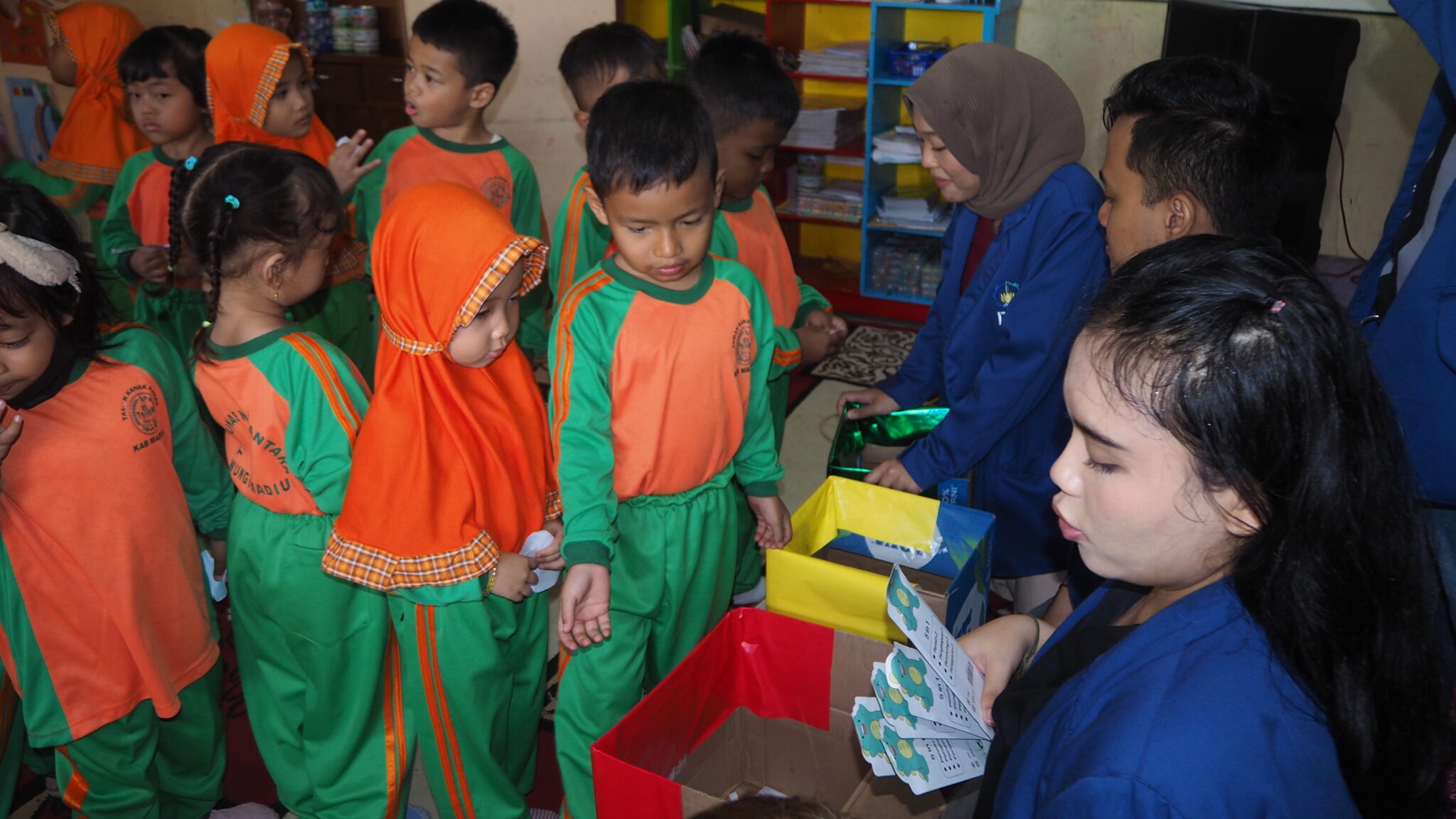
At the school level, the Movement of 1,000 Environmentally Friendly Schools, initiated by the Centre for Sustainable Infrastructure and Environment Studies (ILB ITS), promotes environmental awareness in primary and secondary schools through teacher training, workshops, exhibitions, and competitions. ITS also delivers hands-on education through I'm a Smart Kid, Throw Trash Properly at TK Tunas Nusantara, Madiun. Children learn waste reduction, reuse, recycling, and sorting, understanding how responsible waste management can reduce greenhouse gas emissions, conserve resources, and contribute to climate change mitigation.

Dr. Devy Kamil Syahbana, Head of the Geological Disaster Instrumentation, Data, and Information Team at the Center for Volcanology and Geological Hazard Mitigation (PVMBG), explains the early warning system.
ITS also raises awareness of disaster risks and early warning. The Department of Geophysics Engineering, in collaboration with East Java BNPB, organised a webinar on disaster mapping, highlighting technology-based mitigation and accessible risk information. Its Kelas Inspirasi Kebumian programme in Malang introduced students and residents to geological hazards, including landslides, using educational materials and simulations. In Sawahan District, Surabaya, the Centre for Disaster Mitigation and Climate Change Studies (MKPI ITS) delivered VR-based disaster risk reduction education, allowing early childhood education representatives and PKK members to explore fire, flood, and earthquake scenarios.

ITS Geophysical Engineering students demonstrate how to create holes in a biopore pipe.
Practical learning on climate impacts and adaptation is also integrated into community programmes and research applications. Through Biopores Heroes: Turning Waste Into Wonders at SDN Kejawan Putih 1/243, Surabaya, students learned about climate change and flooding, constructed biopore infiltration holes, and used sensors to monitor soil moisture and temperature. The biopores help reduce flood impacts by improving rainwater infiltration and reducing surface runoff. Complementing this initiative, ITS developed porous paving technology using coal-fired power plant waste, which was applied in Sumberrejo as a local flood mitigation effort. The innovation can increase water infiltration by approximately 70–120% compared with conventional paving, subject to underlying soil saturation conditions, supporting local water management and flood impact reduction.

Participants of the Climate Resilience Workshop learn about ecoprinting practices alongside residents of the 'Climate Village' (Kampung Iklim) in RW 05, Kedung Baruk, Surabaya, during the second day of their field visit.
At the research with community level, ITS hosted a Climate Resilience Workshop with the University of Queensland, BRIN, and other Indonesian universities. The workshop strengthened research collaboration on climate resilience and sustainable development, connecting researchers with kampung communities to exchange knowledge on climate risks, adaptation strategies, and locally relevant responses to climate change.
Together, these initiatives extend climate and environmental learning beyond the university, helping students and local communities understand environmental risks, strengthen preparedness, and engage with practical approaches to climate change mitigation, adaptation, and impact reduction.
Institut Teknologi Sepuluh Nopember (ITS) has established an institutional foundation for addressing climate change and advancing sustainability, guiding its environmental commitments both on campus and in collaboration with external stakeholders. This commitment is anchored by the Rector’s Statement on ITS Commitment to Achieving the Sustainable Development Goals (SDGs), which outlines strategic directions across three domains: Economy and Welfare, Social Life, and Environmental Matters. Its environmental priorities include energy conservation, pollution prevention, waste management, green open spaces, and biodiversity protection. This commitment is further reinforced by the Institutional Commitment to Achieving Carbon Neutrality by 2030, supported by operational frameworks for managing greenhouse gas emissions across Scopes 1, 2, and 3, and integrating renewable energy sources such as solar, biomass, and biodiesel.
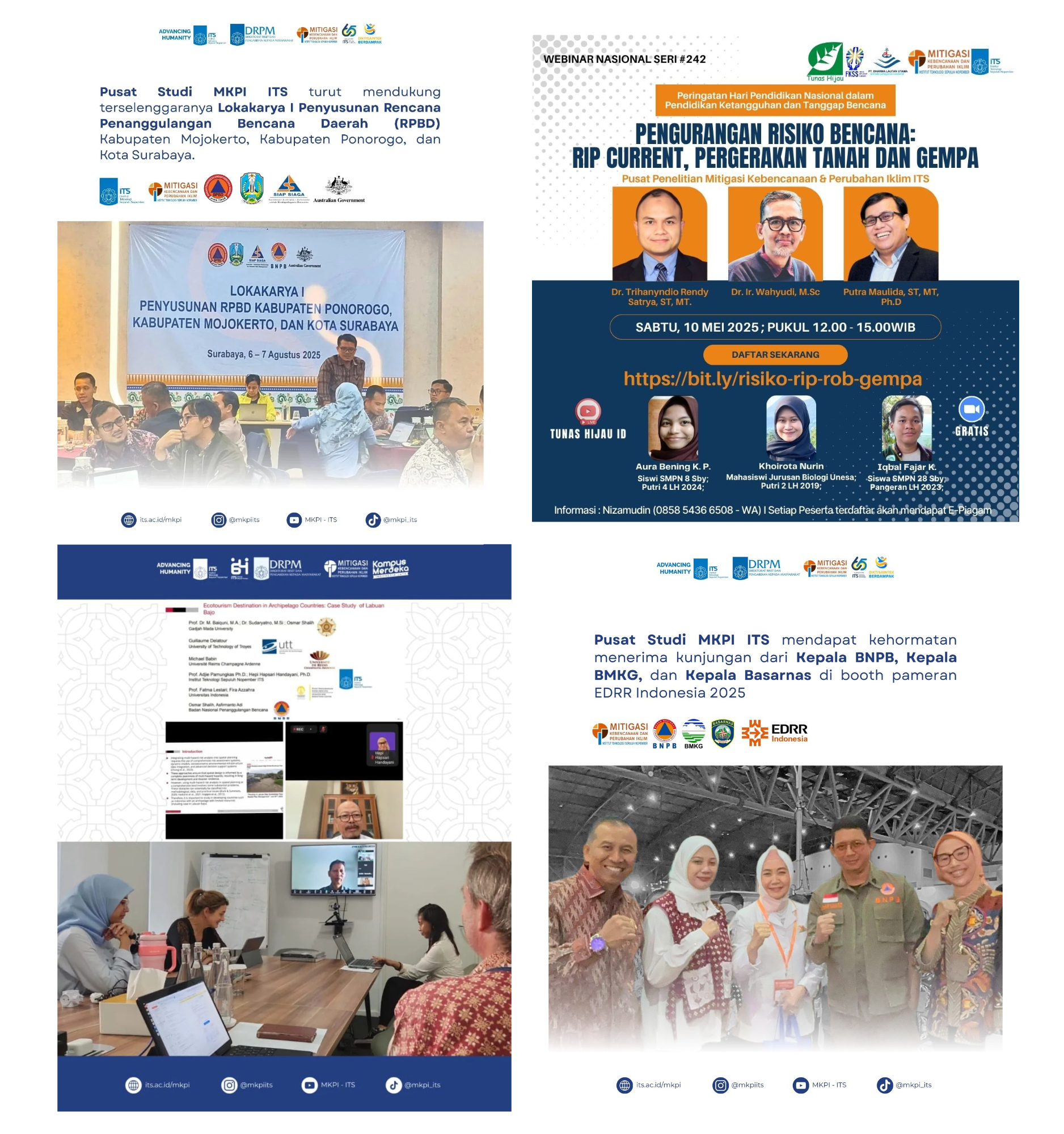
Building upon this institutional foundation, the Disaster Mitigation and Climate Change Research Center (MKPI ITS) serves as a key platform for extending climate and disaster resilience initiatives beyond campus. Its collaborations connect scientific expertise with local government priorities, community needs, and broader research networks. Key initiatives include:
1. Local government engagement and disaster planning: MKPI participated in the Surabaya City BPBD Regional Agencies Forum for the preparation of the 2025–2029 Strategic Plan (Renstra), contributing to discussions on disaster awareness, community participation, cross-stakeholder coordination, and science-based disaster management. MKPI also supported workshops for developing Regional Disaster Management Plans (RPBD) for Mojokerto Regency, Ponorogo Regency, and Surabaya City, including discussions on regional vulnerability, capacity, and disaster threats.
2. Community and public education: MKPI collaborates with community organisations such as Tunas Hijau Indonesia on public webinars addressing disaster risk reduction, including rip currents, land movement, and earthquakes. It also works with the Surabaya City DP3APPKB on public education about children's preparedness for natural disasters, and contributes to public awareness campaigns on tsunami and flood preparedness through radio programmes.
3. Collaboration with academic and research institutions: MKPI works with Universitas Gadjah Mada and BMKG on earthquake early warning education, and participates in the STRAP research initiative with the Institut français Indonésie, the French Embassy in Indonesia, and BNPB. The collaboration explores transdisciplinary approaches to crisis management and community resilience, including multi-hazard risk analysis and digital tools for disaster preparedness. MKPI has also established research collaboration with Keio University, Japan, focusing on disaster mitigation, risk reduction, and solutions for resilient communities.
4. Climate technology and innovation: In collaboration with Sustainable Living Lab (SL2), Ikatan Guru Indonesia (IGI) East Java, and Meta, MKPI is developing the Youth Development for Climate Tech programme. This initiative equips students, young innovators, and youth from Indonesia, Singapore, and India with knowledge and skills in generative AI, Internet of Things (IoT), and data analysis for climate technology applications. MKPI also showcases disaster mitigation innovations, including flood, landslide, and earthquake early warning systems, at public events such as EDRR Indonesia 2025.
Through these initiatives, ITS extends its institutional climate and sustainability commitments into collaborative activities involving local governments, community organisations, academic institutions, and young innovators. This approach connects institutional priorities with regional planning, public awareness, research collaboration, and technology development, supporting shared efforts to strengthen climate resilience and disaster preparedness.
Institut Teknologi Sepuluh Nopember (ITS), through its Disaster Mitigation and Climate Change Research Center (MKPI ITS), actively participates in cooperative disaster planning with government agencies, research institutions, international partners, and local communities. These collaborations bring together scientific expertise, technological innovation, and local knowledge to strengthen disaster preparedness, risk reduction, and climate resilience.
Discussion regarding the program "Improving Intelligent Sensing Capabilities to Build Resilience in East Java," involving the East Java Regional Disaster Management Agency (BPBD), Japan’s Ministry of Economy, Trade and Industry (METI), the Association for Overseas Technical Cooperation and Sustainable Partnerships (AOTS), and ITS.
At the local and provincial levels, ITS works with the East Java Regional Disaster Management Agency (BPBD Jawa Timur) and Japan’s Ministry of Economy, Trade and Industry (METI) and Association for Overseas Technical Cooperation and Sustainable Partnerships (AOTS) to explore a pilot research project on smart-sensing equipment for disaster monitoring and early warning. ITS also contributes to regional planning with local governments, including the preparation of Regional Disaster Management Plans (RPBD) for Mojokerto Regency, Ponorogo Regency, and Surabaya City. In collaboration with BNPB and local stakeholders, these planning workshops identify regional hazards, assess vulnerability and capacity, and develop indicators to guide disaster management strategies. At the city level, MKPI also participated in the Surabaya BPBD Regional Agencies Forum for the 2025–2029 Strategic Plan, contributing perspectives on community awareness, stakeholder coordination, and science-based disaster management.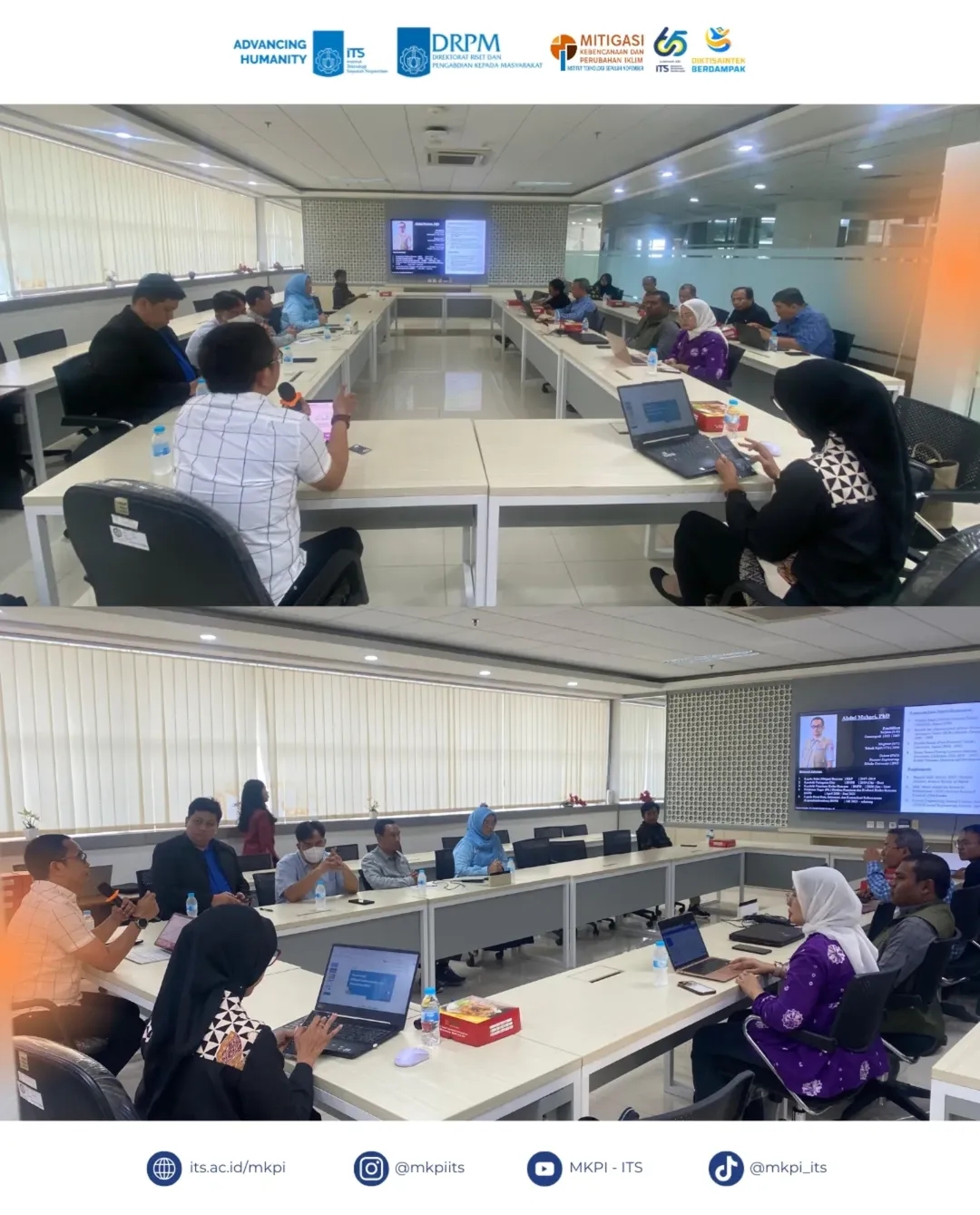
The Center for Disaster Mitigation and Climate Change Studies (MKPI) at ITS received a visit and held an audience with the National Board for Disaster Management (BNPB) to discuss the development of a Collaborative Decision Support System aimed at bolstering disaster mitigation efforts in Indonesia.
At the national level, ITS engages with BNPB on research and policy initiatives, including the Transdisciplinary Research Strategy for Crisis Management and Community Resilience (STRAP) with the Institut français Indonésie (IFI) and the French Embassy. Its contributions include integrating multi-hazard risk analysis into spatial planning and exploring digital tools for disaster preparedness. ITS also works with BNPB and relevant research centres to explore a Collaborative Decision Support System for disaster mitigation, and coordinates with forestry hydrometeorological disaster mitigation stakeholders to share data, map risks, and develop science-based adaptation strategies.
Participants of the Climate Resilience Workshop during the interactive session exchanged ideas.
ITS extends these partnerships to the international level through the Climate Resilience Workshop, organised with the University of Queensland, BRIN, and other Indonesian universities. Bringing together researchers, practitioners, academics, and representatives of urban kampung communities, the workshop addressed climate-related challenges such as flooding and environmental degradation. Participants mapped existing community adaptation practices and contributed to developing an analytical framework for urban climate resilience. ITS also engages in international knowledge exchange on disaster risk assessment with BNPB and the Swiss Government through the Swiss Agency for Development and Cooperation (SDC), as well as technical capacity-building initiatives with Japanese partners.
The ITS team conducting a survey with residents affected by the Mount Semeru eruption for a sustainable recovery program.
ITS also extends its collaborative approach to post-disaster recovery, recognising the needs of communities affected by disasters, including people who may be displaced from their homes. Following the Semeru pyroclastic flow event in Pronojiwo, Lumajang, an ITS team worked with village authorities to assess damage to residential and agricultural areas, identify community needs, and plan support for long-term recovery. The assessment included logistical needs and potential training programmes, with coordination on livelihood recovery for farmers and small businesses.
Through these engagements, ITS contributes to co-operative disaster planning across local, national, and global networks. By connecting government planning processes with research institutions, international expertise, and community participation, ITS supports more coordinated and context-responsive approaches to disaster preparedness, climate adaptation, and community resilience.
Institut Teknologi Sepuluh Nopember (ITS) actively supports and informs local, regional, and national governments in early warning and risk monitoring related to climate change–induced disasters through scientific research, policy recommendations, technological innovations, and direct field assessments.
At the regional level, ITS partnered with the East Java Regional Disaster Management Agency (BPBD Jatim), Japan's Ministry of Economy, Trade and Industry (METI), and AOTS through a pilot project titled "Improving Intelligent Sensing Capabilities to Build Resilience in East Java". This multi-actor collaboration developed advanced disaster management equipment featuring intelligent sensing capabilities and early warning systems designed specifically to mitigate hydro-meteorological risks such as floods and landslides. The project emphasized integrating real-time sensing data with local disaster response operations and recommended actionable strategies for BPBD Jatim to enhance its regional flood monitoring and early warning frameworks.

A research team from ITS discusses landslides with the East Java Provincial Regional Disaster Management Agency (BPBD).
In another initiative, ITS provided technical recommendations to BPBD Jatim to strengthen regional landslide risk assessment and mitigation. Following consultations and discussions with the agency regarding the landslide incident along the Pacet–Cangar route, researchers from the ITS Center for Disaster Mitigation and Climate Change (MKPI ITS) committed to supporting the detailed mapping of landslide susceptibility across East Java. This recommendation emphasizes the importance of identifying and mapping areas vulnerable to ground movement, particularly in steep-slope areas exposed to intense rainfall and water infiltration. The resulting susceptibility maps are intended to provide local authorities with more detailed scientific information for identifying high-risk areas, informing disaster preparedness measures, and strengthening community resilience against landslides.
To inform national policy and spatial risk assessment, researchers from the ITS Center for Disaster Mitigation and Climate Change (MKPI ITS) participated in the Disaster Risk Assessment (KRB) Seminar organized by the National Disaster Management Authority (BNPB) through the Directorate of Disaster Risk Mapping and Evaluation (PERB), in collaboration with the Swiss Agency for Development and Cooperation (SDC). The initiative aimed to evaluate and update national disaster risk mapping standards. During the forum, ITS experts analyzed regional hazard data and provided scientific input to ensure that local climate risks and vulnerabilities are accurately reflected in government risk monitoring frameworks.
The MKPI Study Center at ITS participated in a Disaster Risk Assessment (DRA) seminar organized by the Indonesian National Board for Disaster Management (BNPB) through its Directorate of Disaster Risk Mapping and Evaluation (PERB), in collaboration with the Swiss Government via the Swiss Agency for Development and Cooperation (SDC).

Furthering its commitment to institutional governance, ITS organized a formal national webinar in December 2025 to propose revisions to the General Guidelines for National Disaster Risk Assessment (KRB). This academic initiative analyzed existing evaluation methodologies and formulated comprehensive technical recommendations for central and regional government bodies. The project recommended standardized guidelines for local governments to evaluate, map, and monitor climate change disaster risks more effectively across municipal and provincial spatial planning.
Through these strategic initiatives—spanning applied sensing technology, scientific recommendations for landslide susceptibility mapping, policy consultation, national guidelines development, and direct field risk assessment—ITS strengthens the capacity of local and national governments to monitor, anticipate, and respond to climate-related hazards.
Institut Teknologi Sepuluh Nopember (ITS) actively partners with non-governmental organizations (NGOs), youth climate movements, and civil society groups to deliver climate change adaptation education, environmental awareness, and practical mitigation actions at both campus and community levels. These collaborations combine academic expertise, youth mobilization, and community outreach to translate climate knowledge into tangible on-the-ground solutions for vulnerable coastal populations.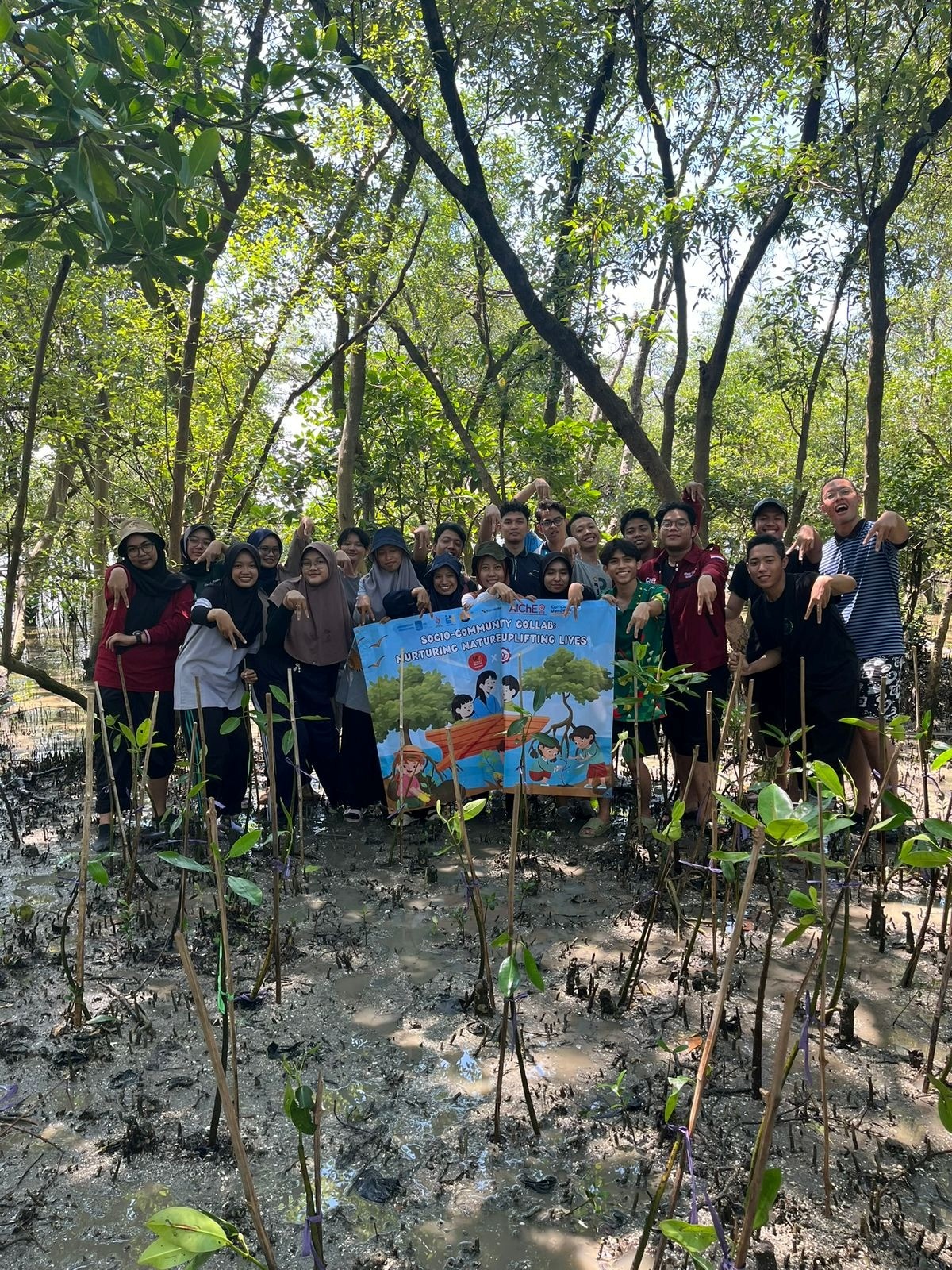
Documentation Photos of the Organizing Committee and Volunteers of the Socio-Community Collab 2025 initiative.
At the youth climate advocacy level, the American Institute of Chemical Engineers (AIChE) ITS Student Chapter partnered with Climate Rangers Surabaya—a youth-led environmental NGO—to execute the "Socio-Community Collab 2025" initiative. This collaborative project aimed to advance climate change education, promote blue carbon ecosystem conservation, and foster youth engagement in coastal restoration. The joint team analyzed the vulnerability of East Java's coastal areas to sea-level rise and coastal erosion, subsequently organizing educational workshops and hands-on mangrove planting sessions in local coastal zones. The initiative emphasized the crucial role of mangrove ecosystems as natural carbon sinks and buffers against severe weather events, recommending sustained community-based monitoring to ensure long-term sapling survival and coastal resilience.

The SIBECON 2025 team from the UKM PLH SIKLUS ITS student organization, together with the community of Labuhan Village, held an outreach session to introduce blue carbon ecosystems.
At the community-based environmental conservation level, ITS student environmental groups (UKM PLH SIKLUS ITS) partnered with local community groups and civil society actors, such as WALHI, one of the largest and oldest environmental advocacy non-governmental organization (NGO) through the SIBECON 2025 (SIKLUS Blue Carbon Conservation) initiative. This project analyzed coastal carbon sequestration capacity and climate-induced shoreline erosion in coastal villages. To strengthen local adaptive capacity, the coalition developed and implemented interactive workshops educating residents on blue carbon ecosystems and climate change mitigation. The program emphasized how restoring coastal vegetation mitigates extreme climate impacts and traps greenhouse gases, recommending decentralized, community-managed coastal conservation frameworks across vulnerable coastal regions.
Through these integrated educational programs and NGO partnerships—spanning youth climate advocacy, blue carbon restoration, and grassroots coastal climate adaptation—ITS leverages civil society collaboration to empower local communities, build adaptive capacity, and foster long-term environmental sustainability.
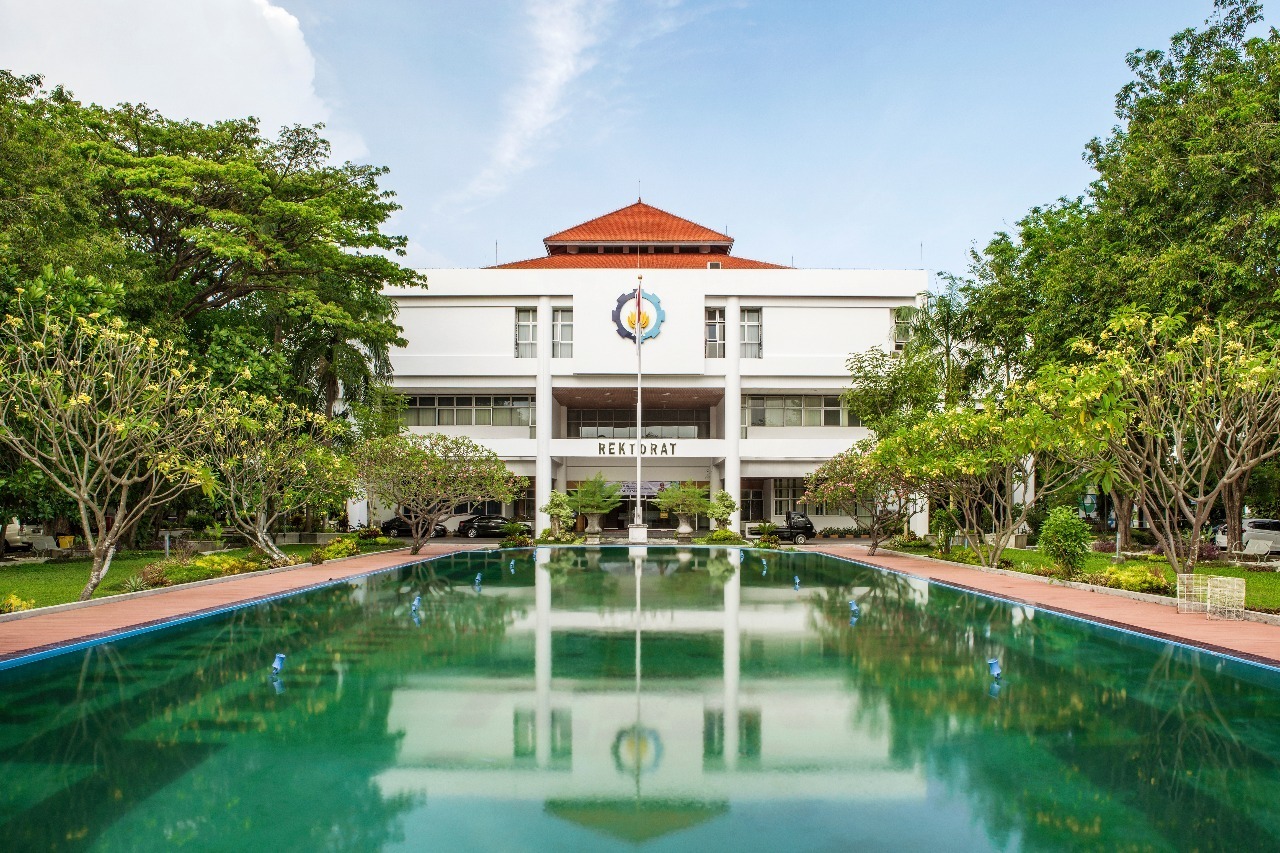
Institut Teknologi Sepuluh Nopember (ITS) has set a clear target to achieve carbon neutrality by 2030, as stated in Rector’s Decree No. 439/IT2/T/HK.00.01/XII/2024. This commitment demonstrates ITS’s strong dedication to sustainability and aligns with both national and global climate goals.
The university’s comprehensive strategy to reduce emissions is outlined in the Greenhouse Gas Emission Reduction Program, which addresses all three scopes defined by the Greenhouse Gas Protocol.
Scope 1 (direct emissions) focuses on reducing fossil fuel use within campus operations through initiatives such as promoting bicycles, electric vehicles, and campus buses, as well as establishing vehicle-free zones.
Scope 2 (indirect emissions from purchased energy) emphasizes the utilization of renewable energy, particularly solar power, alongside improvements in energy efficiency and conservation across campus facilities.
Scope 3 (other indirect emissions) covers sustainable procurement, waste management, and transportation activities, as well as awareness and engagement programs for staff, students, and the surrounding community to promote low-carbon behaviors.
To ensure measurable progress, ITS allocates adequate human, material, and financial resources, enabling systematic monitoring, evaluation, and continuous improvement of its emission reduction performance.