
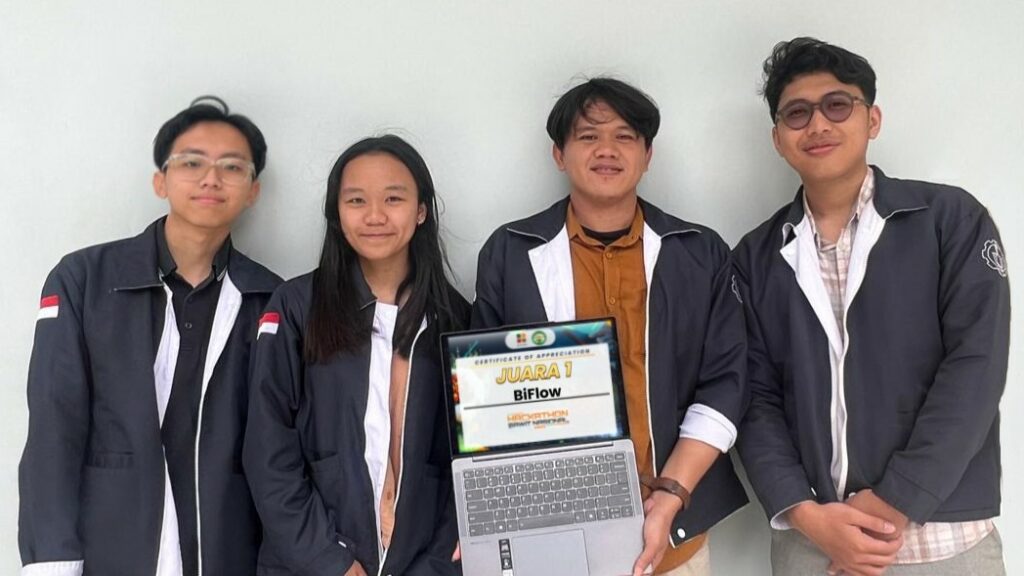
Surabaya, ELECTICS ITS – Amid the strong push toward agricultural digitalization, Team BiFlow’s victory as First Place Winner at the 2025 National Palm Oil Hackathon brings fresh optimism for the future of the palm oil industry. Through RAPIDS, a non-invasive early detection system for Ganoderma based on radar technology and machine learning, the team offers a practical solution to maintain plantation productivity and reduce losses caused by disease.
The team consists of four members with complementary backgrounds. Afan Ghafar Al Hadad, a master’s student in Electrical Engineering, served as the main research driver and prototype developer. Meanwhile, Muhamad Rusydi Al Hakim from Biomedical Engineering prepared the commercialization strategy and market simulation to ensure RAPIDS would not remain merely a prototype. Fabiola Tasya Natalia Wijaya strengthened the project’s analytical foundation by mapping field needs and highlighting the urgency of solutions to the Ganoderma problem. Marco Tjandrapurnama focused on long-term sustainability, including competitor analysis and business model direction. This well-distributed role structure enabled the project to progress systematically from early development through competition preparation.
The formation of BiFlow began with information about the competition shared by Rezki El Arif, a Biomedical Engineering lecturer with expertise in radar systems. The alignment between the competition theme and the team’s academic experience became the catalyst for the team’s creation. This step led them to compete against hundreds of participants and ultimately emerge as winners. The involvement of lecturers and academic guidance illustrates how academic pathways can spark applied innovation when opportunities and resources converge at the right moment.
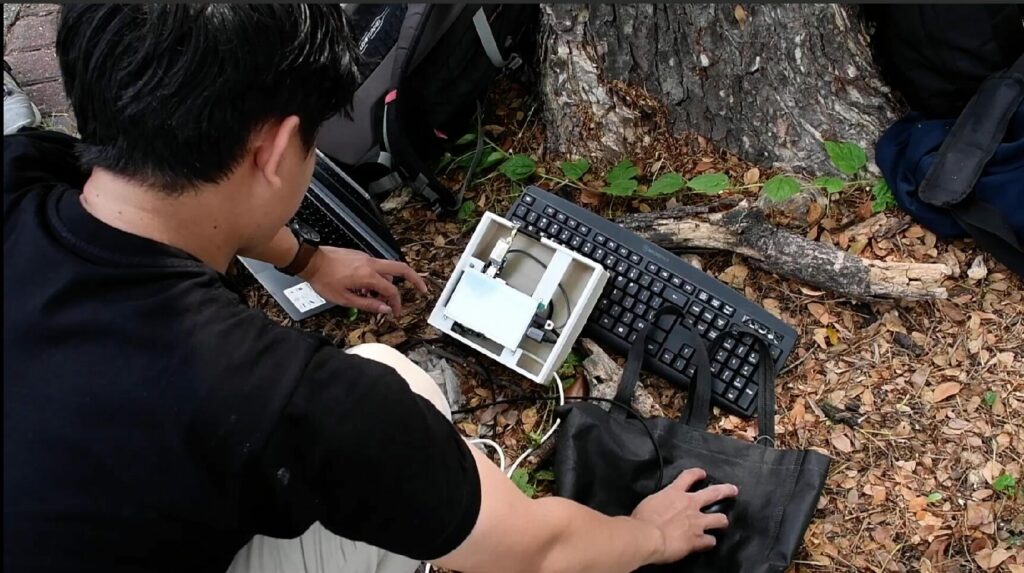
The team’s decision to focus on Ganoderma boninense stemmed from impactful field observations. This disease is known for its aggressive nature, damaging trunks and roots, and is often detected only when conditions are already critical. Farmers and plantation companies are frequently late in taking action, forcing trees to be cut down and causing long-term declines in land productivity. Discussions with industry practitioners revealed that while various treatment methods have been attempted, early detection remains a major unresolved challenge. This gap is what RAPIDS seeks to address as a non-invasive system capable of observing internal tissue conditions without harming the plant, allowing plantation managers to respond more quickly before damage spreads.
The radar-based approach was selected based on literature reviews and comparative studies of detection methods. Destructive alternatives or attached sensors were considered inefficient for large-scale monitoring. Radar offers advantages such as rapid signal penetration into the trunk, repeatable use, and compatibility with algorithmic processing. During the research, collected data revealed intriguing patterns. Healthy plants showed a decreasing signal trend from morning to afternoon, following photosynthesis dynamics, whereas infected plants exhibited unstable or even opposite patterns. This phenomenon became a crucial foundation for building a more precise machine learning prediction model.
The signal processing stage posed its own challenges. Radar is highly sensitive to sensor position, distance, and even minor vibrations, requiring meticulous preprocessing. Data normalization, window selection, and filtering became critical steps to prevent the model from misinterpreting daily signal variations as disease indicators. In addition, the risk of overfitting required training the model with data variations across different individuals so that the algorithm learned biological patterns rather than technical measurement conditions. Once the model stabilized, testing was conducted using data from trees not included in the training set. Consistent results across different sessions and samples indicated that RAPIDS performs reliably in real-world conditions.
The main advantages of RAPIDS lie in its speed, non-invasive nature, and integration with digital monitoring systems. The device only needs to be attached to the trunk to read internal signals, after which data are automatically processed by the system, minimizing subjectivity in assessing plant health. This contrasts with visual inspections, which are only effective when infections are already severe, or laboratory methods that require significant time and cost. With this system, field decisions can be made based on data rather than intuition.
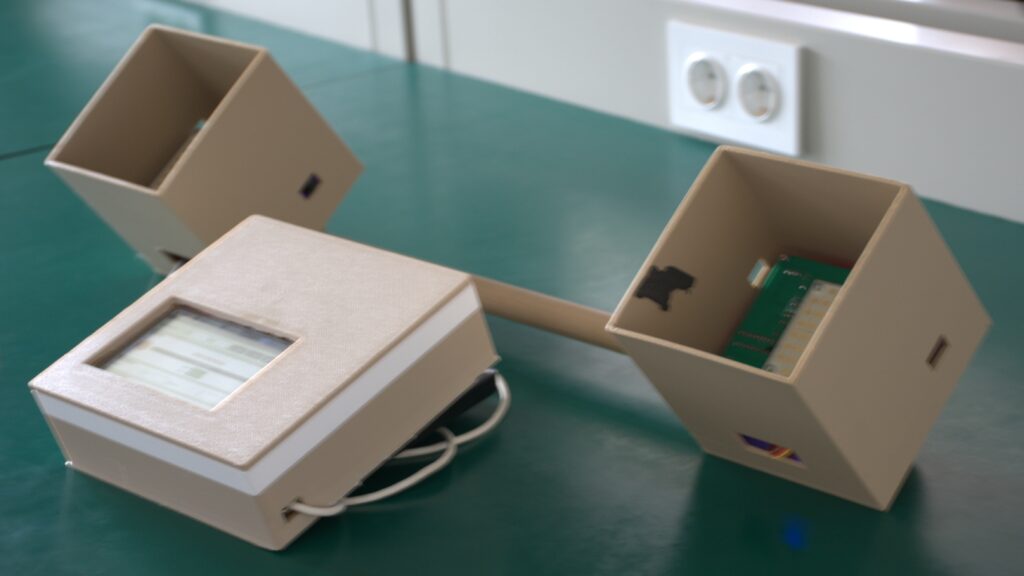
Looking ahead, BiFlow aims to make RAPIDS more compact and ready for production as a portable device that can be directly used by foremen and agronomy teams. Integration with a monitoring dashboard will enable periodic analysis at the plantation block level and expand the technology’s application scope. This technology also has the potential to be applied to other plant diseases that attack trunk tissues or affect water transport, with appropriate protocol adjustments and model retraining.
BiFlow’s journey demonstrates that innovation does not always originate from large laboratories; sometimes it begins with curiosity, the courage to seek opportunities, and disciplined, sustained research. RAPIDS is not only about radar and data, but about the future of smarter, more efficient, and more sustainable agriculture. If development continues consistently, it is not impossible for this technology to become a new standard for early detection in palm oil plantations and other commodities.