
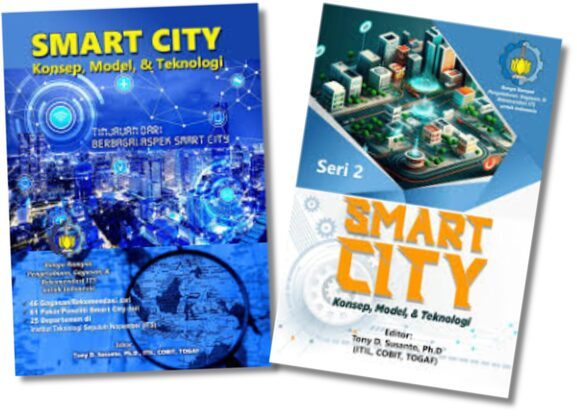
Surabaya, ELECTICS ITS – The Faculty of Intelligent Electrical and Informatics Technology (ELECTICS) at ITS has once again reaffirmed its contribution to national development. This is manifested through the publication of a book titled “Smart City: Concepts, Models, & Technologies – A Collection of Knowledge, Ideas, & Recommendations from ITS for Indonesia”, which compiles insights, experiences, and recommendations from lecturers, researchers, and practitioners across disciplines.
The book is the result of interdisciplinary collaboration among ITS lecturers, with strong contributions from the ELECTICS academic community. One of them is Tony Dwi Susanto, S.T., M.T., Ph.D., a lecturer from the Department of Information Systems, ELECTICS ITS, who also contributed as an author. “This book is a collection. It contains ideas, knowledge, and real experiences of ITS lecturers in supporting the development of cities and regencies in Indonesia,” said Dr. Tony.
For years, ITS has contributed to various aspects of urban development, from Smart Governance, Smart Branding, Smart Economy, Smart Living, Smart Society, to Smart Environment. Unfortunately, according to Dr. Tony, many works by ITS lecturers have not been properly documented. “That’s why this book serves as a documentation medium so that the knowledge and experiences of ITS researchers are not lost but can be widely accessed by governments, communities, and academia,” he explained.
Uniquely, the ITS Smart City book is not only published in print but also available as a free downloadable e-book. Beyond that, ITS also distributes printed copies free of charge to regional leaders across Indonesia. This initiative, according to Dr. Tony, aims to broaden the perspectives of regional leaders on the potential of innovations and technologies that can be implemented in their areas. “Because digital transformation is top-down in nature, regional leaders must first gain access to ideas and insights. This book is one way to provide that,” he added.
The book’s preparation process demonstrates how lecturers from various ITS departments collaborated. For example, Information Systems researchers focused on e-Government, the Department of Industrial Product Design contributed to Smart Branding, Environmental Engineering discussed Smart Environment, while the medical and civil engineering fields worked on aspects of Smart Living. “The collaboration is simple: any ITS lecturer with an idea could immediately write it down. The book even serves as a platform for students to publish parts of their final projects, theses, or dissertations,” Dr. Tony explained.
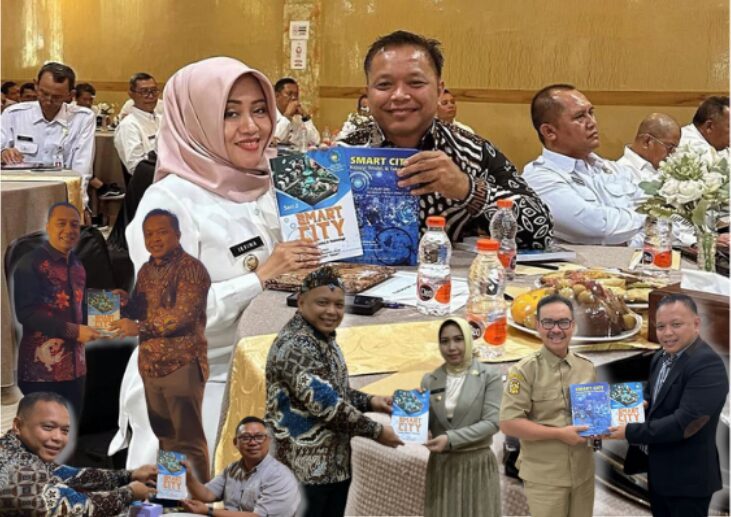
The book has been received by many regional leaders, from the Mayor of Surabaya and the Mayor of Yogyakarta to other local government leaders. “They were delighted to receive the book, with some even placing it directly on their desks or in their official cars. Our hope is that this book will truly be read and inspire real policy,” he added.
Aligned with the development of national policies on Smart City, ITS plans to continue improving the content quality in future editions. The main focus will be on producing writings that are more communicative, relevant to regional needs, and easier for government leaders to understand.
“Smart City is not just about technology. There are human, cultural, process, and cross-sector collaboration aspects. My hope is that this concept can be taken more seriously at the national level, not only through the Ministry of Communication and Information but also the Ministry of Home Affairs, Public Works and Housing, and Statistics Indonesia,” emphasized Dr. Tony.
Dr. Tony also stressed the importance of academics collaborating to make urban issues a source of research ideas that provide real solutions for society.
“Our research should not stop at journals or thesis defenses. It must be tested and validated in the field to truly create real impact for cities and regencies in Indonesia,” he concluded.