ITS Implements IoT-Based Smart Farming to Optimize Shallot Harvests in Madiun
Published on
Wednesday, 3 December 2025
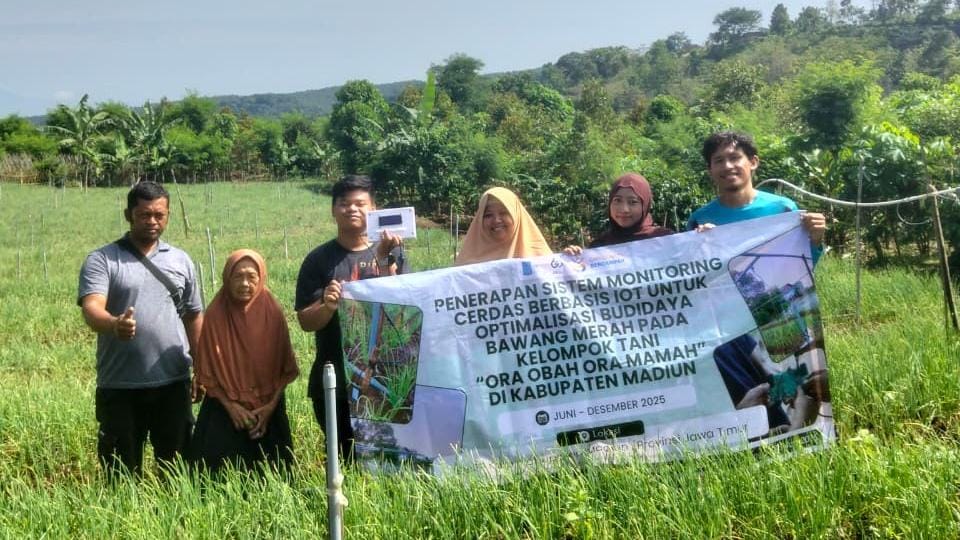
The ITS Information Technology Department team together with members of the farmer group at the smart farming technology implementation site.
Madiun, IT Journalistic — The Department of Information Technology (DTI) of Institut Teknologi Sepuluh Nopember (ITS) continues to demonstrate its role in advancing the agricultural sector through digital technology. Through the 2025 Community Service Program (Abmas), DTI ITS has successfully implemented an Internet of Things (IoT)–based smart monitoring system to support shallot cultivation for the farmer group “Ora Obah Ora Mamah” in Kare Village, Madiun Regency.
Kare Village, located on the slopes of Mount Wilis, has great potential as a shallot production center, especially after many farmers shifted from clove cultivation. However, the Head of the Product-Based Abmas Team, Dr. Ir. Henning Titi Ciptaningtyas, S.Kom., M.Kom., revealed that farmers are still facing challenges in land management. “Until now, cultivation has been carried out conventionally based on intuition. As a result, fertilizer use is often inefficient and harvest productivity becomes inconsistent,” she explained.
To address this issue, the DTI ITS team introduced a Smart Farming solution that allows farmers to monitor land conditions in real time with high precision. The system integrates a variety of advanced sensors, including NPK sensors for measuring soil nutrient levels, temperature sensors, and soil moisture sensors for monitoring plant conditions. The data collected is then transmitted to a server and displayed through a user-friendly digital dashboard.

The ITS team provides technical guidance and demonstrates sensor data readings through the dashboard to local farmers.
The application of this technology has been enthusiastically welcomed by the partnering farmers. Through intensive training sessions, farmers can now determine the right time to irrigate and the appropriate amount of fertilizer dosage based on accurate data displayed on their laptops or mobile devices. This technology is expected to reduce crop failure risks while also lowering agricultural operational costs.
This program is not only about deploying devices but also about building a sustainable agricultural ecosystem aligned with the Sustainable Development Goals (SDGs)—particularly in reducing hunger and promoting industrial innovation. Moving forward, the system is planned to be further enhanced with automation features and artificial intelligence–based analysis, positioning Kare Village as a model of smart agriculture in East Java.
Reporter : Agnes Zenobia Griselda Petrina
=================================================================
Information provided by :
Department of Information Technology
Website: its.ac.id/it
Instagram: its_teknologi_informasi
YouTube: Information Technology ITS