
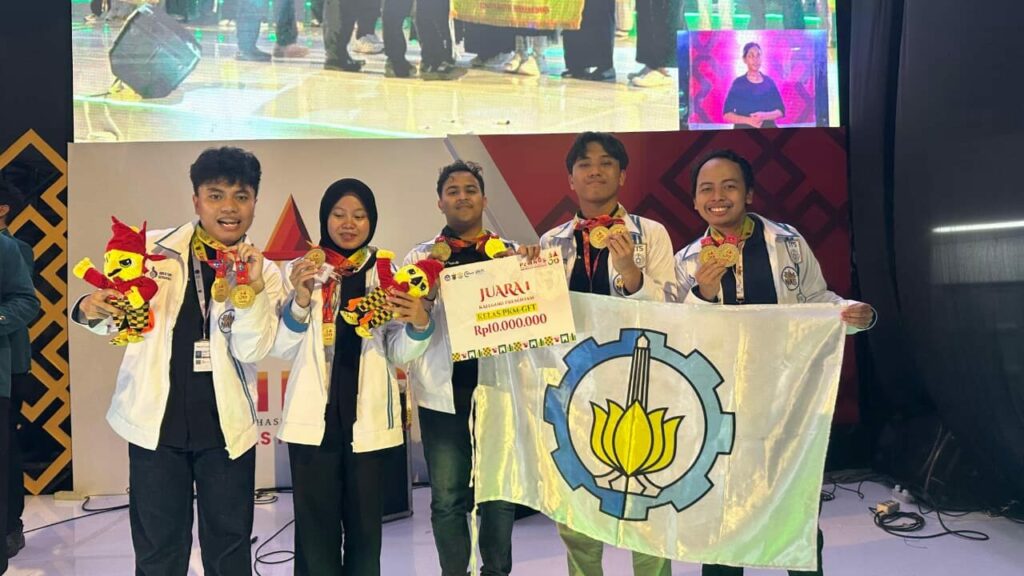
Surabaya, ELECTICS ITS – Driven by concerns over the limitations of renewable energy sources that remain intermittent in nature, the Space Solar Team from the Department of Electrical Engineering, Institut Teknologi Sepuluh Nopember (ITS), achieved an outstanding accomplishment by winning 1st Place in Presentation and Poster at PIMNAS 38 in 2025 under the Futuristic Written Ideas (GFT) category. The idea presented was not only innovative but also went beyond conventional approaches by proposing the utilization of Space-Based Solar Power as a future energy solution for Indonesia.
The Space Solar Team is a PKM GFT team that proposes the use of solar panels in outer space through satellites to provide continuous renewable energy. The team leader, Muhamad Ais Faza Rohmat, explained that the idea stemmed from the desire to introduce a clean energy source that is unaffected by weather conditions or time. “We aim to address one of the major challenges of renewable energy today, namely the continuity of power supply,” said Faza. Within the team structure, Faza served as the leader and was responsible for handling the question-and-answer session with the judges. He was supported by Syabila Cahya Diani and Gading Alvaro Sudjarwo as presenters, Fariz Rifqi Naufal Arrafi, who was responsible for operations, editing, and presentation animations, as well as Muhammad Haidar Syahab, who assisted in preparing strategies for responding to judges’ questions. The entire idea development process was supervised by Dr. Dimas Fajar Uman Putra, S.T., M.T.
The team’s journey to the PIMNAS stage was far from instant. Faza explained that the team was formed through an open recruitment process under the PKM Project PSSL, which was open to students from various departments. The selection process was rigorous, considering portfolios and alignment of competencies with the team’s needs. “Initially, the team composition was quite dynamic, and some members even withdrew after the proposal received funding. However, we quickly adapted and found suitable replacements,” Faza shared. After qualifying for PIMNAS, the team focused on refining their presentation and poster, accompanied by intensive training sessions with reasoning lecturers to sharpen their arguments, particularly in defending the urgency and benefits of the proposed idea.
The Space-Based Solar Power concept proposed by the Space Solar Team is rooted in the academic background of its members, most of whom come from the Department of Electrical Engineering at ITS, especially in the Power Systems field. Their interest in clean energy issues led the team to explore various futuristic technologies before ultimately choosing a concept that is also being developed by NASA. “This technology has the potential to provide energy supply continuity of more than 97 percent,” Faza explained. The novelty of the idea was further strengthened by proposing its integration into a smart energy management system in Indonesia’s new capital city, Ibu Kota Nusantara (IKN). According to Faza, IKN is projected to have very high energy demands as it develops into a smart city, while simultaneously facing strong demands to use clean energy toward 2045. In this context, Space-Based Solar Power is considered both relevant and strategic.
To refine the concept, the team conducted an in-depth literature review. Various scientific journals and articles related to Space-Based Solar Power were studied to understand both the potential and limitations of the technology. Faza mentioned that internal discussions, including brainstorming with the assistance of AI technology, played an important role in identifying research gaps and preparing responses to potential criticisms. “We tried to simulate how our idea might be challenged and prepared strong theoretical arguments in advance,” he said.
Nevertheless, methodological challenges remained a major obstacle. To date, no country has fully implemented Space-Based Solar Power. Global research is still fragmented, with NASA focusing on satellite efficiency and JAXA concentrating on wireless energy transfer. In addition, the absence of specific regulations governing this technology at both national and international levels presents another significant concern.
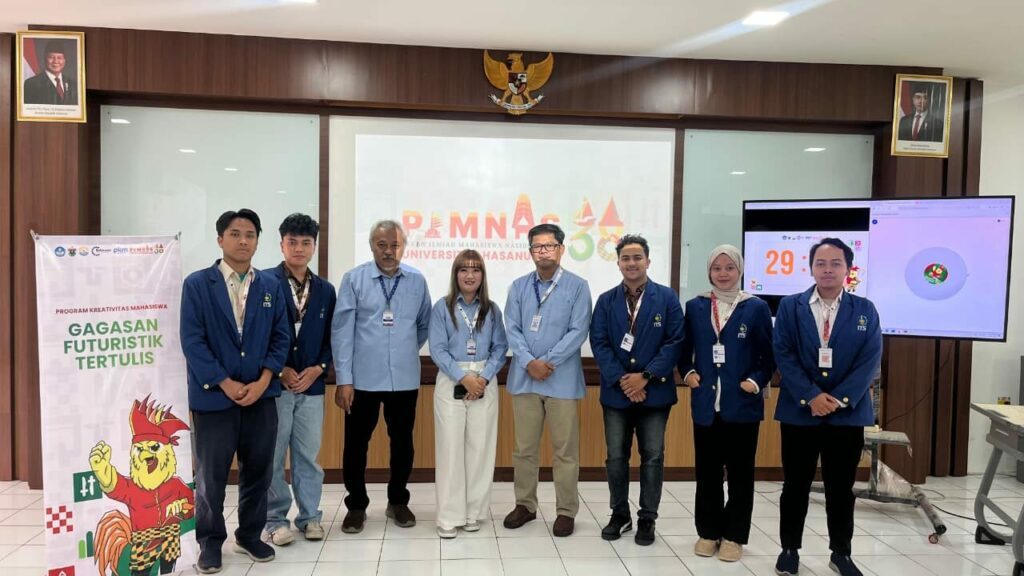
The uniqueness and boldness of the idea ultimately became the team’s distinguishing factor at PIMNAS 38. According to Faza, the Space-Based Solar Power concept is considered extreme compared to other teams’ ideas, which generally remain at the city or national scale. During the presentation session, the team’s composure in responding to critical questions from the judges was regarded as a key to their success. The same strength was reflected in the poster category, where a dense yet concise layout, appropriate color selection, and efficient information presentation allowed the Space Solar Team’s poster to stand out among competitors.
If implemented in the future, this concept is believed to have a significant impact, particularly for the IKN area and its surroundings. Communities could benefit from a stable supply of clean energy, while also opening opportunities for electricity distribution to other provinces through surplus power. Furthermore, this concept could contribute to reducing Indonesia’s dependence on fossil fuels, which are limited in supply and harmful to the environment.
The Space Solar Team has opened opportunities to further develop this idea into scientific publications as a continuation of the studies that have been conducted. However, Faza noted that realizing a prototype remains challenging due to licensing constraints and the need for specialized expertise in the aerospace field. In his closing remarks, Faza encouraged students interested in participating in PKM GFT to continuously broaden their knowledge and expand their literature review. He emphasized that innovation can only emerge from strong understanding, while future-oriented technology ideas will always be tested in terms of feasibility. Therefore, the ability to think calmly, structure logical arguments coherently, and engage in in-depth team discussions are key factors for success. The achievement of the Space Solar Team not only brings pride to ITS but also demonstrates that bold ideas, when systematically developed and supported by strong theoretical foundations, can compete and gain recognition at the national level.