About
Published on
Tuesday, 22 September 2026
Maheswara Yogha Putra Al Ardha, an undergraduate Electrical Engineering student at ITS from the 2023 batch, won 1st Place/Champion at the IEEE BIG 2026 Business Case Competition. In this competition, Yogha was part of team JavaneseSmile, alongside Marva Prayata and Raffi Muhammad. The three brought different backgrounds and perspectives, but shared the same goal: to build a solution that was not only innovative, but also commercially feasible and relevant to the given problem.
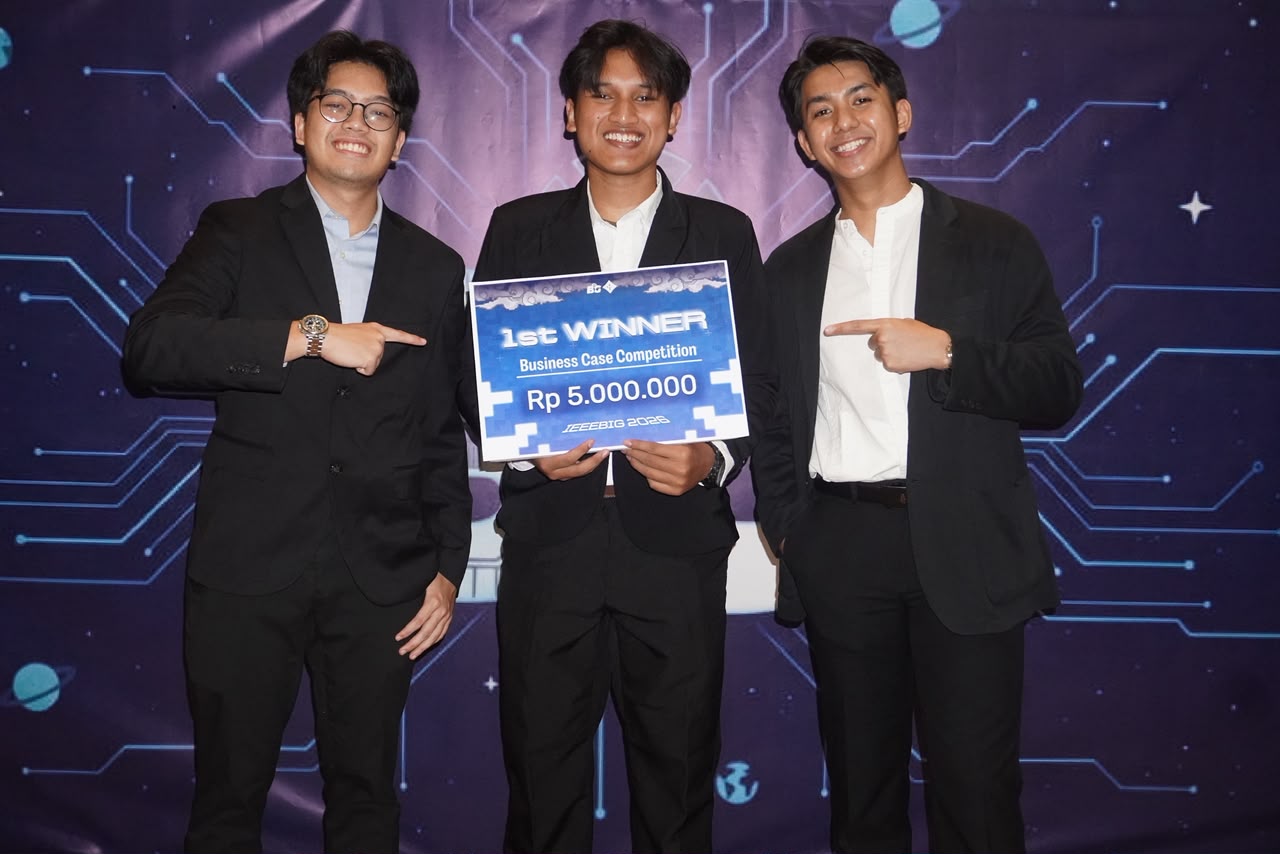
Image: Team JavaneseSmile winning 1st Place (Champion) at the IEEE BIG 2026 Business Case Competition
IEEE BIG 2026, or IEEE Brilliant Ideas Generator 2026, is a series of competitions organized by the IEEE ITS Student Branch, with the Business Case Competition as one of its branches. The business case tackled by team JavaneseSmile centered on a case-study company called EcoBat, which faced challenges in managing end-of-life electric vehicle batteries. The challenge was how to increase battery return rates, prevent batteries from entering the informal market, and recover valuable materials such as lithium, nickel, and cobalt back into the supply chain.
According to Yogha, one of the main reasons he was drawn to this competition was because the business case sat at the intersection of technology, business, sustainability, and energy transition. As an Electrical Engineering student, he sees the development of electric vehicles not only from a technological standpoint, but also in terms of how that technology can be supported by a sustainable business ecosystem and supply chain. The competition also gave him the opportunity to move beyond a purely technical engineering approach, and to start examining problems from consumer, operational, financial, regulatory, and sustainability perspectives.
The team’s process began with understanding EcoBat’s condition and identifying its root problems, using several frameworks such as SCQA, 5 Whys, Issue Tree, and PESTLE Analysis. From this analysis, the team identified three main problem clusters: consumer behavior, operational inefficiency, and market leakage. The root cause they found was a mismatch between consumer behavior, incentive structure, and system accessibility, which caused EcoBat to fail in effectively capturing the flow of end-of-life batteries.
Based on this root cause, the team developed a solution called the Circular Battery Recovery Ecosystem (CBRE), consisting of three main components: a decentralized collection network through Mini Hubs, financial incentives such as trade-ins, and a digital lifecycle tracking system. The solution was then tested for operational and financial feasibility, covering logistics flow, financial projections, KPIs, risk mitigation, and a three-year implementation roadmap.
During the preparation process, the team’s biggest challenge was not simply coming up with an innovative idea, but building a solution that was holistic and defensible. The team also had to turn fairly complex analysis into a concise presentation and explain it effectively in English. To address this, the team divided responsibilities according to each member’s strengths, cross-checked each other’s analysis, and conducted multiple presentation rehearsals and mock Q&A sessions.
According to Yogha, one of the keys to the team’s success was structured problem solving and teamwork. The team aimed to build a solution that was easy to understand, yet analytically strong and realistic to implement. The team’s chemistry, being open to critiquing each other’s ideas and not being overly attached to a single solution, was also an important factor in this achievement.
The main strength of the team’s CBRE solution lies in its approach of viewing the battery problem not merely as a recycling issue, but as an ecosystem problem, connecting consumers, EV dealers, Mini Hubs, charging stations, logistics partners, and recovery facilities within a single circular ecosystem. The team also developed a three-year roadmap with a target battery return rate increasing from 25% in Year 1, to 50% in Year 2, and 75% in Year 3, with the potential to recover up to around 95% of lithium, nickel, and cobalt materials, as well as a potential reduction in COGS of Rp4.4 million per unit.
Yogha expressed deep gratitude and pride over this achievement, given the significant time the team spent discussing, revising, and preparing their final presentation. However, for him, the greatest achievement was not just the championship title, but proof that students with an engineering background can also develop multidisciplinary skills in business strategy, sustainability, financial thinking, and communication.