Writing is a lengthy process that differs from person to person. Some people start writing by freewriting, while others might prepare their writing structure beforehand. In fact, there is no one-size-fits-all approach to write. You can begin writing at any stage that fits you, nonetheless writing abilities entail more than just employing letters and numbers to construct a text; they also entail the writing process that will help you enhance your writing skill over time. To help you with your writing process, you can refer to the writing process (pre-writing, drafting, revising, editing, and proofreading) adapted from Aliotta (2018) below. You can also refer to the Writing Process on the figure above to evaluate your writing journey.
Pre-Writing
The very first important step to write is reading to gather the literature review and organize it accordingly (Aliotta, 2018). Indeed, how would you write if you do not have enough information to begin your writing. Other ideas of pre-writing activities can be accessed through the following links.
After having abundant resources, drafting can be the next step in your writing process. Before actually writing a text, we can talk about our research with someone, get the structure of our text done, make a mind map, or do a freewriting directly (Aliotta, 2018). Drafting is not a perfect writing yet, thus, rather than focusing on getting your sentences correct, it is better to have clear thesis statements and content first (Langan,2008). Other stages of drafting activities can be accessed through the following links.
After writing your draft, it is important to check and revise what you have written. If you do not know where to start, you can do it based on the urgency level of your draft (Aliotta, 2018) and rewrite or develop more paragraphs (Langan.2008). Hence, you might find yourself going back and forth in this process. To help you with your revising process, here are some links and strategies that you can follow,
Editing and proofreading might be mistaken to be the same stages. However, different from proofreading, editing might still focus on the core of the writing. Some areas that can be edited such as style editing, grammar, redundant information, or negative statements (Aliotta,2018). On the other hand, proofreading may involves reference formatting, grammar, and spelling (Aliotta, 2018). Other proofreading activities such as checking tenses, punctuation, word ending, vocabulary, spelling, and word order (Bailey, 2015). Some links below can help you through your editing and proofreading stages:
If you need more resources to help you understand the writing process or find the writing process that suit you, consider to visit the following links:
Aliotta, Marialuisa. (2018). Mastering Academic Writing in the Sciences: A step by Step Guide. CRC Press.Bailey, Stephen. (2015). Academic Writing: A Handbook for International Students (4th ed). Routledge.Langan, John. (2008). College Writing Skills with Readings (7th ed). Mc Graw Hill.
Meilisa Sindy Astika Ariyanto. September 8 , 2021.
Organizational Structure of an Academic Paper
An academic paper's organizational structure is more than just a document format or a collection of ideas given under several headings (introduction, method, etc.). Organizational structure also organizes our ideas so that the flow of ideas is conveyed (Ahmady et.al, 2016). It is crucial to note that adhering to an academic paper's organizational structure is one approach for assisting writers to present their thoughts to the readers easily.
Among many organizational structures, the IMRaD or IMRaD(C) (Introduction, Methods, Results, Discussions, and Conclusions) format is the most widely applied one. Indeed, high-tier journals worldwide are found to adopt the IMRaD format for publication (Trinh et.al, 2020). However, you should be aware that there are several organizational structures format that you must follow based on the type of research that you undertake. Review articles, conceptual papers, or field studies are examples of those papers which do not follow IMRaD format.
Pendahuluan
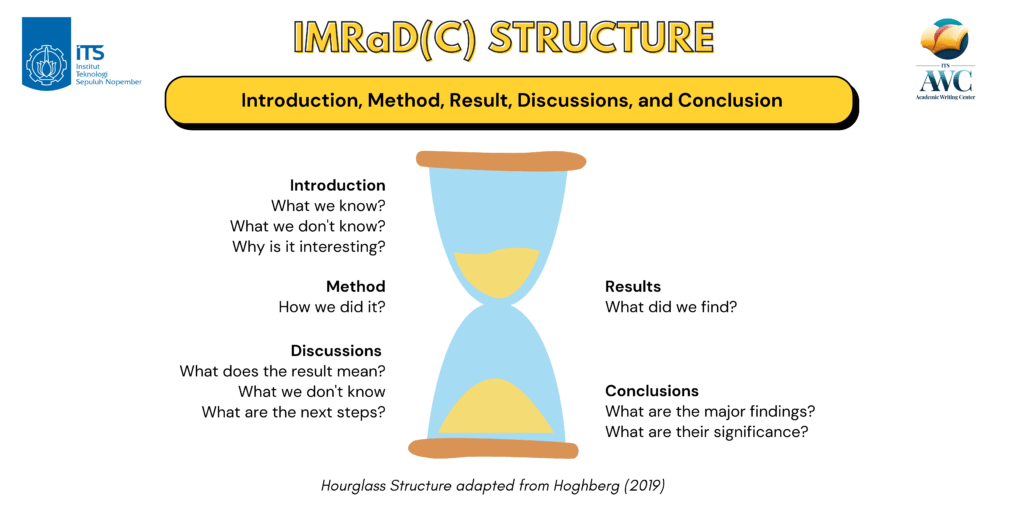
Sebuah pendahuluan sebagian besar dimulai dengan konteks atau domain studi. Anda mungkin melihat Pendahuluan banyak makalah dimulai dengan sudut pandang yang luas terlebih dahulu sebelum beralih ke ide yang lebih spesifik. Memang, pendahuluan ditulis dari ide-ide umum atau luas ke yang paling sempit (Todorovic, 2003). Bentuk pendahuluan biasanya dikaitkan dengan segitiga terbalik karena ide penulis semakin spesifik pada tujuan penelitian. Hoghberg (2019) juga mengasosiasikan struktur makalah sebagai struktur jam pasir (lihat gambar di atas). Seperti yang dapat Anda lihat pada gambar di atas, pendahuluan dimulai dengan latar belakang dari apa yang kita ketahui, masalah apa yang dapat ditemukan, dan solusi atau tujuan apa untuk mengatasi masalah tersebut. Untuk membantu Anda memeriksa pendahuluan Anda, merujuklah pada beberapa elemen Pendahuluan/langkah retoris yang diadaptasi dari beberapa sumber di bawah ini.
Elemen Pendahuluan/langkah retoris diadaptasi dari Todorovic (2003):
Deskripsi masalah
Keadaan penelitian saat ini di bidang tersebut
Kesenjangan penelitian (keterbatasan penelitian saat ini atau masalah yang belum terjawab)
Solusi untuk masalah (tujuan dari studi)
Rasional bagaimana solusi dapat memecahkan masalah atau mengapa penting untuk dilakukan
Penjelasan singkat tentang desain studi
Elemen Pendahuluan/langkah retoris diadopsi dari Nair & Nair (2014):
Sifat dari studi
Deskripsi masalah
Tinjauan literatur berbasis masalah
Tujuan dari studi
Penjelasan singkatan dan istilah
Metode
Metode mengacu pada deskripsi tentang bagaimana penelitian dilakukan. Metode harus mencakup semua hal yang dilakukan peneliti untuk mengumpulkan data hingga bagaimana data dianalisis. Bagian Metode juga harus mencakup informasi yang diperlukan sehingga dapat diulangi oleh peneliti di masa depan yang ingin melakukan hal yang sama (Nair & Nair, 2014). Elemen-elemen yang dicakup dalam bagian Metode disajikan di bawah ini.
Elemen Metode/langkah retoris diadaptasi dari Todorovic (2003):
Desain studi
Peserta / subjek studi (ukuran sampel & karakteristik)
Bahan yang digunakan
Analisis data
Elemen Metode/langkah retoris diadopsi dari Nair & Nair (2014):
Metode / desain studi
Bahan yang digunakan
Lokasi studi jika relevan
Peserta atau subjek studi (manusia, hewan, atau tumbuhan) dan bagaimana mereka dipilih
Analisis data
Hasil
Bagian Hasil menyajikan data atau temuan dari studi. Ini mencerminkan jawaban atas tujuan atau pertanyaan yang kita cari di pendahuluan. Bagian hasil harus ditulis dengan jelas dan cukup karena merupakan bagian penting dari makalah (Nair & Nair, 2014). Untuk membantu Anda melacak bagian Hasil Anda, beberapa elemen yang diadopsi dari Todorovic (2003) dan Nair & Nair (2014) disediakan di bawah ini.
Elemen Hasil/langkah retoris diadaptasi dari Todorovic (2003):
Karakteristik data
Presentasi data utama
Tabel untuk menjelaskan ringkasan data atau ilustrasi berkualitas baik (grafik, gambar, foto, atau mikrograf) untuk menunjukkan bagian penting dari data.
Elemen Hasil/langkah retoris diadopsi dari Nair & Nair (2014):
Presentasi data utama dan data yang dianalisis.
Tabel dan gambar yang diperlukan untuk interpretasi hasil
Diskusi
Seperti yang tersirat dari judulnya, bagian ini membahas bagaimana penulis mendiskusikan hasil atau temuan mereka. Bagian ini biasanya dianggap sebagai bagian yang paling sulit oleh banyak mahasiswa yang telah melakukan konsultasi tatap muka dengan kami. Anda dapat merujuk pada elemen-elemen yang disajikan di halaman ini untuk membantu Anda membedakan bagian Hasil dan Diskusi. Singkatnya, bagian Diskusi menggali lebih dalam temuan/hasil Anda dan apa yang dapat Anda simpulkan dari fakta-fakta tersebut; bagian ini tidak hanya tentang menyajikan data seperti yang biasa kita lakukan di bagian Hasil.
Elemen Diskusi/langkah retoris diadaptasi dari Todorovic (2003):
Ringkasan bagian Hasil
Pentingnya hasil dan interpretasinya
Kekuatan dan keterbatasan studi
Implikasi dari penelitian
Elemen Diskusi/langkah retoris diadopsi dari Nair & Nair (2014):
Presentasi hasil yang berkaitan dengan pendahuluan
Interpretasi hasil
Latar belakang teoritis hasil
Signifikansi hasil
Saran untuk penelitian di masa depan
Kesimpulan
Kesimpulan dari makalah akademik biasanya mengacu kembali pada apa yang telah kita tulis sebelumnya. Namun, Kesimpulan bukanlah pengulangan dari bagian-bagian sebelumnya (Kurniawan et.al, 2019). Untuk membantu Anda memeriksa Kesimpulan Anda, merujuklah pada elemen-elemen Kesimpulan di bawah ini.
Elemen Kesimpulan/langkah retoris diadaptasi dari Todorovic (2003):
Hasil utama dari studi yang menjawab pertanyaan penelitian / tujuan dari studi
Implikasi atau signifikansi hasil
Keterbatasan
Saran untuk penelitian di masa depan
Elemen Kesimpulan/langkah retoris diadopsi dari Nair & Nair (2014):
Hasil studi
Saran untuk penelitian di masa depan
Referensi
Ahmady, Gholam, Mehrpour, Maryam, Nikooravesh, & Aghdas. (2016). Organizational Structure. Procedia - Social and Behavioral Sciences. 230. 10. 455-462. doi: 10.1016/j.sbspro.2016.09.057.
Hochberg, M. (2019). An Editor's Guide to Writing and Publishing in Science. Oxford University Press.
Kurniawan, B. A., Warsono, Sutopo, D., & Fitriati, W.S. (2019). The Implementation of Effective Method for Writing Research Articles. International Journal of Scientific and Technology Research, 8(9). 1879-1883.
Nair, R.K.P, & Nair, D.V. (2014). Scientific Writing and Communication in Agriculture and Natural Resources. DOI: 10.1007/978-3-319-03101-9_2.
Todorovic, Ljubomir. (2003). Original (scientific) paper – the IMRAD layout. Archive of Oncology, 11(3). DOI:10.2298/AOO0303203T
Trinh, T.P.T., Tran, T., Nguyen T.T., Nghiem, T., Danh, N.N. (2020). Comparative Analysis of National and International Educational Science Articles in Vietnam: Evidence from the Introduction, Methods, Results, and Discussion Structure. European Journal of Education, 9(3), 1367-1376. DOI: 10.12973/eu-jer.9.3.1367.
Tautan Bermanfaat IMRaD(C)
"Writing a Scientific Research Report (IMRaD)" oleh George Mason University Writing Center
"Organization and Structure" oleh Purdue Online Writing Lab
"Writing a Science Report" oleh UNC Academic Writing Center
"Scientific Writing Structure (IMRaD) oleh UTSA Writing Center
"Writing a Scientific Research Article" oleh Colombia University
Meilisa Sindy Astika Ariyanto. August 1, 2021.
Abstrak
Abstrak adalah kompilasi, ringkasan, atau penggambaran singkat dari teks lengkap yang mencakup aspek-aspek terpenting dari sebuah teks. Hasilnya, abstrak umumnya ditulis terakhir setelah Anda menyelesaikan isi makalah Anda sehingga Anda dapat memasukkan komponen-komponen kunci dari teks Anda. Latar belakang, tujuan dan pernyataan tesis, metode, dan hasil adalah komponen yang ditemukan dalam abstrak (Bailey, 2015). Yang lain juga dapat mencakup kesimpulan setelah hasil (SJSU Writing Center, 2020). Memang, berbagai penerbit atau jurnal memiliki bentuk abstrak mereka sendiri; Anda harus mengikuti standar mereka dan mencari tren dalam makalah yang diterbitkan di jurnal atau konferensi tempat Anda mendaftar.
Pentingnya Abstrak
Abstrak akan menjadi hal pertama yang dibaca pembaca. Ini berfungsi sebagai ringkasan sehingga pembaca tahu apa yang akan mereka baca (Booth et.al, 2016). Selain itu, abstrak dapat memikat pembaca untuk terus membaca teks lengkap atau tidak (Greeny & Lidinsky, 2015). Satu hal yang perlu dicatat, pembaca juga bisa menjadi editor. Mereka dapat menentukan apakah akan melanjutkan meninjau naskah Anda hanya berdasarkan abstrak. Jadi, layak untuk mencurahkan upaya dalam membuat abstrak yang layak dan menarik.
Jenis-Jenis Abstrak
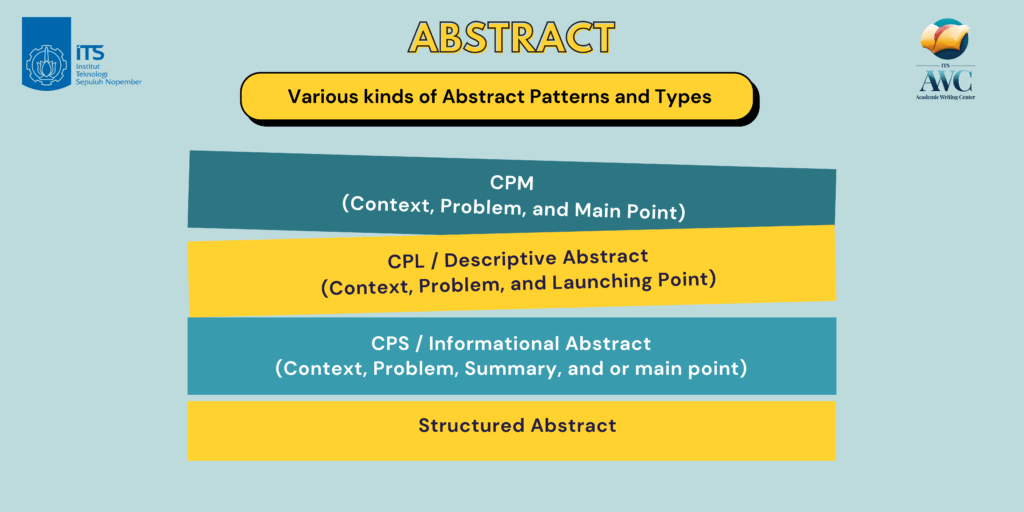
Berdasarkan polanya, ada tiga jenis abstrak: CPM (Konteks, Masalah, dan Poin Utama), CPL (Konteks, Masalah, dan Titik Peluncuran), dan CPSM (Konteks, Masalah, Ringkasan, dan Poin Utama) (Booth et.al, 2016). Ketiga pola abstrak ini menggunakan konteks dan masalah sebagai latar belakang untuk memperkenalkan mengapa studi tersebut penting. Namun, CPM berakhir dengan poin utama yang mungkin mencakup tujuan dan hasil studi (Baca Contoh Abstrak 1). Di sisi lain, pola CPL tidak memperhitungkan bagian hasil, melainkan memiliki tujuan dan metode/tahapan untuk menarik pembaca. Tidak adanya bagian hasil dapat membuat pembaca penasaran untuk terus membaca makalah (Baca Contoh Abstrak 2). Berbeda dari yang pertama dan kedua, pola CPSM mencakup semua komponen (Konteks, Tujuan Masalah, Metode, Hasil, dan Poin Utama) sebagai ringkasan (Baca Contoh Abstrak 3); penulis lain mungkin mengenalnya sebagai abstrak informatif. Ada juga jenis abstrak lain yang diklasifikasikan berdasarkan cara penyusunannya: abstrak terstruktur. Abstrak ini dapat dibedakan dengan mudah dari abstrak lain karena cara penyusunannya. Abstrak ini memiliki label sebelum setiap bagian (misalnya Latar Belakang, Metode, Hasil, dan Kesimpulan). Beberapa jurnal mungkin meminta penulis untuk membedakan setiap label menjadi beberapa baris atau paragraf sementara jurnal lain mungkin masih ingin menggabungkan label tersebut menjadi satu paragraf abstrak (Lihat Contoh Abstrak 4). Semua penulis harus mencatat bahwa struktur abstrak harus selalu mengikuti pedoman jurnal, konferensi, atau penerbit.
Contoh Abstrak 1
CPM: Konteks, Masalah, dan Poin Utama
Studi tentang perilaku perlindungan diri sapi perah yang menderita serangan serangga diptera penting untuk mengevaluasi lingkungan pemuliaan dan pemuliaan selektif sapi (konteks penelitian sebelumnya). Praktik saat ini untuk mengukur perilaku perlindungan diri sapi perah sebagian besar adalah dengan observasi manusia, yang tidak hanya membosankan tetapi juga tidak efisien dan tidak akurat (masalah). Dalam makalah ini, kami menunjukkan bahwa sistem pemantauan otomatis berdasarkan analisis video dapat lebih efektif menganalisis perilaku perlindungan diri sapi perah dan lingkungan hidup dalam proses pemuliaan dan manajemen sapi perah (poin utama).
Contoh di atas dimodifikasi dari Li Jia, et.al. (2018).
Contoh 1 dimulai dengan konteks dari penelitian sebelumnya dan diikuti oleh masalah situasi ideal. Berdasarkan masalah, penulis memberikan solusi sebagai poin utama. Poin utama juga mencakup hasil studi “effectively analyse” (menganalisis secara efektif). Dengan kata lain, abstrak ini mencakup:
Pendahuluan (dari penelitian sebelumnya)
Masalah utama
Tujuan dan Hasil
Contoh Abstrak 2
CPL (Konteks, Masalah, dan Titik Peluncuran) atau Abstrak Deskriptif
Studi tentang perilaku perlindungan diri sapi perah yang menderita serangan serangga diptera penting untuk mengevaluasi lingkungan pemuliaan dan pemuliaan selektif sapi (konteks penelitian sebelumnya). Praktik saat ini untuk mengukur perilaku perlindungan diri sapi perah sebagian besar adalah dengan observasi manusia, yang tidak hanya membosankan tetapi juga tidak efisien dan tidak akurat (masalah). Dalam makalah ini, kami mengembangkan sistem pemantauan otomatis berdasarkan analisis video (tujuan). Pertama, disajikan algoritma pelacakan aliran optik yang ditingkatkan berdasarkan deteksi sudut Shi-Tomasi. Kemudian, algoritma deteksi digunakan untuk menghitung jumlah gerakan ekor, kaki, dan kepala dengan menggunakan jaringan saraf tiruan. Rentang akurasi ekor dan kepala dan tingkat perolehan kembali (recall rate) dianalisis. (Titik peluncuran / metode).
Contoh di atas dimodifikasi dari Li Jia, et.al. (2018).
Salah satu cara untuk membuat pembaca penasaran adalah menulis abstrak tanpa hasil. Namun, tidak semua jurnal atau penerbit menggunakan format ini. Selain itu, CPL dikenal sebagai abstrak deskriptif. Abstrak deskriptif tidak memberikan hasil dan kesimpulan dari penelitian. Ini menggabungkan kata kunci yang ditemukan dalam teks dan dapat mencakup tujuan, metode, dan ruang lingkup penelitian. Singkatnya, CPL mencakup:
Pendahuluan
Masalah Utama
Tujuan
Metode
Contoh Abstrak 3
CPS (Konteks, Masalah, Ringkasan, dan atau poin utama) atau Abstrak Informatif
Studi tentang perilaku perlindungan diri sapi perah yang menderita serangan serangga diptera penting untuk mengevaluasi lingkungan pemuliaan dan pemuliaan selektif sapi (konteks penelitian sebelumnya). Praktik saat ini untuk mengukur perilaku perlindungan diri sapi perah sebagian besar adalah dengan observasi manusia, yang tidak hanya membosankan tetapi juga tidak efisien dan tidak akurat (masalah). Dalam makalah ini, kami mengembangkan sistem pemantauan otomatis berdasarkan analisis video. Pertama, disajikan algoritma pelacakan aliran optik yang ditingkatkan berdasarkan deteksi sudut Shi-Tomasi. Dengan menggabungkan fitur morfologi gerakan kepala, kaki, dan ekor, metode ini secara efektif mengurangi jumlah titik Shi-Tomasi, menghilangkan gangguan dari gerakan latar belakang, mengurangi kompleksitas komputasi algoritma, dan meningkatkan akurasi deteksi. Algoritma deteksi digunakan untuk menghitung jumlah gerakan ekor, kaki, dan kepala dengan menggunakan jaringan saraf tiruan. Rentang akurasi ekor dan kepala mencapai [0.88, 1] dan tingkat perolehan kembali (recall rate) adalah [0.87, 1] (ringkasan / tujuan, metode, dan hasil). Metode yang diusulkan dalam makalah ini memberikan pengukuran objektif yang dapat membantu peneliti untuk lebih efektif menganalisis perilaku perlindungan diri sapi perah dan lingkungan hidup dalam proses pemuliaan dan manajemen sapi perah. (poin utama/ kesimpulan)
Contoh di atas diambil dari Li Jia, et.al. (2018).
Tidak seperti Contoh Abstrak 1 dan 2, abstrak CPS mencakup semua elemen yang mungkin Anda temukan dalam makalah lengkap. CPS mencakup ringkasan tujuan, metode, dan hasil. Ini diakhiri dengan poin utama atau kesimpulan. Poin utama yang termasuk dalam Contoh 1 dan 3 serupa karena keduanya memberi tahu pembaca tentang apa yang akan mereka temukan dalam makalah. Yang merupakan poin utama dari apa yang ingin diketahui pembaca sebelum memutuskan untuk membaca teks lengkap atau tidak. Kesimpulannya, abstrak CPS mencakup:
Latar Belakang
Masalah utama
Tujuan
Metode
Hasil Utama
Kesimpulan
Contoh Abstrak 4: Abstrak Terstruktur
Tujuan: Tujuannya adalah untuk mengevaluasi penggunaan sumber daya perpustakaan berbasis Web oleh mahasiswa kedokteran tahun ketiga.
Pengaturan/Peserta/Sumber Daya: Mahasiswa kedokteran tahun ketiga (147) dalam rotasi perawatan primer multidisiplin dua belas minggu di komunitas dan pengaturan rawat jalan.
Metodologi: Survei pengguna individu dan analisis file log Situs Web digunakan.
Hasil/Luaran: Dua puluh topik sumber daya disusun menjadi sebuah situs web untuk memberikan mahasiswa akses ke sumber daya perpustakaan elektronik dari lokasi kepaniteraan berbasis komunitas mana pun. Topik sumber daya ini, yang mencakup mata pelajaran seperti hipertensi dan sakit punggung, dihubungkan ke masalah pelatihan kurikulum, artikel jurnal teks lengkap, pencarian MEDLINE, bab buku elektronik, dan Situs Web yang relevan. Lebih dari separuh mahasiswa (69%) mengakses Situs Web setiap hari atau setiap minggu. Lebih dari 80% berpendapat bahwa Situs Web adalah tambahan yang berharga untuk kepaniteraan mereka.
Diskusi/Kesimpulan: Sumber daya informasi berbasis Web dapat memberikan dukungan kurikulum kepada mahasiswa yang kesulitan dan memakan waktu untuk mengakses perpustakaan.
Contoh abstrak di atas diambil dari Tannery et.al. (2002)
Abstrak terstruktur memberikan label pada setiap bagian yang disertakan sehingga pembaca dapat dengan mudah menemukan apa yang mereka cari dalam sebuah makalah. Tidak ada label pasti yang harus dicantumkan dalam abstrak terstruktur. Persyaratan akan berbeda pada setiap konferensi atau jurnal.
Writing an Abstract
There are many ways in writing an abstract. You may need to find what is best for you because everyone has different techniques. One thing to note, you need to always start by finding the main ideas of every section (Introduction, Method, Result, Discussion, and Conclusion) you have in your full paper. Some different strategies of writing an abstract can be seen on the link below:
Bailey, Stephen. (2015). Academic Writing: A Handbook for International Students (4th ed). Routledge.
Booth, C.W., Colomb, G.G., Williams.M.J., Bizup, J., & FitzGerald, T.W. (2016). The Craft of research (4th Ed.). Chicago: The University of Chicago Press.
Greene, S. & Lidinsky, A. (2015). From Inquiry to Academic Writing: A Practical Guide (3rd Ed). Bedford/St. Martin’s.
Jameson, A.R., & Kostinski, B.A. (2002). When is Rain Steady?. Journal of Applied Meteorology and Climatology. 41(1). https://doi.org/10.1175/1520-0450(2002)0412.0.CO;2
Li, Jia., Wu, P., Kang, f., Zhang, L., Xuan, c. (2018). Study on the Detection of Dairy Cows’ Self-Protective Behaviors Based on Vision Analysis. Advances in Multimedia, Vol. 2018. https://doi.org/10.1155/2018/9106836
Sirithunge, C., Buddhika, G.A., Jayasekara, P., & Chandima, P. D. (2020). An Evaluation of Human Conversational Preferences in Social Human-Robot Interaction. Applied Bionics and Biomechanics. Vol. 2021. https://doi.org/10.1155/2021/3648479
SJSU Writing Center.2020. https://www.sjsu.edu/writingcenter/docs/handouts/Abstracts.pdf
Tannery, N. H., Foust, J. E., Gregg, A. L., Hartman, L. M., Kuller, A. B., Worona, P., & Tulsky, A. A. (2002). Use of Web-based library resources by medical students in community and ambulatory settings. Journal of the Medical Library Association : JMLA, 90(3), 305–309.
Plagiarism is a serious issue in the academic field. It is critical to understand that plagiarism is the intentional use or copying of other people’s ideas or works (Swales & Feak, 2012). The video above is presented to help you understand what plagiarism is. As White mentions in the video, you can plagiarize unintentionally because you don't have enough understanding of plagiarism (ClickView, 2014). You also may deal with heavy consequences if you plagiarize someone, thus, you should understand and prevent plagiarism before you get yourself in trouble.
Degrees of Plagiarism
To help you understand more about plagiarism, some situations can be used as examples to identify how something can be identified as plagiarism. Some situations that can be considered as plagiarism may include one or several points from the following list taken from Bailey (2015):
Giving citation but only change a few words
Giving no citation to a copy-paste text
Giving no citation to classmates’ text/ paragraphs
Quoting and citing someone’s ideas without using quotation marks
Failing in self-citing previous work that has been published
Misspelling the author’s name
More information about plagiarism examples can be accessed here
With the aforementioned information and examples of plagiarism, you should have a better idea of what constitutes a plagiarism, particularly in the higher education. It is time for you to take extra precautions when dealing with the use of someone else’s work. Not to mention, plagiarism practice is detectable, especially when you find several writing styles in one paper, off-topic writing, unrelated citation to the writing topic, incoherent ideas, or give-away presence (Baggaley in Librero, 2012). An experienced reader, editors, or reviewers can easily spot plagiarism practice. You may get severe consequences if you are found to plagiarize someone.
Consequences of plagiarism
Knowing that plagiarism can be detected easily, we should not take the plagiarism issue lightly. Some consequences might occur because we fail to acknowledge someone. You may fail a course or even drop out of college if you deal with plagiarism issue (Bailey, 2015). I believe that no one wants to have such experience. Some links below will help you understand the consequences of plagiarism more:
Many prior research reveal that students lack the information required to understand plagiarism and how to avoid it (Voelker et al, 2012; Probett, 2011). This condition is certainly common among beginner writers. To help you avoid plagiarism, there are some principles adopted from Turabian (2013) that you need to note:
Use quotation marks to indicate other people’s ideas
Cite every source you use to indicate that the ideas are not yours
Do not patchwriting or paraphrase too closely
Avoid being ignorance or innocent intentionally
More strategies for avoiding plagiarism can be read on the following websites
ClickView. (2014, May 23). What is Plagiarism. YouTube. https://www.youtube.com/watch?v=-SoAISJrULw
Bailey, Stephen. (2015). Academic Writing: A Handbook for International Students (4th ed). Routledge.
Librero, F. Felix. (2012). Writing Your Thesis: A Practical Guide for Students. University of the Philippines Open University
Probett, C. (2011). Plagiarism prevention. Business Communication Quarterly, 74(2), 170-172.
Swales, M.J., & Feak, B.C. (2012). Academic Writing for Graduate Students: Essential Skills and Tasks (3rd Ed.). University of Michigan Press
Turabian, L. Kate. (2013). A Manual for Writers of Research Papers, Theses, and Dissertations. Rev. Ed. The University of Chicago Press
Voelker, T., Love, L., & Pentina, I. (2012). Plagiarism: What they don’t know. Journal of Education for Business, 87(1), 36-41.
Meilisa Sindy Astika Ariyanto. September 11, 2021.
Citation
One way of avoiding plagiarism is citing. Citation is an acknowledgment or credit given to someone else's idea that we use (Librero, 2012). Citation is one method of avoiding plagiarism and a critical idea in maintaining academic integrity. You are being honest with other people's works by ensuring that you have correctly cited someone because “other people's ideas are treated as an intellectual property” (Geyte, 2013, p.101). Therefore, properly citing others' works will help you prevent plagiarism, acquire the trust of your readers, and gain scientific or social value (Booth et.al., 2016). To cite properly, you have to understand in-text citation and reference word to refer to someone's else idea.
In-text citation
One way of citing a source is using in-text citation. In-text citation can be defined as putting citation “immediately after the source material—whether it’s a quotation, paraphrase, or summary” (Texas A&M University Writing Center, n.d). One thing to keep in mind is that the citation should adhere to a specific citation style, such as MLA, APA, or IEEE. Before submitting to a journal or conference, it is best to read the author guidelines. You can visit some websites below to assist you distinguishing various citation styles.
Reporting verbs are used to refers to someone’s works. It is a common practice in the academic writing field. Reporting verbs can be written in the present tense to indicate a recent work or past tense to indicate an older source (Bailey, 2015). An example of reporting verbs can be seen in the following examples
Carla & Margareth (2021) describe …..
Lagnan (2020) supports……..
Dorothy (2019) discovers……
Notice the bold words on the examples above (state, supports, and discovers). These words are the examples of reporting verbs. The reporting verb “describe” for example, is used to simply state Carla’s & Margareth’s statement about something. Meanwhile, “supports” is used to state Lagnan’s belief or agreement over something. To conclude, different reporting verbs might have a different intention, thus, knowing different verbs and their meaning is useful to help you use them correctly. Some links below provide many lists of reporting verbs that you can use in your writing:
Bailey, Stephen. (2015). Academic Writing: A Handbook for International Students (4th ed). Routledge.
Booth, C.W., Colomb, G.G., Williams.M.J., Bizup, J., & FitzGerald, T.W. (2016). The Craft of research (4th Ed.). Chicago: The University of Chicago Press.
Geyte, V.E. (2013). Writing: Learn to Write Better Academic Essays. Harper Collins Publishers.
Librero, R. F. (2012). Writing Your Thesis: A Practical Guide for Students. UP Open University.
Meilisa Sindy Astika Ariyanto. August 28, 2021.
Quotation
Quoting is another method of avoiding plagiarism. According to Geyte (2013), quotation refers to utilizing someone else's precise words in a quote, often known as direct speech in English grammar. Different from paraphrasing or summarizing, quotation is using the exact author's words without any attempt of summarizing or paraphrasing. However, it should be mentioned that the quotation should also include the citation. If you fail to properly cite your sources, you may face plagiarism charges. Furthermore, remember to utilize the relevant citation format (MLA, APA, IEEEE, etc.). The following example shows how to incorporate a quotation into a passage.
Example of quotation in APA style in-text citation format:A beginner writer might be clueless about the importance of citation in writing. Anna (2019) also mentions that “80% of freshmen in a university fail to understand the importance of citing a source”. One of the reasons mentioned by Damian (2019) is “copying and pasting have been a cultural practice in a country”. For more rules of the citation formatting, visit the links below
Before you quote, you should understand why you are quoting someone's exact words. You can utilize a quotation If you are dealing with one of the following circumstances mentioned by Bailey (2015):
“When the original words express an idea in a distinctive way”. Sometimes, we do not want to lose the essence of the words that have been put together by a writer because of the way the ideas are expressed. In this case, a straight quotation is appropriate. However, you must make sure that you can frame these words or sentences well in your writing.
“When the original is more concise than your summary could be”. When you attempt to make a summary or paraphrase, you may find it hard to make your words as concise as the original words, hence, quoting the original words or sentences can be the best option.
“When the original version is well known”. A quotation is particularly useful when quoting a famous quote or scientific result of a researcher. However, familiarity cannot be a reason for you to choose a quotation for the importance is the idea that you are quoting.
Basic rules in quoting
When you know what source you want to quote, you can begin by copying the exact word to your writing. However, there are some basic rules you must adhere to in quoting. Adopted from Greene & Lidinsky (2015), here are some basic rules that you can follow:
Take an active stance. The quotation is for you to justify your argument.
Do not quote only a line or two that can distort the whole point of another person’s idea.
Inform your reader about the quotation you are using by showing how the quotation can relate to your argument (for a long quotation that is usually written in blockquote; more than 3 or 4 lines).
Using the quotation blended with the grammar of your writing if you use short quotations (only one or two lines).
Use punctuation to attach quotations (for short quotations).
Bailey (2015) adds to use reporting or reference verb (example: state, claim, or agree, etc.) in quoting.
The punctuation rules in quoting
Besides the rules above, there are some punctuation rules you must follow in quoting. Please refer to the punctuation rules taken from Bailey (2015) below:
A long quotation can be written in a smaller font or in a block quote that does not require quotation marks
If some words are deleted, use “……” (without the quotation marks) to indicate what is missing
If some words are inserted, put the words inside of these [….] marks
A double quotation is used when there is a quotation inside of a quotation
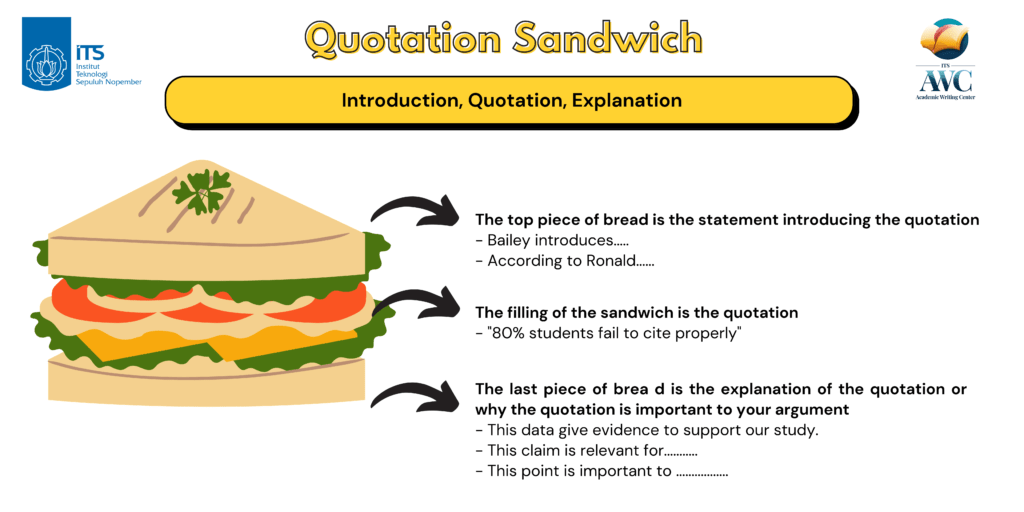
Quotation sandwich is a term that refers to a way of framing a quotation in your text. Three elements make up a quotation sandwich: (1) the introduction sentence, (2) the quote, and (3) the explanation of the quote (Graff & Birkenstein, 2018). Some examples of quotation sandwich (in APA citation style) are as follow
Railey (2015) also makes a claim further by saying that “………………”
According to Railey (2015), “………….…..”. His suggestion is in line with our…..
As a prominent figure in the education field, Railey (2015) puts it “…………………”
For other resources about quoting and quotation sandwich, please refers to some links below
Bailey, Stephen. (2015). Academic Writing: A Handbook for International Students (4th ed). Routledge.
Geyte, V.E. (2013). Writing: Learn to Write Better Academic Essays. Harper Collins Publishers.
Graff, G. & Birkenstein, C. (2018). They say I say: The Moves that Matter in Academic Writing (4th Ed.) W.W Norton & Company.
Greene, S. & Lidinsky, A. (2015). From Inquiry to Academic Writing: A Practical Guide (3rd Ed). Bedford/St. Martin’s.
Meilisa Sindy Astika Ariyanto. September 8, 2021.
Paraphrasing
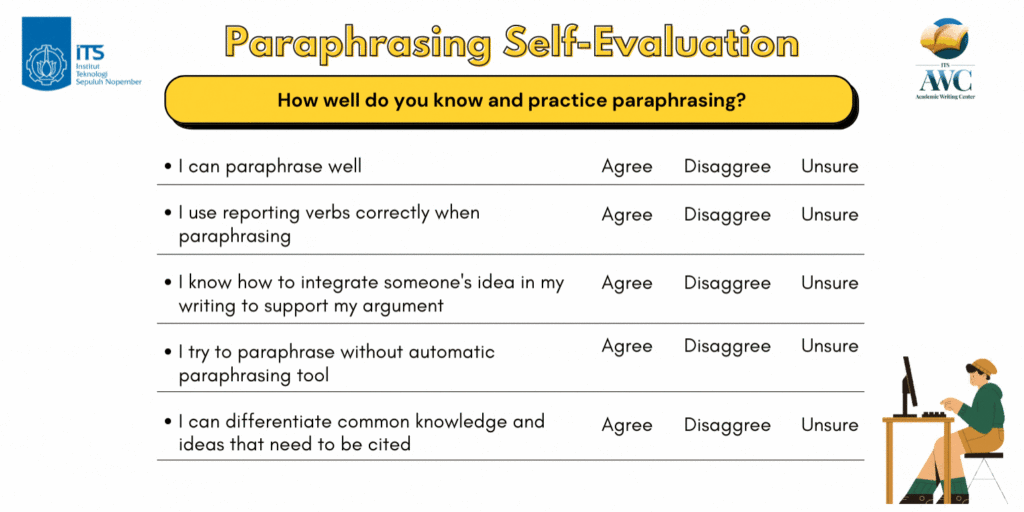
Paraphrasing or better known as indirect quotations means writing someone’s idea using our own words. It's critical to maintain the original text's or thoughts' meaning when paraphrasing. Richard & Schmidt (2010) also defines paraphrasing as writing with different words/phrases. Although we use our own words to express the original ideas, paraphrase does not always result in a shorter text (Hirvela & Du, 2013). It should be noted that paraphrasing is different from summarizing. Finally, a correct citation to credit the author needs to be included(Monash University, n.d). Plagiarism could occur if you don't cite your sources properly.
What paraphrasing is not:
Paraphrasing is not patchworking (Klements, 2021).
Paraphrasing is different from direct quotation (Wallwork, 2011).
Common knowledge does not need to be paraphrased (The Writing Center; the University of Wisconsin-Madison, n.d)
Technical words do not need to be paraphrased (Wallwork, 2011)
When to paraphrase:
If you are dealing with facts or definitions (Monash University, n.d; Wallwork, 2011).
If you want to develop your idea or make a more persuasive text (Hirvela & Du, 2013).
How to Paraphrase:
The list below shows tips to paraphrase
Read the original text.
Make notes on the important words or technical words while reading.
Close the original text so you can focus on writing with your own words.
Try to state what you have read using your own words. Use the list of important words to help you.
Write it down using your own words.
You may want to proofread, edit, and revise your text.
Do not forget to cite.
To help you edit your paraphrased text, some tips adopted from Wallwork (2011) below can be used.
Using synonyms, for examples:
Claim (verb)→ synonym → argue or assert
Liquid (Noun) → synonym → fluid
Changing part of speech, for example from a verb to noun or noun to adjective
Analyze (verb)→ analysis (Noun)
Classify (verb) → classification (Noun)
Changing nouns or pronouns from singular or plural
Changing the verb-form, for example, help → helping /helped
Changing from personal to impersonal style
Reversing the order of the ideas
If you need more tips to paraphrase and understand more about paraphrasing, consider to visit some links below:
Hirvela, A., & Du, Q. (2013). 'Why am I paraphrasing?': Undergraduate ESL writers' engagement with source-based academic writing and reading. Journal of English for Academic Purposes, 12(2), 87-98. https://doi.org/10.1016/j.jeap.2012.11.005
Klements, Kurtis. (2021). Patchworking.https://purdueglobalwriting.center/2021/01/29/patchwriting/
Richards, J.C., & Schmidt, R.W. (2010). Longman Dictionary of Language Teaching and Applied Linguistics(4th Ed). Pearson Education.
The Writing Center; University of Wisconsin-Madison. (n.d). Quoting and Paraphrasing. https://writing.wisc.edu/handbook/assignments/quotingsources/
Wallwork, Adrian. (2011). English for Writing Research Papers. New York: Springer. Springer.
Meilisa Sindy Astika Ariyanto. August 11, 2021
Cohesion
Have you ever read a paragraph or text and had the impression that the ideas between the sentences are jumping and unconnected? In that case, there might be a cohesion issue in the text. Cohesion in a text gives the flow and directs our readers to follow our ideas. Lexically, a text with cohesion means it sticks together by reference words or conjunction (Bailey, 2015). Cohesion is important as it can direct our readers to follow our arguments easily. Lacking cohesion on a text, on the other hand, can confuse your reader and decrease the readability of your text. Thus, it is critical to improve the text cohesiveness.
"An Introduction of Cohesion in Academic Writing" by AWUC (2015). The video can be seen from AWUC YouTube Channel
Enhancing Cohesion
Cohesion can be enhanced using several strategies such as using reference words, conjunction, repeated words/ideas, or ellipsis. The video above explains how you can enhance your cohesion using a pronoun, lexical signpost, repetition, or anaphoric nouns (AWUC, 2015). Two common methods are discussed further below.
1. Using reference words (Bailey, 2015)
Some examples of reference words are he, she, their, it, these, their, etc. Let’s look at the Sample texts belowSample text 1:“During the COVID-19 emergency, many different human activities have been strongly modified or banned. The pandemic has made many people around the world stay at home at some point in time, strongly limiting actions and unfortunately personal freedom. These restrictions have been necessary to save lives” (Caniato et.al., 2021)Notice how the words “these restriction” are used. It refers to the idea of the previous sentences. It sticks and joins the sentences together because it clear to the readers that “these restriction” refers to the banned activities during the covid-19 pandemic limiting people and their freedom. Sample text 2:“Velcro is a fabric fastener used with clothes and shoes. It was invented by a Swiss engineer called George de Mestral. His idea was derived from studying the tiny hooks found on some plant seeds. They cling to animals and help disperse the seeds. Velcro has two sides, one of which is covered in small hooks and the other in loops. When they are pressed together, they form a strong bond” (Bailey, 2015)The paragraph above shows a connection between the sentences by using the reference words (underlined). Instead of repeating the word Velcro in the second sentence, the writer replaces it with "It" to refer to the Velcro. Secondly, instead of writing the name of the engineer in the third sentence, the writer uses simply "his", to show that he refers to him. It is important to note that you can use reference words if what you want to refer to is clear and the reader can easily spot it.
2. Conjunction or linking words
Linking words are used based on their language functions. For examples:
Because, as a result, or therefore are used to show cause and effect
However, although, or but are used to show opposition or contrasting ideas
In addition, and, or furthermore are used to show addition
These words can be used to make your sentences stick together, thus, enabling the readers to follow your logical flow easily. An example of using these in a paragraph can be seen below.Sample Text 3:“Previous studies estimated a wide range of uncertainty in premature deaths attributed to ambient air pollution (AAP) from residential energy use of between 73,000 and 511,000 (ref. 15). However, none of these studies looked at how residential emissions of air pollutants or mortality are distributed across households or trace other emissions sources to the household consumption that triggers them. As a result, it is unclear how the contribution of households to AAP compares to the mortality risks that they face from.” (Rao et.al., 2021).
Other strategies of enhancing cohesion can be access through the following links:
Bailey, Stephen. (2015). Academic Writing: A Handbook for International Students (4th ed). Routledge.
Caniato, M., Bettarello, F. & Gasparella, A. (2021). Indoor and Outdoor Noise Changes due to the COVID-19 Lockdown and their Effects on Individuals’ Expectations and Preferences. Scientific Reports, 11, 16533. https://doi.org/10.1038/s41598-021-96098-w
Rao, N.D., Kiesewetter, G., Min, J. et al. (2021). Household Contributions to and Impacts from Air Pollution in India. Nat Sustain. https://doi.org/10.1038/s41893-021-00744-0
Meilisa Sindy Astika Ariyanto. September 17, 2021.
Coherence
Coherence must be improved in order to build unity in a text. If cohesion relates to how smoothly your thoughts flow from one sentence to the next, coherence refers to how logically structured and presented your ideas are. A paragraph can have cohesion but lack coherence. For example:
Sample Text 1Automated Writing Evaluation (AWE) tools have become increasingly popular, especially in the educational field. Many university students in Indonesia, for example, have begun to use AWE to help proofread and edit their article journal drafts. It happens because of AWE’s automated feedback, explanation of errors, and user-friendly services. If they find writing important, they might find many issues in writing. Thus, many students find this tool to be needed in enhancing their drafts. The above sample paragraph discusses AWE and how it has grown popular in educational field. To discuss the topic and make the paragraph cohesive, some reference and linking words are used such as, because of, if, these, and thus. Despite using some cohesive devices, this paragraph is not coherent. Try to find the reason why the italic sentences cause the paragraph to be lack of coherence. Consider watching the video below to help you find the answer.
“Coherence in Writing” by Mometrix Academy (2023). The video can be seen from this link
Enhancing Coherence
To create unity and coherence in your text there are three ways adopted from Greene & Lidinsky (2015) that you can refer to:
“Use details that follow logically from your topic sentence and maintain a single focus”. Sample Text 1 shows the opposite of this strategy. You can maintain unity and coherence in your text by focusing on one main idea in each paragraph. Remove or revise the supporting details that do not resonate with the main idea.
“Repeat keywords to guide your readers”. Repeating keywords is done to let your readers know that the sentences are connected and united to the same idea. Sample text 1 can be one example of this strategy. You can notice how the word AWE is used in the paragraphs.
“Use transition words to link ideas from different sentences”. Similar to Cohesion, achieving coherence can be done by using transition or linking words such as because, although, however, in addition, furthermore, etc. One thing to be noted, these wordshave different language functions. You might make your text incoherent by using these words incorrectly.
For more strategies in creating coherence in your text, visit the links below:
Greene, S. & Lidinsky, A. (2015). From Inquiry to Academic Writing: A Practical Guide (3rd Ed). Bedford/St. Martin’s.
Skillcourse. (2019, October 12). Cohesion & Coherence. YouTube. https://www.youtube.com/watch?v=TDUgsLZzTTI
Meilisa Sindy Astika Ariyanto. September 21, 2021.
What is a paragraph? “A paragraph is a group of sentences that deal with a single topic" (Bailey, 2015). This single topic is better known as a topic sentence. Many scholars would put this sentence at the beginning of their paragraphs, however, as Booth et.al. (2016) suggest, the topic sentence can appear at the last sentence of the paragraph as well.
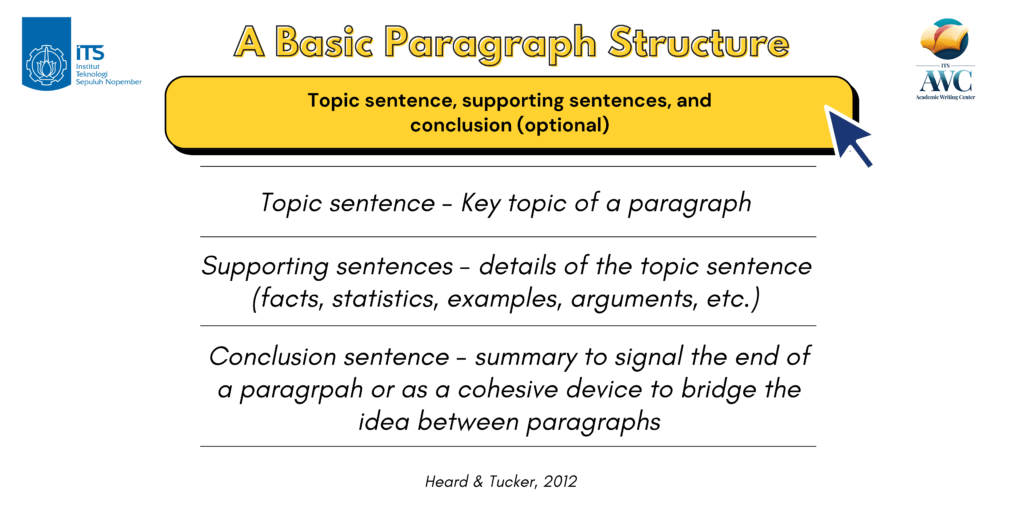
When you are a beginner writer, it might be difficult to develop a paragraph, not to mention a whole academic paper. You might also get overwhelmed to write many paragraphs without any guidance and experience. Therefore it is crucial to understand how a paragraph can be developed starting from knowing the parts of a paragraph. In writing a paragraph, there is a common structure used such as topic sentence, supporting sentence, and concluding sentence (Heard & Tucker, 2012).
Topic sentence
A topic sentence is the main idea of a paragraph. It is important to understand that one paragraph covers one topic sentence that is developed from the main idea. Mostly, the topic sentence appears at the beginning of the first sentence of a paragraph. Adopted from Heard & Tucker (2012) there are 3 kinds of topic sentences:
Too general.
Example: Exercise is very beneficial.
This topic sentence is considered too general because there are various exercises that it is impossible to be explained all in one paragraph.
Too specific
Example: Doing plank for thirty minutes a day will strengthen your cardio-vascular system by thirty percent.
This topic sentence is considered too specific because there is a possibility that there is nothing to say to support this sentence.
Adequate
Example: There rate of car ownership varies across social status in India.
This topic is considered adequate as you can develop this with the variation mentioned in the topic sentence.
Between the three examples, the adequate topic sentence certainly is the desired one. Some links below can help you learn to develop your topic sentence:
Supporting sentences are more specific than the topic sentence. These sentences are developed based on the topic sentence; thus, you cannot put new ideas that do not belong to the topic sentence. Some details that you can put to develop the supporting ideas, such as:
Details of the main idea
Statistics
Examples
Opinion/ argument
Literature review
Some ideas to develop these details into your paragraph can be accessed through the following links:
A Concluding sentence is used to signal the end of your paragraph. It is optional and does not have to be written in every paragraph. In an academic paper, we might find the concluding sentence in the last paragraph the Introduction section, or possibly in the literature review. Having a concluding sentence can help you summarize your points or as a cohesive device that can link your idea to the next paragraph (The University of Sydney, n.d). Overall, some links below can be used if you want to enhance your skill in writing a paragraph
Bailey, Stephen. (2015). Academic Writing: A Handbook for International Students (4th ed). Routledge.
Booth, C.W., Colomb, G.G., Williams.M.J., Bizup, J., & FitzGerald, T.W. (2016). The Craft of research (4th Ed.). The University of Chicago Press.
Meilisa Sindy Astika Ariyanto. August 31, 2021.
Presenting your Research Paper
There are a few things to consider before giving a presentation at an international conference. If you're attending a conference for the first time, you might be frustrated by the fact that you only have 15-20 minutes to present your entire work. To interest your listeners in a short amount of time, meticulous and prepared planning is therefore required. You must also recognize that the audience at a conference differs from that of readers. To present your work orally, you'll need to take a different strategy. For example, use an attractive and easy to listen to approach in presenting points clearly and briefly for each section of your paper
The essence of your paper
You might not be able to present all the things in your paper, so focus on the essence of the sections (Introduction, Method, Result, etc.) in your presentation. Here are some points adapted from Turabian (2013) that can be used
Introduction which may include the aim, problems why the aim is stated that why, and rationale of why you need to address the problem or what conceptual advantages your solution might have to the body of the knowledge
Summary of sub-argument if the argument is too big.
Summary of the method and stages using SmartArt graphics or figures
Summary of result and discussion
The practical or theoretical contribution of your research
Limitation of your study and future research suggestion
Originally, Turabian (2013) mentions three focuses such as:
Introduction which may include a brief literature review, Question, Consequences of not knowing an answer, Claim, and reasons,
Summary of sub-argument,
Methodology and how it solves the problems
You might also use these original points for your presentation, especially if you have a shorter time to present. In conclusion, your presentation should be clear, explicit, and brief yet organized. “Arrange your ideas coherently and express your ideas vividly” (Barker, 2010). Instead of putting a long text in your presentation, create phrases that describe each point above using points, bullets, or SmartArt graphics.
Preparation for the Presentation
After you have the essence of your paper ready, you can prepare:
Notes or cards for your presentation slides. Don't scribble down every single word you're going to say. At this point, you should be prepared to give a discussion and know every detail of your study report. The purpose of the note is for you to remind yourself of the critical facts that you could forget.
Possible questions your audience might ask. It’s not a bad idea to think about some questions your audience might ask about your presentation. This activity might also be beneficial for you to hone your critical skills. If you're worried of getting questions, practice with your friends so you can be more prepared. It also might reduce your nervousness and fillers (um, mmhm, I think, so, well, etc.)
Presenting for listeners
Unlike your writing, your presentation is more informal, so there are some considerations that you might use when presenting:
Use a variation of pitch and tone (Tuhovsky, 2018). Your presentation should be engaging, even in tone, because you don’t want to make your listeners bored. Varying your tone and pitch may also suggest that you are not reading a text in front of you. It also shows that you are ready and master the content.
Make eye contact with your audience (Barker, 2010). It is important that you notice the audience instead of looking at your presentation material all the time because your audience is also a part of your presentation.
Use gestures and movements (Barker, 2010). Using gestures and moving around the room while presenting can energize the session. But using too many gestures or moving around many times, especially in a formal academic presentation, is not appropriate.
Ask one or two questions to your audience. In my experience, asking your audience question is one way of involving your audience in your session. The question, however, should not be too difficult to answer. For example, you can do a quick live poll to ask whether the audience knows a certain problem in your research domain.
Do not use language for writing because Language for writing and speaking are different. Don’t be too stiff as if you are reading your paper. You can address yourself using “I” or “we” and use some informal style such as the abbreviated forms of “don’t” or “shouldn’t”. You may also use some colloquial words and expressions such as “a lot of" or "thing".
References
Barker, A. (2010). Improve your communication skills (2nd Ed.). KoganPage.
Turabian, L. Kate. (2013). A Manual for Writers of Research Papers, Theses, and Dissertations. (Rev. Ed.). The University of Chicago Press.
Tuhovsky, I. (2018). 21 Days of Effective Communication: Everyday Habits and Exercises to Improve Your Communication Skills and Social Intelligence. Positive Psychology Coaching Series.
Meilisa Sindy Astika Ariyanto. Oktober 21, 2021
[vc_wp_calendar]
Unduh dokumen Daftar Periksa Pengoreksian di sini
Video Daftar Periksa Pengoreksian oleh Ms. Caroline Ward terdiri dari 4 bagian: Pembukaan & Dasar-dasar, Organisasi, Konten, dan Mekanika.
Click the + sign to access the links for each topic