Smart Eco Campus



"A high-quality education should be an area where universities excel. Education is a key gateway out of inequalities, especially multi-generational ones. In addition to improving quality of life, access to inclusive education can help equip locals with the tools required to develop innovative solutions to the world’s greatest problems." (THE Impact Rankings)
Institut Teknologi Sepuluh Nopember (ITS) guarantees inclusive, equitable, and borderless quality education by granting open access to foundational academic resources, digital platforms, and campus research facilities for external communities. By eliminating institutional barriers, ITS equips professionals, educators, independent researchers, and lifelong learners with structured knowledge repositories, certified online short courses, and open academic literature.
Access myITS Open Learning Portal and Online Certification Catalog
ITS actively breaks institutional barriers to higher education by providing free, publicly accessible academic short courses through its central learning management platform, myITS Learning. Available to lifelong learners, industry practitioners, and non-enrolled students worldwide, the portal hosts comprehensive instructional video modules and competency evaluations across foundational domains including Computer Science, Data Analytics, Maritime Engineering, Structural Design, and Pedagogy.
Strengthening its open digital curriculum, ITS incorporates international joint learning frameworks such as the Erasmus+-supported SustainaBlue initiative from the Department of Biology, launching dedicated Massive Open Online Courses (MOOCs) focused on sustainable aquaculture, blue bio-economy innovations, and seafood traceability. Completing these modular open curricula provides participants with formal credentials, certifying actionable competencies that directly enhance public workforce employability and technological literacy.
 Figure 1: MyITS Learning Logo.
Explore Public Membership Services and Open Scientific Repositories at ITS Library
The ITS Library serves as an open intellectual hub for the broader civic community, accommodating independent scholars, industry researchers, and local residents through formal external public membership services. Registered external users are granted on-site access to campus reading halls, technological workstations, reference archives, and specialized document reproduction equipment across multiple library floors, promoting equitable literacy throughout East Java.
In addition to physical equipment utilization, ITS systematically curates and maintains open-access institutional repositories, granting unpaywalled digital access to undergraduate and postgraduate theses, non-restricted research monographs, and community-service proceedings. This policy ensures that the technological innovations generated across university laboratories directly support regional enterprise development and grassroots scholastic endeavors without paywall barriers.
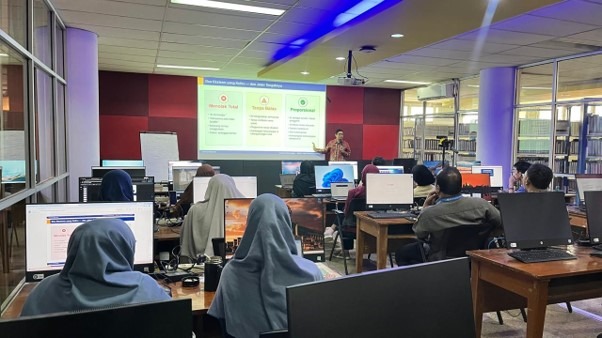 Figure 2: Open scholarly access, digital research workshops, and public workstation facilities at ITS Library.
Read News Report: Medical Technology Showcase and Open Health Device Initiative at Innovatech Medika
In response to national technical shortages in clinical instrumentation, the Department of Medical Technology, within the Faculty of Medicine and Health (FKK) ITS, releases educational design documentation, instructional prototypes, and technical catalogs for unhindered public access. Showcased during the Innovatech Medika exhibition, student-engineered prototypes are converted into standardized open-access references for clinical workers, device manufacturers, and health polytechnic students.
Primary educational resources include digital compendiums and web-based instructions for maternal emergency tools such as the Uterine Balloon Tamponade (UBT) system, designed specifically for primary healthcare clinics (Puskesmas) in remote rural areas. By providing openly downloadable design blueprints, clinical handling protocols, and barcode-integrated instructional manuals, ITS equips external health practitioners with actionable life-saving technical knowledge without royalty or registration overheads.
 Figure 3: Dean of FKK ITS, Dr. Lukman Hakim, M.Kes., Sp.U(K), Ph.D., visits the Uterine Balloon Tamponade (UBT) innovation booth at the Innovatech Medika Vol. 1 event.
Institut Teknologi Sepuluh Nopember (ITS) serves as a dynamic public academic forum by regularly hosting diverse educational events, scientific conferences, and technology exhibitions on campus that are accessible to the wider community. By opening its laboratories, auditoriums, and convention venues to primary and secondary school students, educators, industry professionals, and the general public, ITS bridges academic knowledge with civic society to stimulate continuous intellectual growth and national technological capability.
Read News Report: Ministry of Communication and Digital Partners with ITS to Establish AI Talent Factory | Read News Report: Strengthening AI Ecosystem, ITS Inaugurates 1,000 National AI Ambassadors
In strategic collaboration with the Ministry of Communication and Digital (Komdigi) Republic of Indonesia and the East Java Provincial Education Agency, ITS convened the AI Talent and Innovation Day (ATID) 2025 at Grha Sepuluh Nopember ITS. The university-hosted summit gathered over 1,300 primary, junior high, and senior high school students alongside hundreds of educators from across East Java to foster ethical and productive computational literacy in an era dominated by artificial intelligence.
The public event marked the national inauguration of the 1,000 AI Ambassadors program, celebrating 977 students and teachers from 290 schools who successfully completed rigorous digital readiness coaching. Concurrently, ITS held an open technology exhibition showcasing working prototypes including the RAISA Humanoid, Smart Robotic Dogs, and immersive Virtual Reality (VR) pedagogical modules, alongside handing over comprehensive school AI policy guidelines to regional educational authorities to democratize responsible technological adoption.
 Figure 1: Handover of the Institutional AI Policy Guidelines to the East Java Provincial Education Agency during ATID 2025 at Grha Sepuluh Nopember ITS.
Read News Report: Baronas 2025 Fosters Robotics Creativity and Innovation for the Broader Community | Read News Report: WRO Indonesia 2025 Promotes Youth Robotics Innovation at ITS
Demonstrating its leadership in mechatronics, ITS hosted two premier national robotics events open to public learners and academic institutions nationwide. The 2025 National Robotics Competition (Baronas), organized by the Department of Electrical Engineering, attracted 1,141 participants ranging from elementary school students to university scholars across Indonesia, competing in five dynamic engineering tracks—Line Follower Analog and Microcontroller, Transporter, Sumo, and Robotic Soccer—as well as an SDG-centered Paper Competition.
Complementing this, the ITS Center for Mechatronics and Industrial Automation (PUI MIA) staged the World Robot Olympiad (WRO) Indonesia 2025 at the ITS Robotics Center. Involving 142 youth teams divided into elementary, junior, and senior categories, the multi-day tournament integrated hands-on Arduino and Lego robotic assembly clinics with open-mission challenges. The public championship served as a springboard for qualifying youth teams to represent Indonesia on international engineering stages.
 Figure 2: Primary school students testing automated functional prototypes during the World Robot Olympiad (WRO) 2025 at the ITS Robotics Center.
Read News Report: Mahfud MD Emphasizes Character Leadership for Golden Indonesia 2045 at ITS | Read News Report: RDK 46 ITS: Asma Nadia Advocates for Enhanced Community Reading Literacy
Promoting continuous social and ethical literacy, the 46th Ramadan di Kampus (RDK 46) organized a series of open public lectures hosted at the Manarul Ilmi Mosque, situated within the central ITS campus. Designed for both the campus populace and surrounding residential communities, the program provided an inclusive forum to examine contemporary national governance, ethical leadership, and character formation. Former Coordinating Minister for Political, Legal, and Security Affairs Prof. Dr. Mohammad Mahfud MD delivered a public address addressing constitutional mandates, judicial integrity, and holistic higher education.
Broadening the thematic scope toward civic literacy in the digital era, prominent author and cultural activist Asma Nadia led an interactive public session focusing on critical media consumption and reading habits. The lecture highlighted the central role of women in shaping literate, morally grounded families capable of navigating online misinformation. These open mosque-based forums served as accessible educational spaces that advanced public dialogue beyond conventional lecture halls.
 Figure 3: Keynote speaker Prof. Dr. Mohammad Mahfud MD alongside public attendees and academic leadership during the RDK 46 Public Lecture at Masjid Manarul Ilmi ITS.
Organized by the Department of Mathematics, the 18th ITS Mathematics Olympiad (OMITS 18th) and the Mathematics ITS Calculus Competition (MISSION 9.0) mobilized 1,864 participants from elementary schools, junior and senior high schools, and universities across 18 regional zones nationwide. The hybrid structure combined 6 virtual nodes with 12 decentralized testing centers across Indonesia, concluding with grand finals and masterclasses at the ITS campus.
Beyond competitive testing, OMITS 18th featured dedicated public engagement agendas such as the "Emerald Path" interactive forum. This initiative engaged primary and secondary students in educational logic games and interactive problem-solving clinics, while providing secondary educators and collegiate participants with open analytical discussion sessions to master advanced calculus concepts and mathematical modeling.
Figure 4: Award ceremony for the junior high school category champions alongside the Head of the ITS Department of Mathematics at OMITS 18th.
Read News Report: Procommit V15 at ITS Nurtures Hundreds of Regional Digital Talents
Highlighting long-term educational partnerships with regional schools, the ITS Information and Communication Technology Applied Program (Prodistik) held the Procommit V15 championship at the ITS Robotics Center. The event convened 476 students and supervising teachers representing 29 partner senior high schools (SMA/MA) across East Java and the Special Region of Yogyakarta, celebrating competencies built across five semesters of applied IT instruction.
The public competition featured seven applied digital tracks, including Excel Programming, Low-Code Application Development, Infographic Design, User Generated Content, and Smart Robotics, alongside an open Final Project Exhibition. The event also incorporated Training of Trainers (ToT) clinics for visiting secondary school teachers, ensuring sustainable pedagogical development and bridging the digital divide across non-metropolitan educational institutions.
 Figure 5: Secondary school students participating in the Excel Programming track at the Procommit V15 championship held at the ITS Robotics Center.
Read News Report: TEDxITS 2025 Inspires Youth to Build Ambitions through Resilience
Organized under an official license from the global TED organization, TEDxITS 2025 convened an interdisciplinary audience at the ITS Research Center Auditorium under the guiding concept "Ideas Worth Spreading." Centered on the theme "House of Cards," the annual public conference explored psychological resilience, personal reinvention, and social innovation, offering a reflective intellectual space for youths and external attendees.
The program brought together eight prominent thinkers, cultural icons, and medical professionals—including psychiatrist dr. Andreas Kurniawan, SpKJ, and traditional master performer Didik Nini Thowok. Speakers delivered curated discourses on the Japanese philosophy of wabi-sabi, emotional antifragility, and grassroots cultural preservation. The forum engaged registered community participants in constructive dialogue on personal and societal development.
 Figure 6: Invited speaker delivering a presentation on mental resilience and personal development during TEDxITS 2025 at the ITS Research Center Auditorium.
Institut Teknologi Sepuluh Nopember (ITS) drives regional economic resilience and workforce capability by hosting rigorous vocational training and executive education programs on campus. Open to job seekers, industrial technicians, commercial food operators, and school administrators, these market-oriented short courses translate university laboratory expertise into certified, practical competencies that expand lifelong career pathways and foster inclusive community employment.
Read News Report: ITS Enhances East Java Workforce Competency through SMAW Welding and Safety Training | Read News Report: Industry-Standard Marine Welding Training for Vocational Students at Tekmanpro Lab
Addressing regional post-pandemic unemployment and industrial skills shortages across East Java, the Department of Mechanical Engineering and the Department of Naval Architecture opened their university laboratories to deliver certified industrial welding courses. Utilizing the Production Engineering Laboratory and the Ship Production Technology and Management Laboratory (Tekmanpro), the programs provided intensive, industry-grade instruction covering Shielded Metal Arc Welding (SMAW), welding groove fabrication, weaving bead techniques, and butt-joint welding.
Structured with an 80% practical and 20% theoretical ratio, the cohorts targeted individuals affected by layoffs, local job seekers, and vocational high school (SMK) students from Surabaya, Gresik, Sidoarjo, Kediri, Jember, and Pamekasan. Beyond core mechanical execution, the curriculum enforced rigorous Occupational Health and Safety (Welding Safety) standards, equipping participants with verifiable vocational qualifications to enter shipyard manufacturing or establish independent fabrication enterprises.
 Figure 1: Hands-on Shielded Metal Arc Welding (SMAW) and industrial safety session conducted at the Production Engineering Laboratory, Department of Mechanical Engineering ITS.
In structured collaboration with the Surabaya City Government, the ITS Halal Center organized a two-day certified capacity-building program titled "Food Hygiene and Sanitation Competency Training for Food Business Managers and Handlers" at the ITS Research Center Auditorium. The vocational short course directly supported compliance with Ministry of Health Regulation No. 14 of 2021, which mandates formal hygiene certifications for commercial culinary operators and food handlers.
The university-hosted training certified 214 public food service workers, including campus canteen vendors, culinary tourism center (SWK) micro-entrepreneurs, wet market meat vendors, and local restaurant managers. Facilitated by chemical engineering and food safety specialists, the curriculum delivered actionable vocational guidance on environmental maintenance, clean food production workflows, cross-contamination prevention, and microbiological hazard control to elevate urban food standards.
The Department of Materials and Metallurgical Engineering (DTMM) at the Faculty of Industrial Technology and Systems Engineering (FTIRS) ITS conducted an intensive vocational short course on "Enhancing 3D Printing Object Quality" in partnership with industrial manufacturer PT Tridiku Teknokarya Indonesia. Held at Assembly Hall MT 204 and the ITS Manufacturing Metallurgy Laboratory, the workshop resolved technical bottlenecks commonly faced by local small-and-medium enterprises (SMEs) in rapid prototyping.
Attended by industry practitioners, micro-enterprise technicians, and educational instructors, the program integrated engineering theory with practical laboratory trials. Participants mastered polymer material behaviors, slicing configuration adjustments, and post-printing chemical and thermal treatments to optimize surface quality, geometric precision, and mechanical strength, directly transferring academic research to commercial manufacturing workflows.
 Figure 3: Technical presentation on polymer materials and additive manufacturing parameter optimization at the Department of Materials and Metallurgical Engineering ITS.
To eliminate the administrative digital divide within grassroots educational institutions, the Intelligent Information Management Laboratory at the Department of Informatics ITS conducted a vocational short course on digital portal administration and Online Student Admission (PPDB) management. Held at Aula Prof. Handayani, the training targeted administrative staff and educators from partner early childhood and kindergarten (TK) institutions across Surabaya.
Participants completed applied computer laboratory sessions covering web layout management, secure content updating, and online registration database monitoring. By replacing traditional manual paperwork with automated digital intake mechanisms, the course equipped educational administrative workers with essential digital competencies, enhancing transparency, institutional credibility, and operational productivity.
 Figure 4: Informatics instructors mentoring preschool and kindergarten educators in digital portal management at Aula Prof. Handayani, Department of Informatics ITS.
Access Tekno Sains Academy Professional Short Courses and Certification Catalog
Operating under PT ITS Tekno Sains, the Tekno Sains Academy (TSA) functions as the university's permanent executive education and professional upskilling unit. TSA offers programmed, non-degree short courses and professional certifications specifically structured for corporate executives, engineering practitioners, and external job seekers seeking continuous professional development in fast-evolving industrial disciplines.
The academy provides certified training in Occupational Health, Safety, and Environment (OHSE/K3), applied project management, digital business analytics, and industrial automation compliant with national certification frameworks (BNSP). Through recurring cohorts and executive workshops, TSA bridges academic innovation with corporate skill standards, serving as a pillar of ITS' lifelong professional learning ecosystem.
Institut Teknologi Sepuluh Nopember (ITS) extends its educational expertise beyond campus boundaries through structured community outreach, specialized school clinics, inclusive assistive training, and student-run volunteer schemes. By deploying faculty, researchers, and multidisciplinary student teams directly into rural public schools, special education foundations, remote villages, and vocational academies across East Java, ITS actively dismantles geographical and socioeconomic barriers to deliver inclusive, high-impact learning for all.
Read News Report: ITS Enhances Rural Literacy Culture through Thematic Community Service in Nglinggo | Read News Report: Interactive Literacy Drives Revitalize Reading Enthusiasm for Candirejo Village Youths
Conducted under formal institutional curriculum frameworks and aligned with strategic site recommendations from the National Library of Indonesia (Perpusnas), ITS deployed structured cohorts of the Thematic Community Service (KKN Tematik Literasi) to underserved rural jurisdictions across Nganjuk Regency, East Java. Stationed for an intensive 20-day residential immersion in locations such as Nglinggo Village (Gondang District) and Candirejo Village (Loceret District), student teams tackled systemic educational deficits and low reading engagement among primary and junior high school pupils.
The initiative combined physical educational infrastructure development—refurbishing the Bougainville and Candiboto village libraries with interactive spatial layouts—with pedagogical interventions. Collegiate facilitators instituted recurring reading clinics (MEHAKA), creative literature and expressive writing workshops (Dongeng Pena), educational cinema screenings, and personalized afternoon foundational literacy circles. By training village librarians and local women's welfare cadres (PKK), the program established permanent community-managed reading ecosystems.
 Figure 1: Primary school children participating in interactive reading and group discussion sessions organized by the ITS Thematic Literacy Community Service team at Bougainville Library, Nganjuk.
Reflecting autonomous student-led civic dedication, the Manarul Ilmi Mosque Student Congregation (JMMI ITS) organized and executed the annual JMMI Mengajar 2025 educational scheme. Mobilizing an entirely volunteer collegiate contingent comprising 23 committee members and 11 student instructors from diverse engineering and science disciplines, the team spent six intensive days in residency at Pondok Pesantren Modern Nurus Sa'adah in Sidoarjo, an independent grassroots Islamic boarding school currently undergoing educational revitalization.
The volunteer curriculum blended foundational STEM competencies with character development, guiding primary and junior secondary boarding students through interactive mathematics exercises, water rocket aerodynamics workshops, and creative scientific experiments alongside religious studies. The self-funded, student-driven framework exemplifies how university youth associations actively apply collegiate leadership to bridge educational disparities in neighboring peripheral communities.
 Figure 2: One of the student instructors explained quantitative material to the participants as part of ITS students’ contribution to improving numeracy literacy
Addressing physical learning barriers experienced by students with physical and cognitive disabilities, the Department of Biomedical Engineering at ITS conducted specialized off-campus capacity building at the Mutiara Hati Autism and Special Education Foundation in Sidoarjo. The initiative targeted educators and assistive caregivers managing students diagnosed with cerebral palsy (CP), where severe muscle stiffness and limited mobility frequently disrupt daily classroom engagement and personal development.
Led by biomedical engineering faculty, the clinical outreach introduced specialized electrotherapy units (Combo Electrotherapy Device R-C101F), training teachers on precise electrode placement and frequency regulation across two electrical stimulation modalities: Transcutaneous Electrical Nerve Stimulation (TENS) for sensory neuromodulation and Neuromuscular Electrical Stimulation (NMES) for controlled muscle contraction. Educators were also equipped with standardized daily motor tracking logs, ensuring tailored and safe therapeutic integration within special needs classrooms.
 Figure 3: Biomedical engineering faculty conducting clinical simulations of TENS and NMES electrotherapy devices with special education teachers at Yayasan Pendidikan Autis Mutiara Hati Sidoarjo.
Recognizing the vulnerability of southern coastal East Java to tectonic hazards, the Department of Geophysical Engineering executed an educational outreach program titled "Kelas Inspirasi Kebumian" (Earth Science Inspiration Class) across Sumbermanjing Wetan District, Malang Regency. Hosted at the auditorium of SMP Negeri 2 Sumbermanjing Wetan and extending into the surrounding rural jurisdictions of Sumberagung and Argotirto villages, the initiative translated geophysical research into accessible civic education.
Collegiate researchers and faculty integrated physical geoscience demonstrations, interactive fault simulation models, geological hazard posters, and field mapping workshops to educate secondary school students and village administrators on landslide precursors, subterranean vulnerabilities, and groundwater conservation. Combined with ground-penetrating radar (GPR) and gravity surveys conducted by students, the outreach equipped local communities with foundational scientific knowledge to construct localized disaster mitigation plans.
 Figure 4: Geophysical Engineering students delivering participatory natural hazard mitigation and earth science education to students at SMPN 2 Sumbermanjing Wetan, Malang.
To align secondary vocational schooling with the demands of the national manufacturing industry, the Department of Mechanical Engineering conducted a comprehensive off-campus training program on Reverse Engineering for students and vocational instructors at SMK Brawijaya Batu, East Java. The outreach introduced secondary technical students to precision methodologies for digitizing, re-engineering, and fabricating automotive components to reduce industrial reliance on imported parts.
Facilitated by university lecturers and laboratory technicians, the curriculum guided students through laser 3D optical scanning to capture complex physical components, digital surface cleaning to eliminate point-cloud noise, parametric redrawing using Computer-Aided Design (CAD) software, and slicing into machine G-code. Participants concluded the training by operating additive manufacturing 3D printers and verifying the dimensional tolerance of produced prototypes against original industrial components.
 Figure 5: Students at SMK Brawijaya Batu conducting hands-on 3D laser surface scanning under the mentorship of the ITS Department of Mechanical Engineering outreach team.
Institut Teknologi Sepuluh Nopember (ITS) guarantees inclusive, equitable, and non-discriminatory lifelong learning opportunities across all institutional activities. Supported by statutory academic senate regulations and executive directives, ITS legally ensures that educational platforms, campus facilities, and community training initiatives remain open and accessible to all individuals without bias.
ITS promotes inclusive and equitable lifelong learning opportunities, as stated in the Regulation of the Academic Senate No. 6 on Policy Direction of ITS Students Development. Enacted in 2017, this policy remains an active and core foundation for good governance and inclusive education at ITS today. This regulation continues to guide the university’s approach to fostering equitable access to learning and personal development opportunities across all academic faculties and departments.
Specifically, Section 5.9 "Field of Lifelong Learning Development" on page 8 explicitly mandates: “ITS provides a lifelong learning system to all, regardless of ethnicity, religion, disability, immigration status or gender through public lectures, community service trainings, and scholarship offers.” Serving as a living institutional document, this regulation ensures that capacity-building programs extend beyond the university community, integrating fairness, accessibility, and social responsibility into ITS’ enduring educational culture.
The Rector Circular Letter affirms ITS’ institutional commitment to maintaining a green and sustainable campus by integrating environmental responsibility with inclusivity and social welfare. The active directive establishes that sustainability at ITS must reflect not only ecological awareness but also social justice, non-discrimination, and accessibility for all members of the university community and visiting public learners.
In its section on Welfare and Social Life, the Circular Letter explicitly dictates: “No member of the academic community shall be discriminated against or subjected to acts of violence based on religion, ethnicity, race, gender, or disability. ITS upholds the values of equality, humanity, and justice in all aspects of campus life, including education and human resource management.” This principle is reinforced through scholarship and subsidy programs for diverse socioeconomic backgrounds, alongside the sustained development of disability-friendly campus facilities that guarantee equal participation in lifelong learning.