Smart Eco Campus


"SDG 16 and 17 explore some of the underlying factors that are needed in order to ensure delivery of the other SDGs. Peace and Justice go hand in hand and indeed are vital for equity between people and countries. Supporting this we need our institutions to be strong enough to maintain a focus on delivering the SDGs. This can range from individual justice eradicating modern slavery and people trafficking to ensuring that our countries have the evidence base needed to react appropriately to crises." (THE Impact Rankings)
 Chairman of ITS Board of Trustees, Prof Dr Ir Mohammad Nuh DEA (left), greets the attending delegates of the PTN-BH Board of Trustees
Institut Teknologi Sepuluh Nopember (ITS) guarantees and protects student autonomy through the formal recognition of democratic student governing bodies across all institutional tiers. By integrating representative student parliaments into campus policy dialogues, providing substantial leadership scholarship endowments, and supporting grassroots community initiatives, ITS fosters an inclusive academic ecosystem where student unions exercise independent leadership, defend student welfare, and drive progressive social transformation.
Demonstrating adherence to democratic governance, ITS officially formalized the operational mandates of student self-government during the inauguration of 101 Student Organizations (Ormawa) for the 2025 administrative period. Supervised by the Directorate of Student Affairs (Ditmawa), this statutory structure recognizes autonomous legislative and executive bodies, including the Student Representative Council (Badan Legislatif Mahasiswa / BLM), the Student Executive Board (Badan Executive Mahasiswa / BEM), Faculty Student Boards, Departmental Student Associations (HMD), and the Student Activity Institute (Lembaga Minat Bakat / LMB).
Operating under full democratic autonomy, these bodies formulate independent constitutions, conduct campus-wide democratic elections, and provide critical student perspectives directly to university leadership regarding tuition policies, campus facilities, and academic curricula. The university bolsters this governance partnership by integrating organizational workflows into the centralized myITS digital platform, providing physical office headquarters, and conducting managerial capacity building to preserve institutional accountability and ethical leadership across all student governing councils.
 Figure 1: Official inauguration of 101 autonomous student organizations (Ormawa) at the ITS Postgraduate Auditorium, establishing formal executive and legislative student governance.
ITS recognizes that meaningful student representation requires robust socioeconomic backing and structural protection. To ensure that financial hardship does not impede student advocacy and civic participation, the university disbursed the Future Leader Scholarships (Beasiswa Pemimpin Masa Depan) during the Ormawa Awards assembly. Managed through the ITS Endowment Fund Management Agency (LPDA), the grant provided IDR 7.5 million in direct academic funding to 50 active student executives holding strategic leadership roles in campus unions.
Beyond direct scholarship subsidies, student unions receive institutional budget allocations to execute independent welfare advocacy. Unions manage peer mental health networks, academic tutorials for junior cohorts, legal consultation desks for housing rights, and emergency student welfare funds. By securing the financial autonomy and logistical stability of elected student leaders, ITS safeguards an equitable governance framework where diverse student cohorts can participate actively in institutional administration.
 Figure 2: Vice Rector I Prof. Nurul Widiastuti conferring educational grants under the Future Leader Scholarship framework to support student union executives through the ITS Endowment Fund Agency.
Student organizations at ITS serve as prime drivers of social responsibility and civic engagement, extending academic knowledge into regional community development. During the annual Ormawa Awards celebration held at Plaza Dr. Angka, the university honored student unions for impactful social programs. The Environmental Engineering Student Association (HMTL) was awarded the Social Contribution Award for its grassroots empowerment, waste literacy campaigns, and clean water mapping in peripheral urban settlements.
The vibrant student ecosystem was further highlighted through public exhibitions featuring 18 student organizations, scientific research teams, and international student chapters. From academic reasoning clubs advancing scientific literacy to creative arts ensembles such as the ITS Choir (PSM) and debate societies, student unions independently design hundreds of cultural festivals, social volunteer initiatives, and public educational forums annually, anchoring ITS as an incubator for democratic engagement and societal welfare.
 Figure 3: Student representatives receiving honors at the Ormawa Awards 2025 in recognition of outstanding community empowerment projects, digital communication innovations, and civic outreach.
 Signing of the Digitalization MoU by Acting Vice Rector IV of ITS (left), and the Regional Secretary of North Morowali Regency, (right).
ITS demonstrates a clear commitment to stakeholder engagement through structured collaboration with local governments, communities, and civil society organizations. The university formalizes these partnerships via Memorandums of Understanding (MoUs), community service programs (Abmas and KKN), and policy development workshops. For instance, ITS collaborated with the Morowali Utara government to digitalize public services, conducted community digitalization programs in Gresik, and organized a policy brief training to enhance evidence-based policymaking. Additionally, ITS partnered with religious and civic institutions such as PWNU Jawa Timur in holding national forums to strengthen social harmony and public awareness. These initiatives highlight ITS’s systematic approach to identifying key external stakeholders and involving them in sustainable development dialogues. By aligning education, research, and community engagement with local needs, ITS exemplifies SDG 16.2.3’s vision of inclusive partnerships that drive transparent and responsive governance.
Source:
Institut Teknologi Sepuluh Nopember (ITS) enforces a zero-tolerance policy against bribery, extortion, financial misappropriation, and organized administrative crime across all operations. Operating under national Integrity Zone (Zona Integritas) benchmarks, the university safeguards public trust through rigorous financial reconciliation controls, institutional risk-management defense architectures, systematic procurement oversight, cybersecurity crime prevention, and verified public information transparency.
Demonstrating uncompromising fiscal compliance, ITS was awarded first place nationally in financial management performance by the Ministry of Finance (Kemenkeu) through KPPN Surabaya I. The university secured top honors as the best autonomous public university entity in Financial Statement Reconciliation and Budget Implementation Indicators (IKPA), meeting rigorous national parameters across budget absorption, payment dispatch verification, and strict regulatory compliance.
To eliminate conflicts of interest and procurement malfeasance, university executives and newly appointed administrators complete mandatory anti-fraud programs through the ITS Leadership Technical School focused on transparent fiscal governance. Administered by the Directorate of Strategic Planning and the Procurement Unit (UKPBJ), this curriculum trains administrators in automated budget allocation limits (Standar Biaya ITS), public competitive tender laws, and anti-bribery protocols. This institutional standard builds upon the pioneer FSAD Integrity Zone pact endorsed by the Directorate General of Higher Education, scaling corruption-free zone standards university-wide.
 Figure 1: Delegates from the ITS Finance Bureau receiving first-place accolades for financial reconciliation and budgetary integrity from the Ministry of Finance.
To systematically detect and intercept institutional malfeasance, ITS institutionalized the Enterprise Risk Management (ERM) framework during the Leadership Learning Series. Led by executive governance experts, the institutional framework equips university officers to construct operational risk maps and deploy proactive mitigation barriers against potential fraud, financial leakage, and procedural abuses.
The university structures its internal accountability through three distinct lines of defense: the Rector and department leaders serve as the first line directly managing operational integrity; the specialized Risk Management Unit acts as the second line monitoring compliance across academic units; and the independent Internal Audit Office (SPI) functions as the third line, conducting unannounced audits and evaluating statutory fiduciary controls. This interlocking oversight structure prevents unilateral authority and enforces continuous institutional checks and balances.
Addressing modern organized crime threats, ITS actively shields the campus community from sophisticated digital fraud networks, phishing syndicates, and data exploitation schemes. Through the Directorate of Technology Development and Information Systems (DPTSI), ITS deployed enterprise Multi-Factor Authentication (MFA), institutional credential firewalls, and active dark-web intelligence sweeps to secure employee and student personal records.
To preempt organized social engineering scams that target individuals during admissions and graduation cycles, the university instituted cybersecurity handbooks while pursuing international ISO 27001 information security certifications. Complementing digital barriers, the university established the ITS Legal Service Unit (ULH), providing free legal advocacy, formal investigation support, and protective counseling for campus members targeted by external syndicates or coercive cyber extortion schemes.
Recognizing public scrutiny as the primary safeguard against bribery and administrative corruption, ITS was designated as an "Informatif" Public Agency with an exceptional rating of 95.04 at the National Public Information Openness Awards. Conferred by the Central Information Commission (KIP), this rating represents the highest tier of government transparency, validating the institutional accessibility of university budgets, procurement outcomes, and administrative decrees.
This commitment is operationalized through the university Information and Documentation Management Officer (PPID) portal and regular civic engagements such as the Public Consultation Forum held in collaboration with national information commissioners. By establishing verifiable information classifications and clear public request protocols, ITS guarantees external civic visibility into institutional resources, eliminating secretive bureaucratic enclaves and fortifying democratic integrity across the institution.
 Figure 2: ITS Rector Prof. Bambang Pramujati displaying the National Public Information Openness Award certifying ITS as a fully transparent and accountable public institution.
To support and protect academic freedom in the campus environment, ITS provides Rector Regulation No. 32 Year 2020. As stated in Rector Regulation No. 32 Year 2020 Chapter 4, the ITS Rector guarantees and protects academic freedom, freedom of academic pulpit, and scientific autonomy carried out based on the provisions in Chapter 2 and Chapter 3.
In Chapter 2 Point 4, it is stated that each member of the ITS academic community has full freedom in:
ITS Surabaya publishes annual financial reports in addition to the annual institutional report. Each annual financial report is publicly accessible and audited by an Independent Auditor, classified as information available at any time under Central Information Commission Regulation No. 1/2010 concerning Public Information Service Standards.
Institut Teknologi Sepuluh Nopember (ITS) functions as an institutional policy advisor and technical think tank across municipal, provincial, and national tiers of government. Through specialized research centers, engineering task forces, and formal statutory partnerships, university scholars supply empirical evidence, regulatory frameworks, digital governance architectures, and strategic infrastructure designs that enable public authorities to modernize civic administration and resolve complex developmental challenges.
At the municipal and regency level, ITS translates emerging technologies into transparent civic governance tools. Through the Center for Industrial Development and Public Policy Studies (PSPI-KP) and the Indonesia Blockchain Centre ITS Chapter, the university partnered with the Surabaya City Government to deploy decentralized blockchain infrastructure for public licensing and municipal food supply-chain verification. Engineered to prevent land-permit tampering and track municipal rice reserves, this regulatory innovation earned joint international recognition when ITS and the Surabaya municipal administration received an award from the Dubai Blockchain Center for pioneering the GovChain Permit system.
Beyond metropolitan digital transformation, university engineering teams provide technical planning guidance to regional administrations addressing environmental sanitation and resource management. ITS formalized an advisory partnership with the North Central Timor (TTU) Regency Government in East Nusa Tenggara to design municipal solid waste and fecal sludge treatment roadmaps, complementing parallel environmental engineering assistance for Madiun City’s Waste-Free 2027 masterplan.
 Figure 1: ITS leadership and Surabaya municipal communication officials formalizing the implementation of blockchain governance for transparent public permitting and food security monitoring.
Across East Java Province, ITS advises regional policymakers on public-sector artificial intelligence adoption and inclusive socioeconomic development. Following a formal agreement signed with Governor Khofifah Indar Parawansa, the university expanded the provincial deployment of SENOPATI, an institutional generative AI platform integrated into East Java’s Smart Governance monitoring framework and public high school instruction. Previously proven during the 2025 East Java Student Admission System (SPMB), the multilingual virtual assistant processed regulatory admission guidelines and zoning quotas 24 hours a day to assist provincial education administrators and applicants.
In regional economic policy, ITS established the One Pesantren One Product Training Center (OPOP-TC) in partnership with the East Java Cooperative and SME Agency, formulating five standardized modules covering cooperative legality, halal certification, digital marketing, production mechanization, and sharia capital access. Concurrently, a seven-year policy partnership with the East Java Education Agency and UNICEF under the SMA Double Track program culminated in a MURI national record for catalyzing 1,600 student-run enterprises across non-vocational high schools.
 Figure 2: East Java Governor Khofifah Indar Parawansa reviewing the live architecture of the SENOPATI generative AI assistant developed by ITS for provincial student admission governance.
At the national level, ITS contributes specialized engineering guidance to defense, energy, and regional development ministries. Naval architects from the Maritime Science Techno Park completed the full structural design and sea-trial supervision of ADRI LIII, a 102-meter, 2,500-DWT Landing Craft Utility serving as the largest multipurpose warship in the Indonesian Army (TNI AD), engineered under strict Ministry of Defense class regulations. Building on this maritime defense mandate, the National Ship Design and Engineering Center (NaSDEC) convened the Indonesian Navy (TNI AL), PT PAL Indonesia, and international naval architects to formulate a roadmap for Indonesia’s first national Submarine Technology Development Center.
Supporting national decarbonization mandates under Presidential Regulations No. 22/2017 and No. 112/2022, ocean engineering faculty collaborated with state utility PT PLN and the National Energy Council (DEN) to release three national technical guidelines for marine energy development—covering Pre-Feasibility Studies, Feasibility Studies, and Engineering Design for tidal, wave, and ocean thermal power plants. Simultaneously, under a mandate from the Ministry of Transmigration, ITS deployed 228 researchers across 57 multidisciplinary Ekspedisi Patriot teams to 33 transmigration zones in 17 provinces to supply empirical spatial and economic policy blueprints.
 Figure 3: Principal designer Prof. Dr. Ir. Agoes Santoso conducting functional sea-trial inspections aboard the 102-meter ADRI LIII multipurpose warship engineered by ITS for the Indonesian Army.
Institut Teknologi Sepuluh Nopember (ITS) actively bridges academic research and public administration by delivering structured educational outreach, regulatory briefings, and technical upskilling for civil servants, regional regulators, and defense strategists. Through specialized policy workshops and hands-on simulation training across environmental law, climate adaptation, circular agricultural economics, and maritime security technology, ITS equips decision-makers with the analytical competencies required to formulate evidence-based governance.
To strengthen municipal regulatory capacity in addressing climate change and urban ecological degradation, the Department of Environmental Engineering conducted intensive technical capacity-building sessions for municipal government agencies (OPD) in Madiun City. Mobilizing experts from four specialized environmental laboratories, the training equipped local civil servants with operational competencies in Life Cycle Assessment (LCA) policy evaluation, ambient air pollution mitigation, domestic greywater treatment, and community-based 3R solid waste governance.
Addressing statutory compliance with Spatial Planning Law No. 26 of 2007—which mandates a minimum 30 percent allocation of urban Green Open Space (RTH)—ITS environmental remediation teams delivered regulatory outreach and botanical design training to the Bangkalan Regency Environmental Agency (DLH), introducing multi-tiered canopy structures and nocturnal carbon-absorbing Crassulacean Acid Metabolism (CAM) vegetation. At the national research policy level, ITS partnered with the National Research and Innovation Agency (BRIN) and The University of Queensland to convene a multi-stakeholder Climate Resilience Workshop, upskilling researchers and local practitioners in urban flood adaptation and grassroots climate governance frameworks.
 Figure 1: Head of the ITS Department of Environmental Engineering Dr. Susi Agustina Wilujeng leading an upskilling workshop on environmental management and waste regulations for Madiun municipal officials.
In the economic and food security sector, ITS equips agricultural policymakers with predictive data analytics to reduce national import dependencies and mitigate climate-induced harvest volatility. Led by researchers from the Department of Information Systems, the university organized policy outreach and technical training on the INESIK soybean circular economy platform for officials from the East Java Agriculture and Food Security Agency (Dipertak), the Livestock Agency (Disnak), and the Agricultural Modernization Implementation Center (BRMP).
During the hands-on briefing, regional agricultural officers and extension specialists were trained to utilize predictive supply-demand dashboards, climate-adjusted planting calendars, and interactive circular economy calculators to project regional production efficiency and farmer price margins. Building upon earlier regional data literacy programs under the East Java One Data initiative, these sessions enable provincial regulators to formulate responsive agricultural subsidies and resilient supply-chain interventions.
 Figure 2: Officials from the East Java Agricultural Modernization Center practicing predictive supply modeling and circular economy calculations on the INESIK platform during an outreach session.
Addressing national security, maritime law enforcement, and territorial conflict prevention, ITS provides specialized simulation training for defense educators and strategic analysts. Information systems researchers convened a technical demonstration and policy simulation workshop on the DAHANA App at the Indonesian Naval Technology College (STTAL) in Surabaya, engaging naval leadership including STTAL Commander First Admiral Dr. Mukhlis.
Designed to safeguard maritime sovereignty in the resource-rich and geopolitically sensitive North Natuna Sea, the DAHANA dashboard trains defense decision-makers to interpret real-time vessel early warning telemetry, evaluate territorial incursion scenarios, and test structured policy recommendations. Through interactive simulation exercises and collaborative policy forums embedded within the system, ITS strengthens institutional readiness and evidence-based strategic planning across national maritime defense bodies.
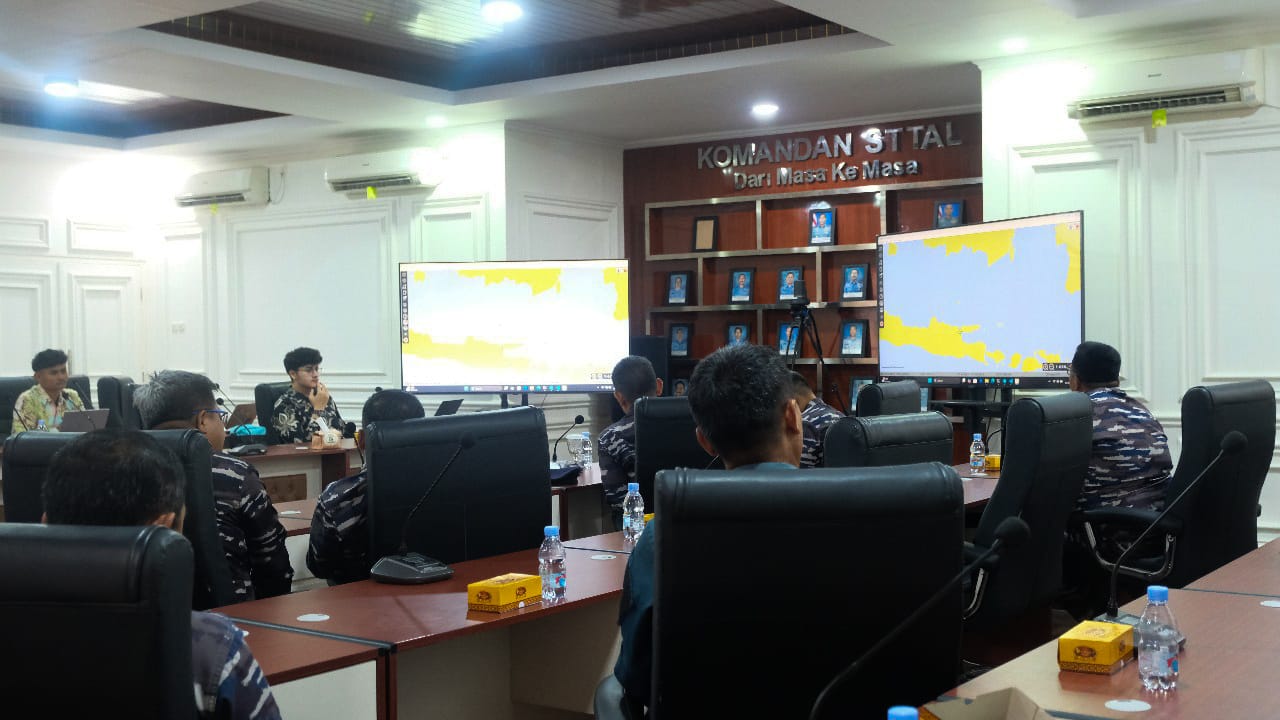 Figure 3: ITS information systems researchers and officers from the Indonesian Naval Technology College (STTAL) evaluating maritime situational modeling and policy response features on the DAHANA App.
Institut Teknologi Sepuluh Nopember (ITS) conducts policy-oriented scientific investigations in direct partnership with national ministries, legislative commissions, and state research agencies. By integrating university laboratories into national oceanographic expeditions, renewable energy standard-setting consortia, and higher education impact frameworks, ITS supplies empirical data and technical blueprints that guide state development agendas.
Advancing national marine governance and biodiversity conservation, ITS researchers joined the OceanX and National Research and Innovation Agency (BRIN) Collaborative Deep Sea Research Mission aboard the research vessel R/V OceanXplorer. Deployed across remote underwater seamount chains in North Sulawesi between December 2025 and January 2026, the expedition addressed six national research priorities spanning deep-sea genomics, oceanographic connectivity, benthic food webs, and deep-ocean carbon dynamics.
Specialists from the Departments of Geomatics and Geophysical Engineering led water-column profiling to locate active hydrothermal vents alongside high-resolution seafloor morphological mapping for geological hazard assessment. Through joint field data acquisition and methodological transfers with BRIN scientists, the expedition builds an empirical scientific baseline to inform Indonesia’s sustainable blue economy and deep-sea resource management policies.
 Figure 1: ITS geomatics and geophysics researchers participating in the OceanX–BRIN deep-sea exploration mission to map underwater seamounts and hydrothermal ecosystems in North Sulawesi.
Supporting statutory renewable electricity targets under Presidential Regulations No. 22/2017 and No. 112/2022, ocean engineering researchers partnered with state utility PT PLN (Persero) and the National Energy Council (DEN) to publish three national technical guidelines for marine energy deployment. Covering Pre-Feasibility Studies, Feasibility Studies, and Engineering Design, the regulatory manuals standardize site selection, socioeconomic evaluation, and grid integration for tidal current, wave, and ocean thermal power installations.
In industrial decarbonization, ITS operates alongside BRIN within the Taiwan–Indonesia Science and Technology Innovation Centre (STIC) consortium to research industrial waste valorization for low-carbon construction materials and public-building solar integration toward Indonesia’s Net Zero Emissions 2060 goal. These programs extend the university’s long-standing state research portfolio, which previously delivered the 75-percent domestic-component Red and White Electric Bus fleet in collaboration with the Ministry of Education, Culture, Research, and Technology and PT INKA.
 Figure 2: Ocean engineering lead researcher Prof. Ir. Mukhtasor presenting the three national marine energy planning guidelines developed with PT PLN and the National Energy Council.
Contributing directly to national higher education governance, an interdisciplinary ITS research task force formulated and launched the Commitment to Impactful Transformation in Society (COMMITS) policy evaluation matrix at the 2025 Indonesian Higher Education Summit (KPPTI). Unveiled jointly with the Minister of Higher Education, Science, and Technology (Mendiktisaintek) Prof. Brian Yuliarto, Director General Prof. Khairul Munadi, and Commission X Vice Chair of the House of Representatives (DPR RI) Lalu Hadrian Irfani, COMMITS establishes a standardized national benchmark for measuring societal returns from academic research.
Structured around five empirical evaluation clusters—community socioeconomic empowerment, widening educational access, problem-solving technological innovation, environmental sustainability, and national disaster response—the framework realigns university research outputs with the national Indonesia Emas 2045 development roadmap.
 Figure 3: Minister of Higher Education, Science, and Technology Prof. Brian Yuliarto, DPR RI Commission X Vice Chair Lalu Hadrian Irfani, and ITS leadership launching the COMMITS national impact assessment matrix.
Institut Teknologi Sepuluh Nopember (ITS) serves as an impartial, constitutionally protected civic forum where policymakers, grassroots advocates, industry leaders, and students engage in frank, evidence-based dialogue on complex societal challenges. Enforcing strict institutional neutrality that permits political and policy discourse exclusively through scientific deliberation without partisan mass mobilization, ITS provides a safe intellectual space to scrutinize public governance, mediate urban disputes, and co-design equitable policy solutions.
Operating under an institutional framework that permits political and policy discourse on campus strictly in academic and scientific formats, ITS empowers student bodies to convene critical debates on contested national agendas. Demonstrating this commitment, the Student Executive Board (BEM ITS) and the Business Management Student Association organized a public policy talkshow examining Indonesia’s Danantara sovereign wealth fund and global reciprocal tariffs.
Bringing together policy scholar Dr. Ir. Arman Hakim Nasution from the Center for Industrial Development and Public Policy Studies and corporate governance consultant Iman Supriyono, the forum provided an open space for students to question whether state investment consolidation strengthens trade diplomacy or introduces market distortions. Panelists and participants frankly debated institutional safeguards, emphasizing that public investment agencies must adhere strictly to transparency, accountability, and social responsibility rather than short-term political expediency.
 Figure 1: Head of the ITS Center for Industrial Development and Public Policy Studies Dr. Ir. Arman Hakim Nasution presenting an independent assessment of national trade diplomacy and sovereign investment governance during the BEM ITS public talkshow.
At the municipal governance level, ITS acts as an honest broker bridging institutional regulators and marginalized urban communities. The Department of Urban and Regional Planning (PWK) convened the Srawungzskuy civic dialogue on adequate housing rights in Surabaya, uniting officials from the Surabaya Housing, Settlement, and Land Agency (DPRKPP) with grassroots advocates from Community Architects East Java (Arkom Jatim).
Within this neutral academic setting, community advocates openly challenged bureaucratic land-titling barriers affecting 71 informal settlements on disputed land and 115,000 low-income residents living along railway corridors, contrasting commercial luxury apartment expansion against persistent housing backlogs. Municipal representatives responded directly by detailing public rental flat (rusunawa) allocations and substandard home upgrades, turning potential civic friction into constructive joint recommendations for inclusive urban land governance.
 Figure 2: Group photo of the speakers and participants at the Srawungzskuy event hosted by the Department of Regional and Urban Planning (PWK) at ITS.
Beyond external political and municipal debates, ITS maintains structured deliberative assemblies to ensure transparent dialogue between educators, students, and industry stakeholders. Under the leadership of Faculty of Vocational Studies Dean Prof. Dr. Wahyu Wibowo, the university institutionalized Rembug Vokasi as an open deliberative assembly for the entire vocational academic community.
Designed as a non-hierarchical forum for gathering ideas, voicing institutional feedback, and debating curriculum reforms, Rembug Vokasi aligns applied technical education with national industrial policies. By embedding open consultation across student-led policy talkshows, municipal mediation forums, and internal stakeholder assemblies, ITS upholds democratic deliberation as a core pillar of institutional governance.
 Figure 3: Faculty members, students, and stakeholders convening during Rembug Vokasi, an open deliberative forum for exchanging policy ideas and institutional feedback.