“Much of the world’s economy is based around producing things for consumption. This drives the engine of industry. If we want the world to develop sustainably, we need to understand how to be more responsible at both ends of this cycle. This means promoting resource and energy efficiency, having a sustainable infrastructure, and providing access to basic services for all.”
(THE Impact Rankings)
Operational measures
Ethical Sourcing Policy: Sustainable Practices for Food and Supply Procurement at ITS
ITS prioritizes the use of domestic products, supporting Micro, Small, and Medium Enterprises (MSMEs) through campus procurement. Partnerships are selected based on their commitment to environmentally friendly principles, ensuring fairness and transparency in sourcing practices (2024 Rector’s Circular Letter, Chapter: Economy).
ITS strives to provide campus food that aligns with environmental sustainability, choosing products from ethical, sustainable agriculture, livestock, and fisheries to meet high standards for health and sustainability (2024 Rector’s Circular Letter, Chapter: Health).
Safe and Responsible Hazardous Waste Disposal Policy at ITS
Temporary Medical Waste Storage: Medical waste, including used gloves and expired medications, is stored in designated containers and freezers, following strict packaging procedures. (SOP for Hazardous Waste and Wastewater Management)
Academic Waste Storage: Non-medical waste from laboratories is stored in labeled drums and containers and kept in sheltered areas to prevent contamination. (SOP for Hazardous Waste and Wastewater Management)
Transportation Collaboration: ITS collaborates with certified third parties for the collective transport of hazardous waste, scheduled each semester. (SOP for Hazardous Waste and Wastewater Management)
Temporary storage of non-medical waste, such as academic laboratory waste, is placed in labeled drums and containers according to the characteristics of each type of B3 waste. These are organized on shelves or in storage areas that have a roof and are protected from sunlight.
Waste Disposal and Recycling Policy at ITS
ITS is committed to minimizing waste sent to landfills by implementing structured waste management and recycling processes. Guided by the Waste Management Procedures at ITS, the policy includes key principles and practices that support environmental sustainability through comprehensive waste reduction and recycling strategies:
Waste Sorting Procedures: Waste is categorized into five types—organic, paper, plastic, residual, and specific waste—facilitating systematic sorting and recycling. This initial sorting process helps minimize the amount of waste that ends up in landfills. (Chapter II, Point 2.1)
Waste Collection and Transportation Procedures: Waste is collected and transported with a clear protocol to prevent mixing sorted materials, thus supporting recycling and reducing landfill contributions. Recyclable waste is directed to ITS' Waste Bank (TaSTe ITS) or composting facilities (Chapter II, Point 2.3)
Waste Processing Procedures: ITS operates a composting program that reduces daily organic waste by approximately 25%, significantly lowering landfill volume. Additionally, recyclable materials are processed through TaSTe ITS, where collected waste is categorized, weighed, and recorded before sale to recycling companies.(Chapter II, Point 2.4)
Furthermore, to support sustainable waste management practices, ITS implements waste reduction, segregation, recycling, and organic waste treatment programs. Food waste generated from campus canteens, dormitories, and other food service facilities is collected separately and processed through composting activities. Garden waste, including leaves, grass clippings, and other biodegradable landscaping residues, is managed through composting and organic waste treatment facilities. Composting activities are carried out at the Rumah Kompos ITS and supported by additional composting systems, enabling the campus to recover a substantial portion of its biodegradable waste while reducing dependence on landfill disposal.
Recyclable materials such as paper, cardboard, plastics, metals, and glass are managed through the campus waste bank program, Tabungan Sampah Terpadu (TaSTe). Through this initiative, recyclable materials are collected, sorted, and transferred to recycling partners for further processing. These recyclable fractions account for a significant portion of the campus waste stream and contribute to resource recovery efforts in line with circular economy principles.
Hazardous waste (B3 waste), which constituted approximately 1.29% of total waste generation, is managed separately in accordance with applicable environmental regulations and transferred to authorized third-party treatment facilities. Meanwhile, residual waste that cannot be recycled or composted is collected by the Facilities and Infrastructure Bureau and transported to the Temporary Shelter (TPS) located on Arif Rahman Hakim Road. Subsequently, the waste is transferred to the Benowo Final Processing Site (TPA Benowo), where part of the waste stream is utilized through a waste-to-energy system.
Through the integration of waste reduction, composting, recycling, and responsible final disposal, ITS continues to strengthen its commitment to sustainable campus waste management and the transition toward a circular and environmentally responsible university ecosystem. The overall waste management system and waste-flow mass balance are illustrated in the accompanying figure. The overall waste management system, including mass balance data, is illustrated in the accompanying figure.
Minimizing Plastic Use Policy at ITS
ITS addresses paper and plastic consumption through institutional policy, reusable alternatives, and digital services. The 2024 Rector's Circular Letter to ITS' Commitment as a Green and Sustainable Campus establishes measures to minimise disposable materials in procurement and campus activities. Its provisions extend to third parties and suppliers, connecting university purchasing decisions with wider efforts to prevent waste with the following key initiatives:
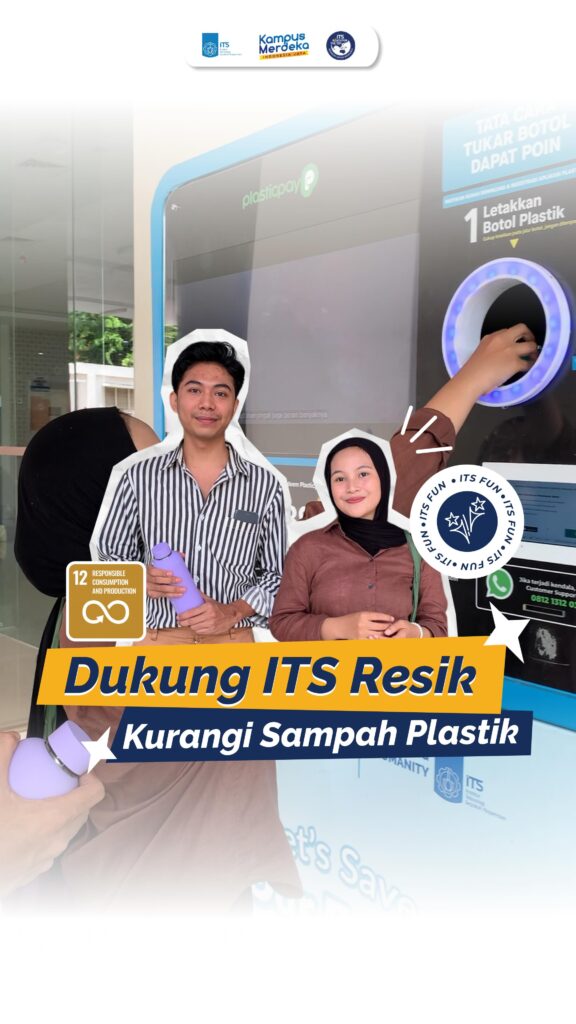
ITS encourages the reduction of single-use plastics in procurement, distribution, and disposal processes. (Chapter 8: Waste Management, Point B)
To minimize plastic bags, food containers, and beverage packaging in both on-campus and off-campus activities, ITS promotes the use of alternatives that are reusable and environmentally friendly. (Chapter 8: Waste Management, Point C)
ITS provides water dispensers and washable cups in workspaces and meeting rooms to reduce reliance on single-use plastic bottled water. (Chapter 8: Waste Management, Point D)
ITS promotes digital platforms for announcements and events, significantly reducing paper and plastic waste while enhancing communication efficiency. (Chapter 8: Waste Management, Point E)
To reduce disposable drinking-water packaging, ITS provides ready-to-drink water taps (Kran Air Siap Minum, KASM), promotes reusable tumblers, and encourages water dispensers and washable cups in offices and meeting rooms. Campus food establishments are encouraged to use reusable dining utensils and reduce plastic straws and other disposable items. Restrictions on single-use plastic bags and the promotion of bulk purchasing further support waste prevention at source.
Digitalisation complements these measures by reducing reliance on printed documents. Administrative services through myITS, research and community-service processes through simpel.its.ac.id, and digital financial reporting help replace paper-based workflows. The my.its.ac.id portal and other digital communication channels also provide alternatives to printed announcements and promotional materials. Where physical documents remain necessary, double-sided printing is encouraged. Used banners are collected for reuse where their condition permits.
Encouraging waste management efforts to reduce campus activity waste by implementing the 3R principles (Reduce, Reuse, Recycle) through waste sorting at the source, minimizing waste accumulation, recycling, and reusing generated waste. (Chapter 8: Waste Management, Point A)
ITS encourages the reduction of single-use plastics in procurement, distribution, and disposal processes. (Chapter 8: Waste Management, Point B)
To minimize plastic bags, food containers, and beverage packaging in both on-campus and off-campus activities, ITS promotes the use of alternatives that are reusable and environmentally friendly. (Chapter 8: Waste Management, Point C)
ITS promotes digital platforms for announcements and events, significantly reducing paper and plastic waste while enhancing communication efficiency. (Chapter 8: Waste Management, Point D)
Minimization of Disposable Items and Supplier Compliance at ITS
All tenants within the Main Canteen of ITS are required to reduce plastic and disposable items while ensuring that their offerings align with halal, safe, and health-focused standards. (Chapter II, Section: Tenant Obligations)
ITS regularly monitors both tenants and suppliers for adherence to this policy. Non-compliant vendors may face warnings or contract termination, maintaining high standards across the facility. (Chapter III, Section: Monitoring)
Minimization of Disposable Items and Outsourced Services Compliance at ITS
The Standard Operational Procedure for ITS Main Canteen on Sustainable Canteen Management: Halal, Safe, and Healthy Culinary Zone (Zona KHAS) policy exemplifies ITS’ dedication to minimizing environmental impact by extending sustainable practices to its supply chain. This policy mandates that all suppliers—including those providing equipment, packaging, and other operational essentials—adhere to ITS’s sustainability standards. These standards emphasize reduced plastic use, eco-friendly packaging, and support for local sourcing, thus minimizing waste and carbon emissions across ITS operations.
All suppliers must comply with ITS' plastic reduction policy. This includes minimizing the use of single-use and disposable items and prioritizing sustainable materials in packaging and other goods provided to ITS Main Canteen (Chapter III, Section: Ensuring Policy Implementation with Suppliers)
ITS encourages tenants and suppliers to source materials from local producers. This not only supports local economies but also reduces transportation-related emissions (Chapter II, Section: Tenant Obligations)
ITS actively monitors suppliers for adherence to sustainability requirements. Suppliers failing to meet these standards may face restrictions or discontinuation of contracts (Chapter III, Section: Monitoring)
Proportion of recycled waste
Waste Tracking and Management at ITS
ITS has implemented a comprehensive waste management system as mentioned in the Waste Management at ITS and Sustainability Report (2025). This approach includes initiatives to minimize waste and enhance tracking capabilities. Key waste management and tracking initiatives:
3R Waste Policy: ITS enforces a 3R (Reduce, Reuse, Recycle) policy across all departments. Each unit has a contractual obligation to reduce waste in accordance with ITS’ sustainability goals, ensuring that at least 50-75% of waste management activities adhere to this policy.
Source Separation and Composting: Waste is sorted into biodegradable, paper, plastic, and residual categories, with clearly labeled bins across campus. Organic waste, including food scraps and leaf litter, is composted at the ITS Compost House or processed with Black Soldier Fly larvae, generating nutrient-rich compost for landscaping and reducing landfill contributions.
Integrated Waste Savings (TaSTe ITS): The TaSTe ITS waste bank program encourages the ITS community to deposit recyclables like paper, plastic, glass, and metal. This initiative promotes waste recycling and allows participants to check their balance through an app, supporting a circular economy approach.
Final Processing and Waste-to-Energy Conversion: Residual waste is transported to a temporary storage facility, then sent to the Benowo landfill equipped with a waste-to-energy plant, converting waste into electricity. This ensures that even non-recyclable waste contributes to ITS’ sustainable energy goals.
Through these systems, ITS recycles over 89% of campus waste and promotes sustainable practices.
Publication of a sustainability report
Sustainability Report 2025
The Sustainability Report 2025 documents the university's extensive environmental initiatives, tracking progress in areas such as waste management, energy conservation, water conservation, and sustainable transportation. Published annually, the report provides a comprehensive overview of ITS' commitment to sustainability and demonstrates transparency and dedication to sustainable development across its operations.