About Us


Collection and Services
User Education
Published on
Thursday, 12 November 2026
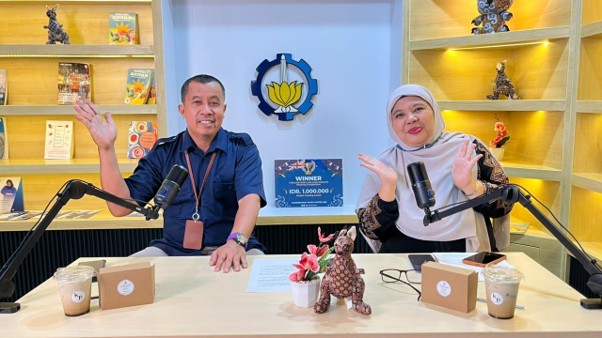
Surabaya – The Library of the Sepuluh Nopember Institute of Technology (ITS) continues to strive to increase the use of its repository as a means of both storing and disseminating the scholarly works of the academic community. This topic was discussed in an ITS Library podcast titled “Repositories for the Common Good: Ensuring Scientific Works Are Properly Documented and Can Be Used as References for the ITS Academic Community” on Thursday (November 12, 2026). The podcast, which was broadcast live on the ITS Library’s YouTube channel, featured Marsudiana, S.Sos., as the guest speaker and Eva Mursidah, S.I.Pust., as the host.
During the discussion, Marsudiana explained that a repository can be understood as a digital home that houses an institution’s scholarly works. Its function is not merely to store documents, but also to manage, maintain, organize metadata, and make it easier for those in need to find and utilize these works. Through proper management, scholarly works such as final projects, theses, and dissertations can serve as reference sources for future research. The existence of a repository also helps researchers track previous studies, thereby reducing the risk of duplicating research topics that have already been explored.
This podcast also discusses the ITS Repository’s access policies, which are aligned with institutional regulations. Currently, access to scholarly documents is governed by separate rules for the ITS academic community and the general public. Members of the academic community can obtain full-text access to documents through the applicable services, while the general public can view bibliographic information—such as titles, abstracts, and authors’ names—for collections with restricted access. In addition to access policies, the repository management process was also discussed, ranging from self-uploading by students, checking document completeness, to metadata validation before scholarly works are displayed on the repository page.
Marsudiana also highlighted the importance of ensuring that uploaded documents are complete and accurate so that the validation process can run more smoothly. Students are encouraged to read the self-upload guide and attend the information sessions organized by the library, and not to delay the upload process until the deadline is approaching. Meanwhile, she encouraged faculty members to contribute by depositing their scholarly works—such as conference papers, teaching modules, and research findings—into the repository. The more diverse the documented collection, the greater the repository’s potential to support information needs and knowledge development.
Through this podcast, the ITS Library invites the academic community to view the repository as an important part of the academic ecosystem, not merely a place to store documents after graduation or the completion of a research project. Well-documented scholarly works have the potential to reach a wider audience, serve as references for future research, and open up opportunities for collaboration and citations. In the spirit of sharing knowledge, the ITS Library hopes that more works by the academic community can be collected, preserved, and utilized for the common good.