About Us


Collection and Services
User Education
Published on
Thursday, 20 August 2026
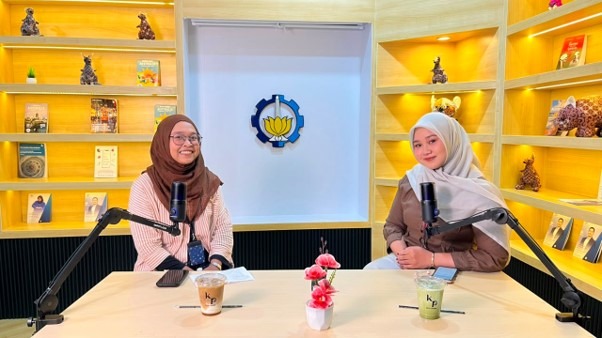
SURABAYA – The development of artificial intelligence (AI) is advancing rapidly and impacting various aspects of life, including the academic sphere. To address these developments and provide guidance on the responsible use of AI, the Library of the Sepuluh Nopember Institute of Technology (ITS) released the latest episode of its podcast titled “Utilizing AI as a Learning Companion: With AI, Exploring Knowledge and Building Smarter Learning Experiences” on the ITS Library’s official YouTube channel on Thursday (August 20, 2026).
Hosted by Maulidina Tri Andini, S.IP., the discussion featured Inka Novita Dinia, S.Si., an ITS librarian stationed at the Dr. Angka Corner and an instructor for the AI literacy class. In her presentation, Inka emphasized that AI should be viewed as a learning companion or assistant, not as a final decision-maker, let alone a replacement for lecturers or librarians. The main advantages of AI lie in its flexibility and 24/7 availability, making it an alternative tool for discussion, brainstorming, and clarifying complex concepts outside of campus operating hours.
Although it offers many conveniences, Inka cautioned that there are significant risks if information from AI is taken at face value. She highlighted the phenomenon of “AI Hallucination,” where AI provides answers that seem highly convincing but are factually incorrect, as well as the term “Hallucitation,” which refers to AI generating fictitious references or citations. Therefore, the academic community is urged to always conduct source evaluation by verifying the existence of article titles, the authors’ expertise, and the credibility of the journal before citing any information.
Regarding ethical boundaries in the academic environment, permissible uses of AI include grammar checking, creating quiz questions, designing search keywords, and using AI as a discussion partner to test arguments. Conversely, instructing AI to create an entire academic paper from the introduction to the conclusion, copying and pasting without verification, and concealing the use of AI (non-disclosure) constitute ethical violations and forms of plagiarism that are strictly prohibited. This is because the name listed on the originality statement is that of the student or researcher themselves, so scientific responsibility remains entirely with the author.
In closing, Inka urged academics to master AI literacy so they can utilize the technology intelligently and ethically without sacrificing independent thinking. She advised the academic community not to be afraid to use AI, as long as they understand its limitations. The use of AI is permitted as a learning tool, but the processes of thinking and learning themselves must still be carried out by humans. Regarding official guidelines for the use of generative AI in higher education settings, the technical regulations have also been implemented at the institutional level and can be accessed through the official portals of the ITS Library and the ITS Directorate of Education.