
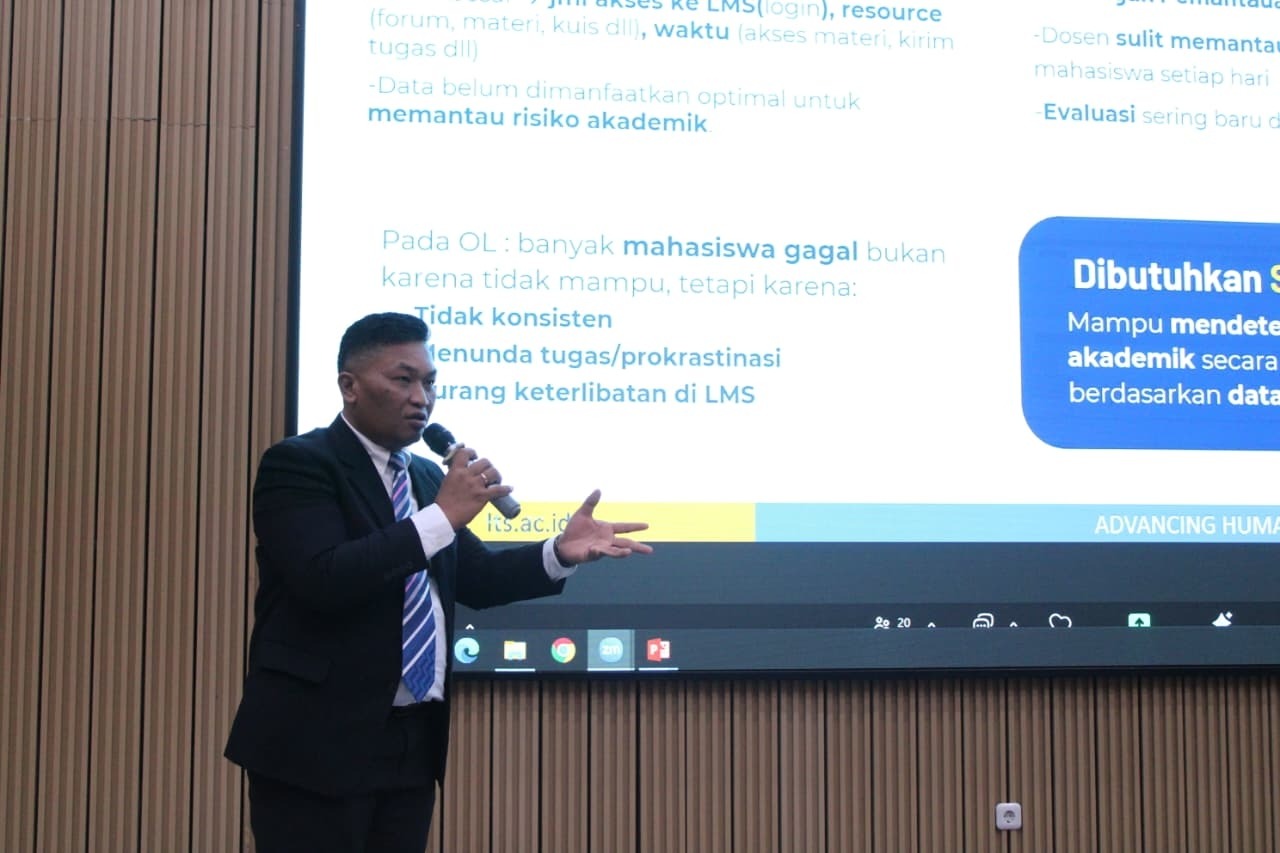
ITS Campus, ITS News — Online learning trends that focus on increasing final grades often cause failure in student learning evaluations. Observing this issue, a doctoral program graduate from the Electrical Engineering Department of Institut Teknologi Sepuluh Nopember (ITS), Dr. Bruri Trya Sartana SKom MM MKom, developed an early warning system model that utilizes learning behavior data to identify academic risks in online learning.
Bruri revealed that online learning systems utilizing a Learning Management System (LMS) have the potential to create patterns of learning failure. He used digital footprints, including material access activities, interactions, and assignment completion patterns, to observe the patterns that cause failure. “Final evaluations that only utilize final grades are less effective in assessing student learning success,” he explained.
Furthermore, the lecturer from the Faculty of Information Technology at Budi Luhur University added that academic risk is a multidimensional factor. These factors can be seen from student learning engagement patterns, assessment performance stability, and procrastination behavior in completing assignments. “Demographic factors were also measured against the possibility of student learning failure risks,” he added.
In developing his research, the man from Jakarta used a non-linear machine learning approach to model the relationship between learning behavior variables and academic risk. The main dataset used was the Open University Learning Analytics Dataset (OULAD), which was then validated using institutional Moodle LMS data. “This aims to ensure relevance in implementation within the educational scope,” he clarified.
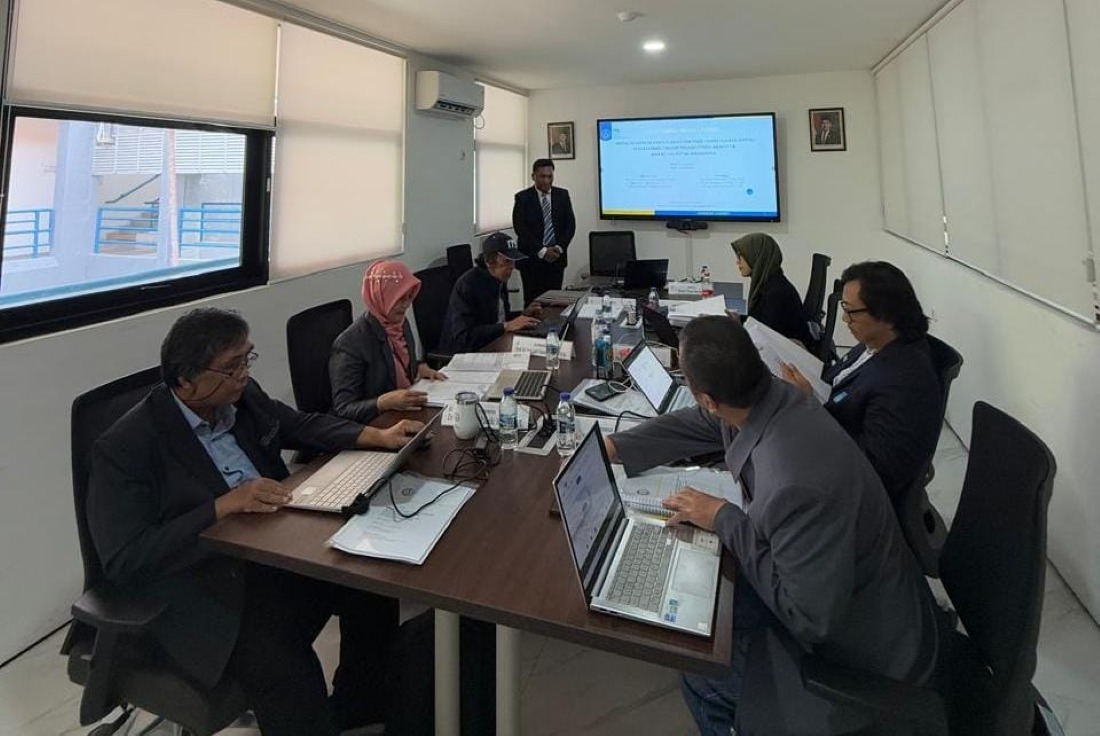
Additionally, Bruri used the Categorical Boosting (CatBoost) research model with a hyperparameter optimization process through the Optuna framework. To ensure model reliability, evaluations were conducted using the 5-fold stratified cross validation method. “This approach allows for a balanced data distribution, resulting in more stable evaluation results with minimal bias,” he elaborated.
Through this combination of approaches, Bruri explained that the CatBoost model is capable of providing the most superior performance compared to other comparative models. This superiority is evident in the Area Under Curve (AUC) value, accuracy level, and consistency of results at each testing stage. “This model is able to detect at-risk students before they enter the final evaluation stage,” he said.
With this combination, Bruri designed an early warning system based on specific timeframes. He divided the risk detection mechanism into three stages: short-term, medium-term, and long-term. “This system can detect near-term risks and generate projections of potential graduation delays,” he explained.
In the short-term stage, Bruri stated that the system will identify students who begin to show a decrease in learning engagement, such as being late in submitting assignments. The medium-term stage will monitor assessment performance stability and academic consistency patterns. “The long-term stage is designed to project the likelihood of students failing to reach their graduation target on time based on performance and learning behavior detected from the start,” he revealed.
These findings prove that the integration of LMS data with non-linear machine learning approaches can serve as the foundation for an accurate and applicable early warning system. The man with glasses explained that this research supports the Sustainable Development Goals (SDGs) commitment on point 4, which is Quality Education. With proper implementation, this research can assist educational institutions in sustainably improving the success of online learning. (ITS PUBLIC RELATIONS)
Reporter: Hani Aqilah Safitri