Academics


Academics

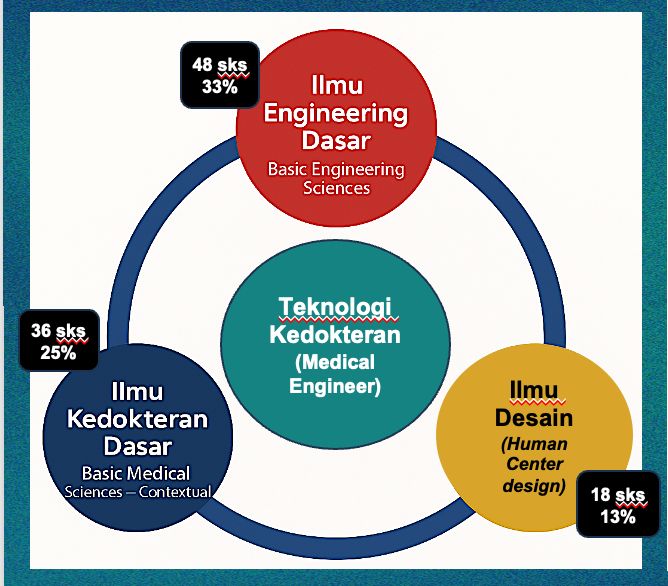
The basic engineering sciences develop core competencies in electrical engineering and informatics.
The basic medical sciences provide a foundation for understanding human body systems, physiological functions, and disease, as well as the use of medical technology in clinical care.
Medical technology design applies ergonomic and human-centered design principles to promote user comfort.
| Learning Outcome Domain | CPL | Description |
|---|---|---|
| ATTITUDES | 1 | Demonstrate faith and devotion to Almighty God, ethical conduct, integrity, and moral character. Show awareness of and concern for social and environmental issues, respect cultural diversity and pluralism, uphold the rule of law, and prioritize national and public interests. Apply creativity, innovation, excellence, strong leadership, collaboration, and other personal strengths to achieve the best possible results. |
| GENERAL SKILLS | 2 | Evaluate and apply science and technology in a specific area of expertise. Make sound decisions based on individual and group work, as evidenced by a final project report or a learning activity with an equivalent output, using logical, critical, systematic, and innovative thinking. |
| 3 | Manage one’s own learning and pursue lifelong professional development to compete nationally and internationally. Contribute to problem-solving by applying information and communication technologies, observing sustainability principles, and drawing on an understanding of technology-based entrepreneurship. |
|
| SPECIALIZED SKILLS | 4 | Identify the sources of engineering problems in medical technology development through investigation, analysis, and interpretation of data and information based on engineering principles. Apply mathematics, natural sciences, and engineering principles to solve complex engineering problems in the development of medical technology systems. |
| 5 | Formulate alternative solutions to complex engineering problems in medical technology, taking economic, public health and safety, cultural, social, and environmental factors into account. Conduct research involving problem identification, formulation, analysis, design, and problem-solving to support engineering and innovation in medical technology. |
|
| 6 | Design and develop innovative medical technologies for diagnosis, treatment, and rehabilitation. Use analytical methods and consider technical standards, performance, reliability, ease of implementation, and sustainability, alongside economic, public health and safety, cultural, social, and environmental factors. |
|
| 7 | Select appropriate resources and use information and communication technology tools for engineering design and analysis in medical technology. |
|
| KNOWLEDGE | 8 | Demonstrate a command of the theoretical concepts of basic science, engineering science, and engineering principles required to develop medical technologies based on imaging, electronics, or design with advanced materials. Demonstrate knowledge of the operating principles, innovations, and design techniques for diagnostic, therapeutic, and rehabilitative technologies that use artificial intelligence (AI). |
| No. | Graduate Profile (PL) | Graduate Profile Description |
|---|---|---|
| 1 | PL-1: Medical Engineer (E) | Apply, analyze, and design medical technology solutions based in medical science and engineering to support clinical services and improve the quality of health care. |
| 2 | PL-2: Medical Technology Designer (D) | Design medical technology products and solutions that address clinical requirements and patient needs in specific health care settings. |
| 3 | PL-3: Medical Technology Innovator (I) | Develop innovative improvements or modifications to medical technologies to solve practical problems in health care delivery. |
| 4 | PL-4: Medical Technology Researcher (R) | Conduct reviews and applied research in medical technology to produce data, analyses, or preliminary prototype designs in accordance with scientific principles. |
| 5 | PL-5: Medical Technology Entrepreneur (T) | Develop viable, innovation-based medical technology business ideas and preliminary business models to launch independent ventures. |