About
Published on
Thursday, 27 August 2026
Reflecting on environmental awareness, HIMA TC together with Lab GIGA held a community service activity in the form of a game development training session with SMA Luqman Al Hakim Surabaya.
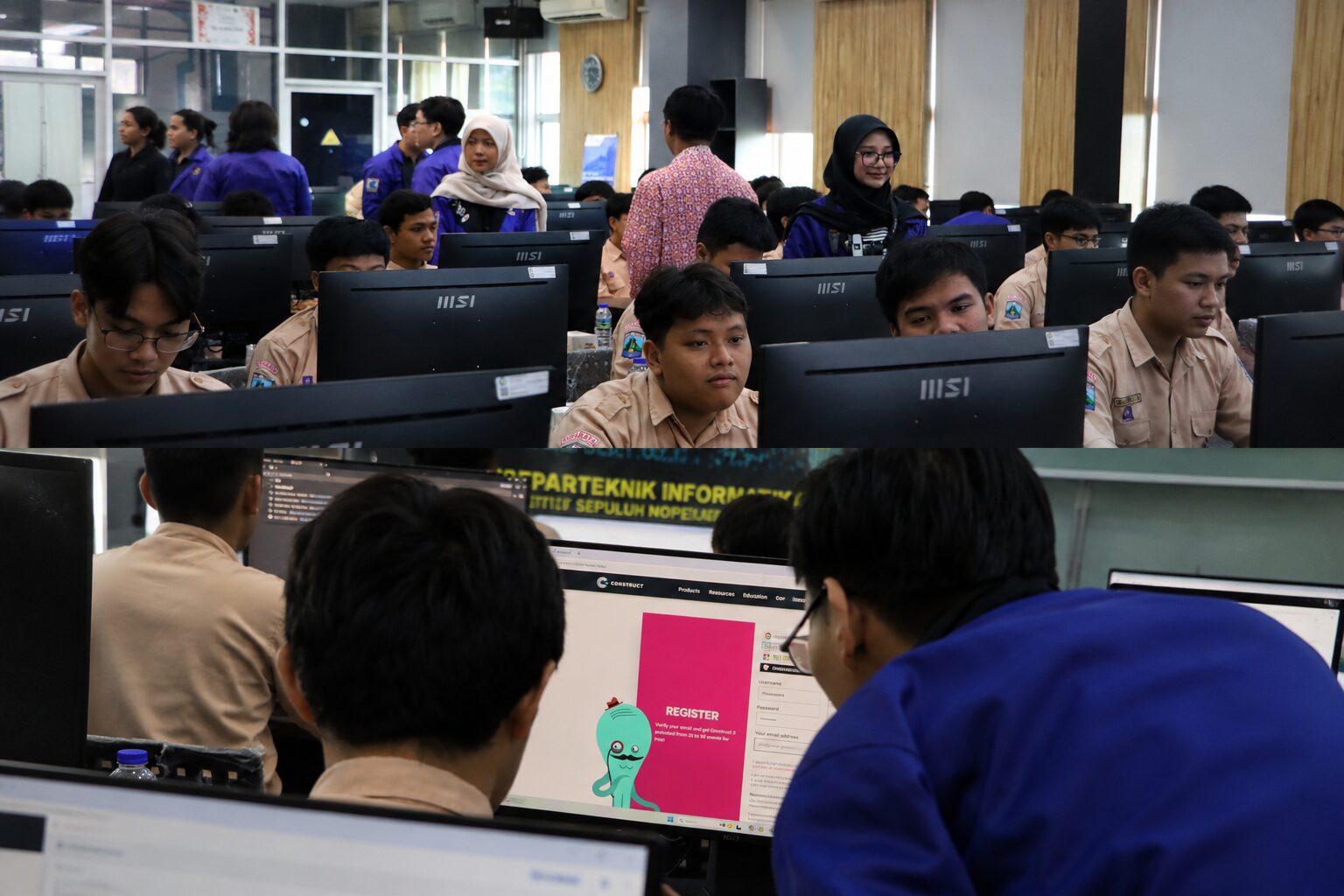
Surabaya, FT-EIC ITS – The Informatics Engineering Student Association (HIMA TC), together with the Graphics, Interaction, and Game Laboratory (Lab GIGA), once again held a community service activity, this time in collaboration with SMA Luqman Al Hakim Surabaya. This activity represents a concrete form of contribution from Informatics Engineering students in passing on the knowledge they have gained in university to the younger generation, particularly in the field of technology and software development. The activity was attended by 54 students from grades XI and XII, who were introduced to the world of game development through a basic training session using the Construct 3 platform. Enthusiasm among participants was evident from the very beginning, as game development remains an appealing topic that is not yet widely covered in the standard high school curriculum.
Through this visual-based platform, students were introduced to simple logic in game-making without having to write code manually, making the material easier to grasp for participants who mostly had no prior programming background. This approach was chosen because Construct 3 allows users to focus on understanding the logical flow behind a game, such as how a certain action can trigger a particular reaction, without being burdened by complex programming syntax. In this way, students encountering coding for the first time were still able to follow the training comfortably and progressively, starting from an introduction to the Construct 3 interface, the concepts of events and actions, up to how both elements are combined into a complete game mechanic.
Beyond theory, students also directly practiced what they had learned by creating an educational game themed around the habit of disposing of trash properly. The game was built using a drag-and-drop mechanism, in which participants learned to design simple game logic flows, from detecting a dragged object to providing feedback to the player. This process taught students to think in a structured manner, breaking down a larger idea into smaller steps that could be translated into game logic, while also training their attention to detail in testing whether each interaction in the game functioned as expected. The choice of an environmental theme, specifically the habit of disposing of trash in the right place, also served as an effective way to embed an educational message within a technological work, allowing students not only to learn game-making but also to reflect on issues around them through the media they created themselves.
This hands-on, learning-by-doing approach was chosen so that students would not merely understand the concept theoretically, but would also experience firsthand the logical thinking process that underlies software development. The end result of the training was an educational game accessible directly through the web, allowing the students’ work to be tried out and shared more widely, rather than remaining a mere in-class exercise. With a game accessible online, students also had the opportunity to showcase their work to friends, family, and teachers, which in turn helped foster a sense of pride and confidence in the technical skills they had just acquired.
All of the material in this activity was delivered directly by members of Lab GIGA from the 2024 cohort. The involvement of students as instructors is one of the distinctive features of the community service program initiated by HIMA TC, in which university students serve not only as event organizers but also actively share their knowledge and experience in game development directly with high school students. The close age gap between the instructors and participants helped make the learning process feel more relaxed and communicative, while also giving the university students an opportunity to sharpen their own skills in sharing knowledge in the field. For the Lab GIGA students themselves, the experience of serving as instructors in this kind of activity became a learning space in its own right, particularly in simplifying technical material so that it could be understood by students encountering game development for the first time.
This kind of community service activity is a program held at least once a year, reflecting the ongoing commitment of HIMA TC and Lab GIGA to continue contributing to the field of technology education. This consistency shows that the community service activity is not merely a ceremonial annual agenda, but part of a long-term effort to build a bridge between higher education and secondary education, particularly in introducing the field of informatics engineering to students from an early stage. This year’s collaboration with SMA Luqman Al Hakim Surabaya is a concrete example of that synergy, in which knowledge gained in university can be passed on to the younger generation in an applicable form relevant to the issues around them, such as environmental awareness.
Through this activity, HIMA TC and Lab GIGA hope that students will not only gain basic technical skills in game-making, but will also be inspired to continue exploring technology as a means of conveying positive messages in everyday life. Furthermore, this activity is expected to broaden students’ insight into study and career opportunities in the field of informatics engineering, while nurturing their interest in technology from as early as high school. With the spirit of collaboration maintained each year, HIMA TC and Lab GIGA hope to expand the reach of partner schools in the future, so that more students can gain similar opportunities to learn about technology while contributing to issues beneficial to their surrounding environment.