

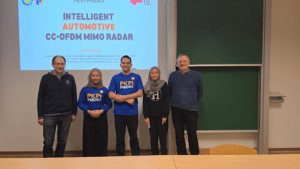
Image: Research Works presentation at the Communication and Sensing Seminar at TU Graz.
Three PhD students in Electrical Engineering (Telecommunications) from the Faculty of Intelligent Electrical and Informatics Technology (F-ELECTICS), Institut Teknologi Sepuluh Nopember (ITS), namely Aulia Saharani, Muhammad Idris Romadly, and Hasna Hanifah, are currently participating in a sandwich program at TU Graz, Austria. This program aims to strengthen research quality and international scientific publications through global collaboration.
The sandwich program provides an opportunity for doctoral students to conduct part of their research at a partner university abroad. Aulia Saharani explained that the program focuses not only on academic mobility but also on improving research publication quality.
“This program is a research visit that allows doctoral students to complete part of their research activities at an overseas partner university,” said Aulia.
The program is implemented through the International Publication Quality Improvement (PKPI) scheme by the Ministry of Higher Education, Science, and Technology for PMDSU students, aiming to enhance the competitiveness of scientific publications under the guidance of internationally recognized professors.
The program involves three PhD students with different funding schemes. Two students are supported by PKPI, while one student receives funding from the Ernst Mach Grant – Worldwide.
All three students are supervised by the same promoter and conduct research based on their respective dissertation topics, while actively engaging in discussions with the research team at TU Graz.
TU Graz was selected due to its strong reputation in telecommunications, particularly in radar and millimeter-wave (mmWave) technology, as well as its established research collaboration with ITS.
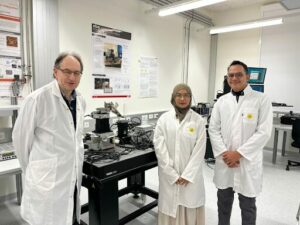
Image: Introduction to campus environment and laboratory facilities at TU Graz.
During the five-month program, students participate in intensive research activities, including research discussions, publication refinement, and collaboration with professors and researchers at TU Graz.
“Through these discussions, I gained valuable technical insights and new perspectives, especially from the RF front-end side such as antennas and hardware,” Aulia added.
In this program, Aulia focuses on developing automotive radar based on CC-OFDM MIMO. Meanwhile, the other two students explore similar technologies for ISAR and monopulse radar applications. These topics are closely related, enabling knowledge exchange and collaborative research development.
From a research perspective, TU Graz provides advanced laboratory facilities, particularly in microwave engineering, antennas, and radar systems. Some laboratories are equipped with high-frequency measurement tools, allowing comprehensive research from simulation to testing. Hasna Hanifah highlighted that the academic environment at TU Graz strongly supports collaboration between academia and industry.
“The academic environment at TU Graz strongly supports research collaboration due to its close connection with industry,” said Hasna.
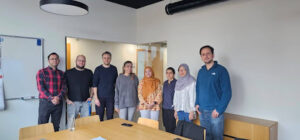
Image: A moment from a research sharing session among PhD students and postdoctoral researchers at TU Graz.
During the program, students also gain valuable experience collaborating with international researchers and students from various countries. Regular seminars help broaden insights and improve scientific communication skills. However, challenges remain, particularly in adapting to a new environment.
“The main challenge was adapting to the environment, especially since the program took place during winter,” Hasna explained.
Through this program, the research outcomes are expected to contribute to the development of radar technology in Indonesia, particularly in improving research quality and radar signal processing. Furthermore, the international experience gained is expected to strengthen research internationalization and promote knowledge and methodology transfer in Electrical Engineering.