


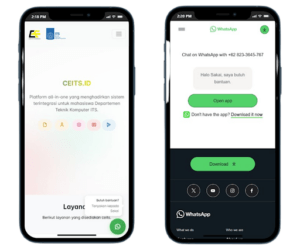
Image: Interface of the SAKAI WhatsApp-based chatbot that enables students to easily access administrative services.
Surabaya – F-ELECTICS ITS – The Department of Computer Engineering, Faculty of Intelligent Electrical and Informatics Technology (F-ELECTICS) at ITS, has once again introduced an artificial intelligence–based innovation through the development of SAKAI, a WhatsApp chatbot designed to simplify student administrative services.
This innovation was developed by a team of lecturers consisting of Arta Kusuma Hernanda, S.T., M.T., Dr. Arief Kurniawan, S.T., M.T., and Dr. Diah Puspito Wulandari, S.T., M.Sc., in collaboration with Computer Engineering students, namely Raditya Rakha Renanda, Defender Artha Widiprasetyo, Alif Ridhwan Al Ghozali, Pranaditya Tri Jyotista, Vavitram Putra Sudana, Muhammad Mirza Farisy Alhadiid, Muhammad Aufaa Prayitno, and Adhitya Raufarhan Sukmana.
The development of SAKAI was driven by the existing administrative service system, which was still handled manually by a single administrator despite the continuously increasing number of students. This condition led to long queues, delayed responses, and limited service availability outside working hours.
“SAKAI was developed because administrative services in the Department of Computer Engineering ITS were still manual and handled by only one admin, while the number of students and volume of inquiries continued to grow,” said Arta.
Other challenges included slow response times, limited service hours (08:00–16:00), and inconsistencies in information related to academic procedures and student services. These issues highlighted the need for a technology-based solution capable of delivering faster, more consistent, and always-available services.
SAKAI was developed as an AI-driven digital solution to improve the quality of administrative services for students in the Department of Computer Engineering ITS.
In its implementation, WhatsApp was chosen as the primary platform due to its widespread use among students in Indonesia. This allows users to access the chatbot without installing additional applications, ensuring easier adoption and accessibility.
From a technological perspective, SAKAI utilizes a Retrieval-Augmented Generation (RAG) approach combined with the QWEN large language model for natural language processing. This system enables the chatbot to retrieve information from a structured knowledge base while generating natural and context-aware responses.
“SAKAI uses a Retrieval-Augmented Generation (RAG) approach combined with the QWEN large language model for natural language processing,” Arta explained.
One of SAKAI’s key advantages lies in its ability to provide 24/7 service while delivering accurate responses based on official departmental data. Compared to conventional services, this system reduces dependency on administrative staff. Unlike static FAQ-based chatbots, SAKAI is capable of delivering more contextual responses and integrating with academic systems.
Currently, students can utilize SAKAI to access a wide range of administrative services, including academic procedures, class schedules, administrative requirements, student services, and departmental announcements.
Students can conveniently access academic administrative information through SAKAI in a fast and flexible manner via WhatsApp.
From the user perspective, SAKAI has received positive feedback due to its accessibility and responsiveness, especially during peak periods such as the beginning of the semester. Meanwhile, the department has also expressed strong support for the system, recognizing its potential to enhance the overall quality of administrative services.
“From the students’ perspective, SAKAI has received positive responses as it helps them obtain academic administrative information more quickly without depending on admin working hours,” Arta added.
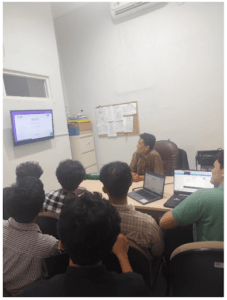
Image: Discussion session of the ITS Computer Engineering development team in designing and building the SAKAI AI-based system.
During the development process, lecturers played a role in system design and academic supervision, while students were involved in needs analysis and initial testing as early users. This collaboration reflects a strong integration between education and technological innovation within F-ELECTICS ITS.
The development of SAKAI aligns with F-ELECTICS’s vision to become a leading faculty in education and research in technology, with tangible contributions to society. This innovation represents a practical implementation of AI that supports the digital transformation of higher education services.
Moving forward, SAKAI is planned to be continuously improved through the expansion of its knowledge base, enhancement in understanding informal language, and potential replication across other departments within ITS and beyond.