About
Published on
Monday, 7 September 2026
Carrying the spirit of cross-department collaboration and international competitiveness, the ITS robotics team achieved a proud result by winning 3rd Place at RoboCup 2026 in South Korea.
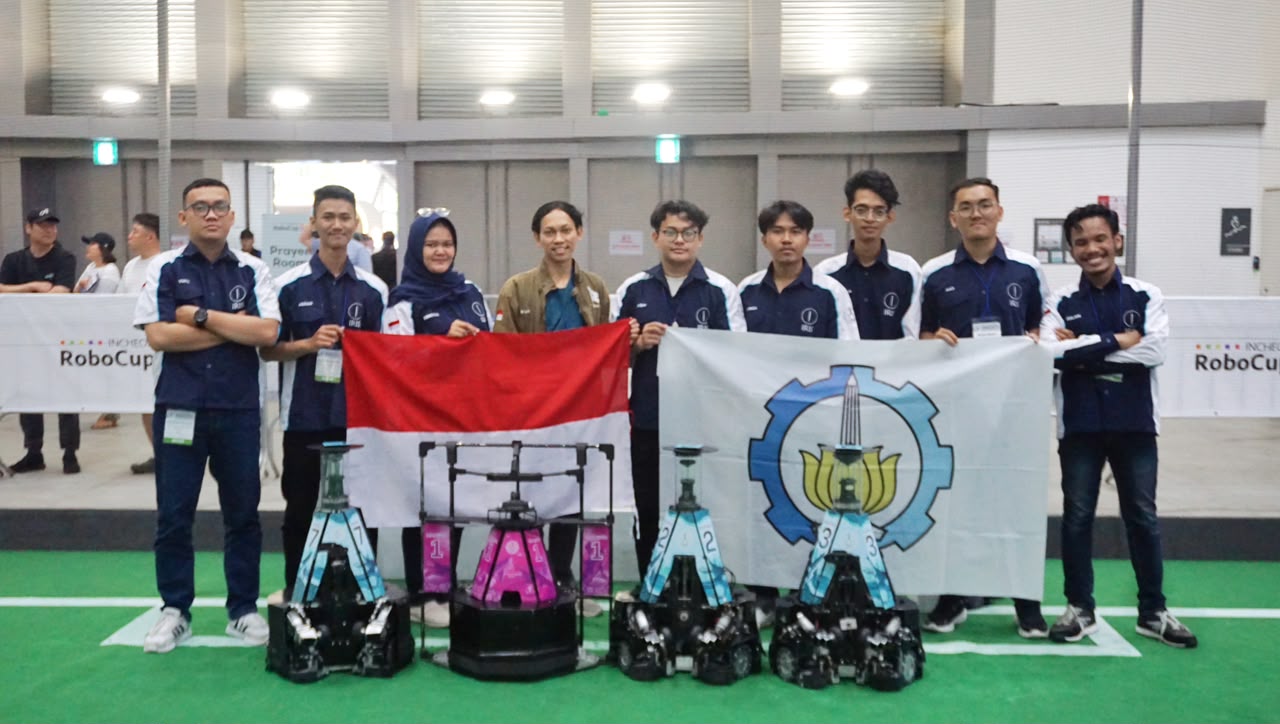
Surabaya, FTEIC ITS – The robotics team of Institut Teknologi Sepuluh Nopember (ITS), IRIS ITS, has won 3rd Place in the Robot Soccer – Middle Size League (MSL) category at RoboCup Incheon 2026, held from June 30 to July 6, 2026, at Songdo Convensia, Incheon, South Korea.
The team consists of Nindita Putri Aisyah from the Telecommunication Engineering study program, class of 2024, Alvaro from the Electrical Engineering study program, class of 2023, Muhammad Navis Azka Atqiya from the Computer Engineering study program, class of 2023, as well as Abrar Rafi Dwianto and Yuke Brilliant Hestiavin from the Computer Engineering study program, class of 2024.
RoboCup is an international robotics competition aimed at advancing research in artificial intelligence, robotics, and autonomous systems through various competition categories. In the Middle Size League (MSL) category that IRIS ITS competed in, each team fields five robots consisting of one goalkeeper and four field players, with all robots playing fully autonomously without manual control throughout the match. The robots are required to independently detect the ball, teammates, opponents, and their position on the field, then make real-time decisions to attack or defend.
The team’s interest in competing at RoboCup stemmed from a desire to develop robotics technology that goes beyond research and can compete at the international level. For Nindita, RoboCup is a challenging event because it combines multiple disciplines, from artificial intelligence and computer vision to control systems, electronics, and multi-agent collaboration.
IRIS ITS itself was established in 2016. The team initially competed in the KRPAI Wheeled category at the Indonesian Robot Contest, and after that category was discontinued in 2017, IRIS shifted its focus to developing robots for the KRSBI Wheeled category, eventually growing into a team that regularly competes in international competitions such as RoboCup.
In preparing for the competition, task division within Team IRIS ITS is carried out through four main divisions: Mechanical, Electrical, Programming, and Official, ensuring that every aspect of competition preparation runs in a coordinated manner. The Mechanical division is responsible for the design, manufacturing, and assembly of the robots. The Electrical division develops the electrical systems, including PCB design, wiring, power distribution, and sensor and actuator integration. The Programming division develops the robots’ software, from computer vision, localization, and navigation to inter-robot communication and the development of autonomous gameplay strategies. Meanwhile, the Official division handles the team’s non-technical needs, such as competition administration, logistics, documentation, and publication.
Because the robots play fully autonomously, team members stationed at the sidelines during matches are responsible for monitoring robot performance, troubleshooting during breaks, replacing batteries, and adjusting strategy configurations before the next match begins.
Preparation for RoboCup Incheon 2026 took approximately one year, starting right after the previous competition ended. The stages involved included evaluating the performance of the previous robots, developing new hardware and software, integrating all systems, field testing, match simulations, and various refinements based on training results. Ahead of departure, the team also conducted stress tests on the robots to ensure they were ready to face real competition conditions.
The biggest challenge the team faced during preparation was ensuring the entire robot system worked stably once all components were integrated, as small changes in one part often affected the performance of other parts, making the debugging process quite lengthy. Beyond the technical challenges, maintaining team coordination was also a key concern, as each member worked on different components. The team addressed this through regular evaluations, joint training sessions, and open communication so that any issues could be resolved more quickly.
The matches at RoboCup Incheon 2026 were highly competitive, as IRIS ITS faced teams with long-standing experience in RoboCup. From the early rounds, the team worked to maintain consistent robot performance and continuously evaluated after each match, ultimately securing 3rd place. This moment became one of the most memorable for Nindita, as it came after overcoming numerous challenges during preparation and seeing the entire team’s hard work pay off. The opportunity to meet and exchange ideas with teams from various countries was also a valuable experience, especially since IRIS ITS was the youngest team in the competition, as many opposing teams were led by professors.
One of the key strengths of the IRIS ITS robots lies in the integration between perception and real-time decision-making systems, where the robots can recognize field conditions, ball position, teammates, and opponents, then determine the best strategy in a very short time. In terms of strategy, the team also developed inter-robot coordination so that each robot can dynamically carry out its role, whether attacking or defending, making gameplay more effective and adaptive to match situations.
In closing, Nindita expressed that she felt very grateful, proud, and touched, as this achievement is the result of months of hard work by the entire team. This achievement also serves as motivation to continue developing their skills and carrying ITS’s name at the international level. Looking ahead, she hopes IRIS ITS can continue to innovate, produce increasingly strong new generations of members, and achieve even better results in both national and international robotics competitions.