About
Published on
Friday, 4 September 2026
Carrying a passion for science competitions that has grown since his high school years, a freshman from ITS’s Electrical Engineering program won a Gold Medal in Physics at the National Mathematics and Natural Sciences Olympiad for Higher Education (ON-MIPA PT).
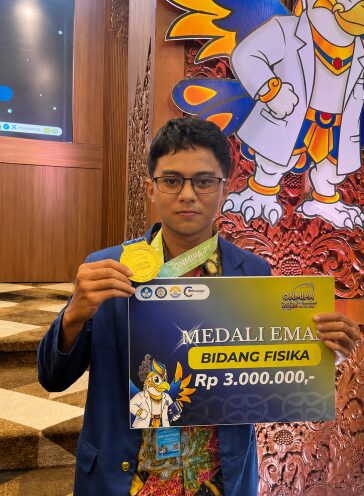
Surabaya, FTEIC ITS – Arfian Rafi Pradana, a student in the Electrical Engineering Study Program at Institut Teknologi Sepuluh Nopember (ITS) from Surabaya, class of 2025, won a Gold Medal at the National Mathematics and Natural Sciences Olympiad for Higher Education (ON-MIPA PT) in the field of Physics.
ON-MIPA PT is an annual national-level science competition for higher education institutions in Indonesia, organized by the Ministry of Higher Education, Science, and Technology (Kemendikti Saintek) through the Indonesian Talent Development Agency (BPTI). In this competition, Arfian represented his university in the field of Physics, competing offline, and successfully brought home the Gold Medal.
Arfian’s interest in science, particularly Physics, has grown since his high school years. He frequently took part in various physics olympiad competitions, including the National Science Olympiad (OSN), and successfully advanced to the national level. He carried that competitive spirit into university, following in the footsteps of previous OSN alumni who also continued their journey in higher education-level competitions.
In his preparation process, Arfian focused on developing a deep understanding of concepts. He began working through advanced physics topics, such as thermodynamics, quantum mechanics, and modern physics, directly from reference textbooks. He aligned this learning process with each stage of the tiered selection process, starting from the university level, then the regional level, before finally advancing to the national level.
The total preparation time before competing at the national level of ON-MIPA PT was around four months, starting from the beginning of his second semester. His study strategy began with reinforcing his foundational understanding of classical mechanics, before moving on to explore other advanced areas of physics and increasing his practice with high-level problem sets.
The biggest challenge Arfian faced throughout the preparation and competition process was the depth of the material and time management. On one hand, he was required to master a substantial amount of in-depth material from several branches of physics. On the other hand, he also had to maintain his academic performance, given the demanding nature of university coursework such as quizzes, Midterm Evaluations (ETS), and Final Evaluations (EAS). To overcome this, Arfian disciplined himself in dividing his time between reading material and practicing problems, as well as setting daily priorities. As a result, he achieved outcomes worth being grateful for, both in terms of his academic grades on campus and his medal achievement at ON-MIPA.
The most tense moment for Arfian came when he saw the profiles of his competitors, who came from various top universities across Indonesia, with many of them from Pure Physics study programs. As a freshman from the Electrical Engineering program, this situation became a source of pressure for him. Initially, he did not set overly high expectations, given how outstanding his competitors were. However, the principle he held onto at the time was simple: “just do it, nothing to lose” — what mattered most was giving his best effort.
According to Arfian, there were three key factors behind his success in winning the Gold Medal at this national event. First, mastery of the material, by reading extensively and understanding fundamental concepts directly from textbooks. Second, rest management, by getting enough sleep and maintaining physical condition so his mind stayed sharp, both while absorbing material and while competing. Third, focus, by reducing the amount of time spent on social media so that time was not wasted and his mind stayed less prone to distraction.
Arfian says he feels very grateful for the results he achieved. Looking ahead, he hopes Indonesia’s education budget can continue to increase, so that support for facilities, research, and scientific talents across the country can become even more adequate.