About
Published on
Thursday, 27 August 2026
The FURAB ITS team from the Department of Electrical Engineering ITS won 1st Place at the IEEEBIG 2026 competition through an AI-based electrical fault classification system for large-scale protection systems.
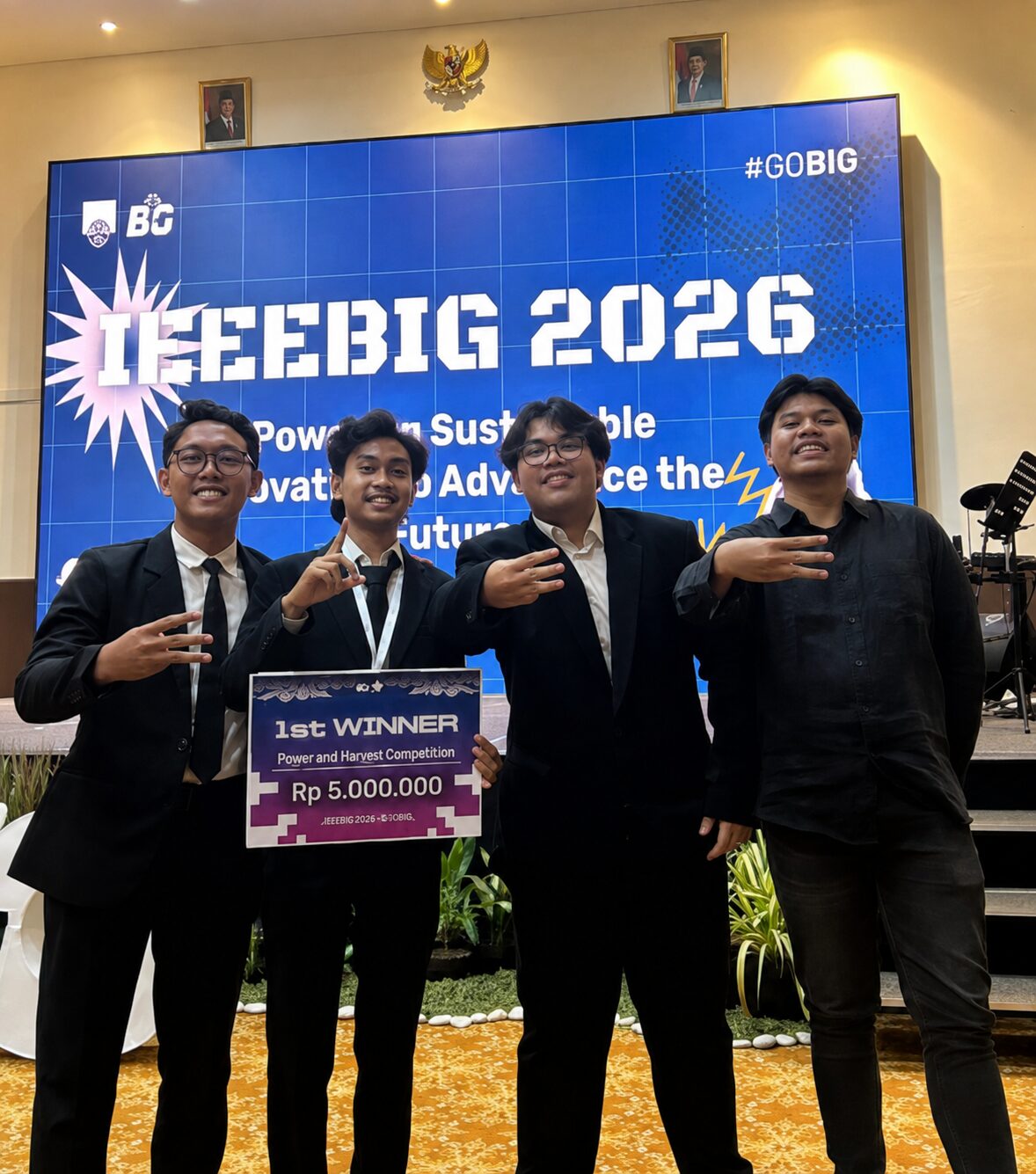
Surabaya, FT-EIC ITS – The FURAB ITS team, consisting of students from the Department of Electrical Engineering at Institut Teknologi Sepuluh Nopember (ITS), successfully won 1st Place in the IEEEBIG (IEEE Big Competition), organized by the IEEE ITS organization. The competition ran from April to May 2026, with the final round held on 10 May 2026, carrying the overarching theme Advances in Electrical Engineering For Effective Renewable and Clean Energy Integration.
The FURAB ITS team is made up of three students from different cohorts: Hafidz Mirza Prambudi from the Electrical Engineering class of 2024, Dionisius Davis from the class of 2023, and I Made Arya Sanjaya from the class of 2024. All three are members of the same research laboratory within the Department of Electrical Engineering ITS, which laid the initial foundation for the team’s collaboration through their shared research interests.
The idea to enter this competition was first proposed by Davis, who was drawn to advancements in electrical engineering technology in the era of artificial intelligence. The interest was subsequently shared by Mirza and Arya, given their common academic focus in Electrical Engineering. The team’s participation was also driven by a desire to broaden their understanding of AI applications in the power sector, particularly aspects relevant to current technological developments.
During the preparation process, the team conducted intensive independent study and research to learn a number of new concepts they had not previously explored, including the integration of artificial intelligence into power system simulation software. This learning process was further supported by their shared laboratory environment, which strengthened the team’s collaborative spirit and consistency in refining their concept until it was ready for competition.
Throughout preparation, the team faced several challenges, particularly in system design and the use of English during presentations. To address these obstacles, the team held regular intensive meetings to align their understanding of key concepts and conducted periodic presentation rehearsals. Through this approach, challenges that initially seemed difficult were gradually overcome through solid teamwork and coordination among members.
The credibility of the organizer was also a key factor that strengthened the team’s motivation to participate to the fullest. As an internationally recognized organization in the field of electrical and electronics engineering, IEEE was regarded as running the competition through a well-structured procedure while upholding strong integrity, including the use of English as the official language. The various challenges faced by the team in earlier rounds further pushed them to deepen their research, expand their curiosity, and continuously encourage one another until they were able to advance to the final round.
The innovation developed by the FURAB ITS team focuses on the automation of electrical systems, particularly large-scale protection systems such as substations and power plants. The system they designed utilizes artificial intelligence to classify types of electrical faults, enabling accurate determination of which faults should trigger a trip and which should not. Through this innovation, the team hopes to minimize unnecessary trips caused by minor faults that, from a technical rating standpoint, should not result in power outages, thereby ensuring uninterrupted activity for communities dependent on electricity supply.
This achievement came as a surprise, exceeding the team’s own initial expectations. Mirza revealed that before the results were announced, the team had anticipated placing only 2nd, 3rd, or in the favorite category, given that teams from other universities also presented physical prototypes as part of their presentations, allowing them to directly demonstrate their innovations before the judges. Nevertheless, the final results showed that the team’s hard work and consistency yielded outcomes better than initially expected.
The achievement of the FURAB ITS team at IEEEBIG 2026 serves as clear evidence that cross-cohort collaboration, dedication to research, and a spirit of mutual encouragement among team members can produce innovations that make a real contribution to the advancement of the electrical engineering field. This accomplishment also serves as motivation for other Electrical Engineering students at ITS to continue exploring the application of artificial intelligence across various fields of study, particularly in supporting the development of renewable energy and sustainable electrical systems.