About
Published on
Tuesday, 7 April 2026
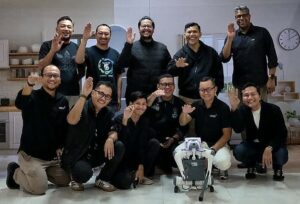
Image: The RoboDog development team. In the front row (center) are Yuke Brilliant Hestiavin and Farrel Ganendra, Computer Engineering students from ITS involved in this project.
Surabaya, F-ELECTICS ITS –The development of RoboDog is part of a strategic collaboration between Institut Teknologi Sepuluh Nopember (ITS), Indosat Ooredoo Hutchison, and Nokia, which began in 2021 to explore various 5G technology use cases within the campus environment. This collaboration has previously resulted in multiple laboratory-scale trials while also fostering the growth of young tech talents at ITS. Over time, the partnership expanded with the involvement of NVIDIA as a key AI computing partner. Through this four-party collaboration, a more advanced AI-based use case prototype was developed, leveraging 5G networks and designed for real-world implementation.
The robot itself is built on a commercial robotic platform from China, which was further enhanced by the ITS team by integrating artificial intelligence capabilities. As a result, RoboDog is not only remotely controllable but also capable of operating more autonomously and interacting intelligently with its surroundings.
RoboDog is designed to assist in high-risk environments that are potentially dangerous for humans, such as industrial facility inspections or inaccessible areas. Equipped with various sensors, including cameras and LiDAR, the robot can analyze environmental conditions in real time. These sensors enable RoboDog to map its surroundings, detect objects and potential hazards, and navigate autonomously toward designated points. Additionally, the robot is capable of understanding human voice commands.
One of the ITS Computer Engineering students involved in the project, Yuke Brilliant Hestiavin, played a significant role in software development, particularly in enabling real-time video streaming from the robot. He also contributed to network engineering and DevOps to ensure system reliability.
“I was responsible for developing the video streaming software from RoboDog so it could be monitored in real time, including during the demonstration in Barcelona, as well as handling network engineering and DevOps tasks such as proxy server setup, tunneling, routing, and software deployment,” he explained.
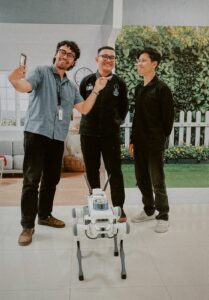
Image: (From right) Farrel Ganendra and Yuke Brilliant Hestiavin, ITS Computer Engineering students, alongside the AI and 5G-based RoboDog they helped develop.
In addition to Yuke, Farrel Ganendra contributed to the robotic system development, focusing on motion control integration to ensure stable robot movement when executing commands. The project also involved distinct roles from each industry partner. Indosat Ooredoo Hutchison led the development of Artificial Intelligence Radio Access Network (AI-RAN), which ensures low-latency connectivity. Nokia provided the 5G network infrastructure, while NVIDIA supported AI computation through its GPU technology for high-speed data processing. These technologies were then integrated by the ITS team into a cohesive robotic system capable of remote demonstrations.
RoboDog is further enhanced with visual interpretation and natural language understanding capabilities through generative AI. This system enables the robot to analyze video input from its cameras and interpret human voice commands using speech recognition models such as Whisper in Bahasa Indonesia.
During development, one of the main challenges faced by the team was maintaining real-time video streaming quality while ensuring stable long-distance communication with low latency. Additionally, integrating AI systems, 5G networks, and robotics required careful optimization. These challenges were addressed through meticulous system planning and robust software development to ensure reliability in real-world conditions.
RoboDog has been tested in various scenarios. In office environments, it can function as a guide, assisting users in locating specific areas. Another test involved remote operation, where the robot received commands from Barcelona and performed real-time monitoring tasks in Surabaya. It has also been tested on Indosat transmission towers with promising results.
The potential applications of this technology in Indonesia are vast. RoboDog can be utilized in high-risk sectors such as oil and gas, mining, disaster monitoring, and critical infrastructure protection. Yuke expressed hope that RoboDog will continue to evolve beyond a prototype into a broader robotics research platform, opening opportunities for further collaboration in the future.
“I hope RoboDog can continue to be developed to become more adaptive and applicable across various critical sectors, while also serving as a platform that opens up wider opportunities for research and collaboration. This way, ITS robotics research can remain at the forefront of autonomous technology, artificial intelligence, and intelligent network systems that are relevant both nationally and globally,” he concluded.