About
Published on
Friday, 14 November 2025
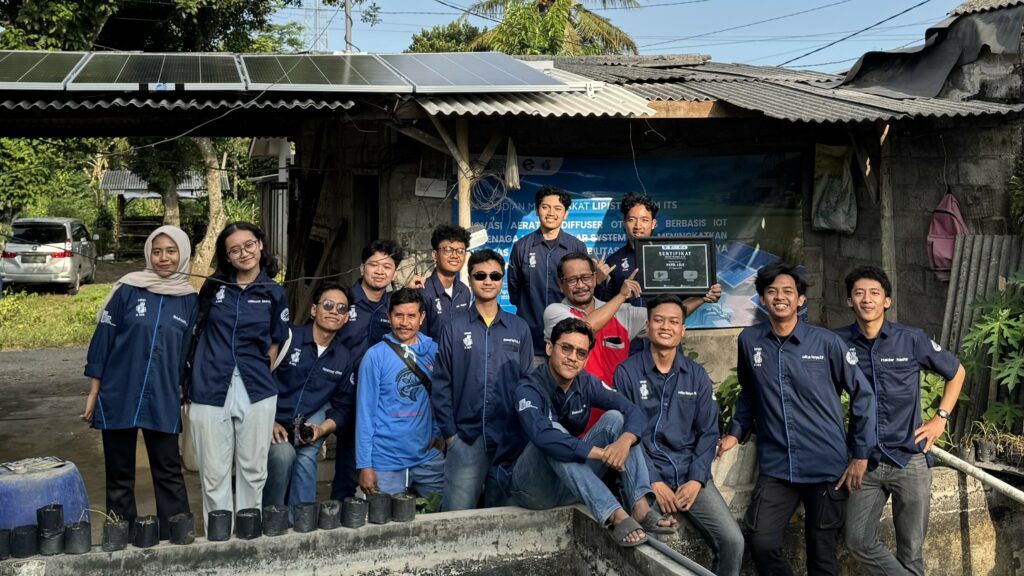
Surabaya, ELECTICS ITS – Community service (ABMAS) activities have long been a tradition at the Instrumentation, Measurement, and Power System Identification Laboratory (LIPIST), Department of Electrical Engineering, Faculty of Electrical Technology and Intelligent Informatics (ELECTICS), Institut Teknologi Sepuluh Nopember (ITS). This year, the laboratory’s Community Service – Student Field Work (KKN ABMAS) team continues to innovate through the development of an Internet of Things (IoT)-based automated aerator system to support catfish farmers in Wringinrejo Village, Banyuwangi.
The project’s coordinator, Vita Lystianingrum B. P., S.T., M.Sc., Ph.D, explained that this initiative is a continuation of the laboratory assistants’ regular community service programs. “Usually, we find partners through the networks of our assistants. This time, one of them came from Banyuwangi and identified a potential collaboration there,” said Dr. Vita. From that idea, the team began designing an automated aerator system to help increase the productivity of local catfish ponds.
One of the team members, Andreas Kristiyadi Suryo Pamungkas, shared that the main issue faced by fish farmers in Wringinrejo was the fully manual aeration process. “There is a farmer group called ‘Patel Lele’ who often struggle because they have to manually monitor the oxygen levels in their ponds. After conducting a survey, we decided to help automate the process,” said Andreas.
Based on their findings, the team developed an aerator system equipped with dissolved oxygen sensors and a hybrid solar-powered energy source. Another team member, Andika Wahyu Vernando, explained that the system can adjust its operation based on real-time oxygen levels. “When oxygen levels drop, the system automatically activates. However, during implementation, we customized it to the farmers’ preference so that the aerator runs continuously for 24 hours,” Andika explained. In addition, the device features an LCD screen displaying real-time oxygen data, eliminating the need for manual monitoring.
Beyond creating the device, the team also prepared a user manual and maintenance guide to ensure the farmers can independently operate the system. “We designed the tool to be as simple as possible and complemented it with visual instructions and an easy-to-follow SOP,” Dr. Vita added. She expressed her hope that the farmers would be able to maintain and operate the system sustainably without relying on the campus team.
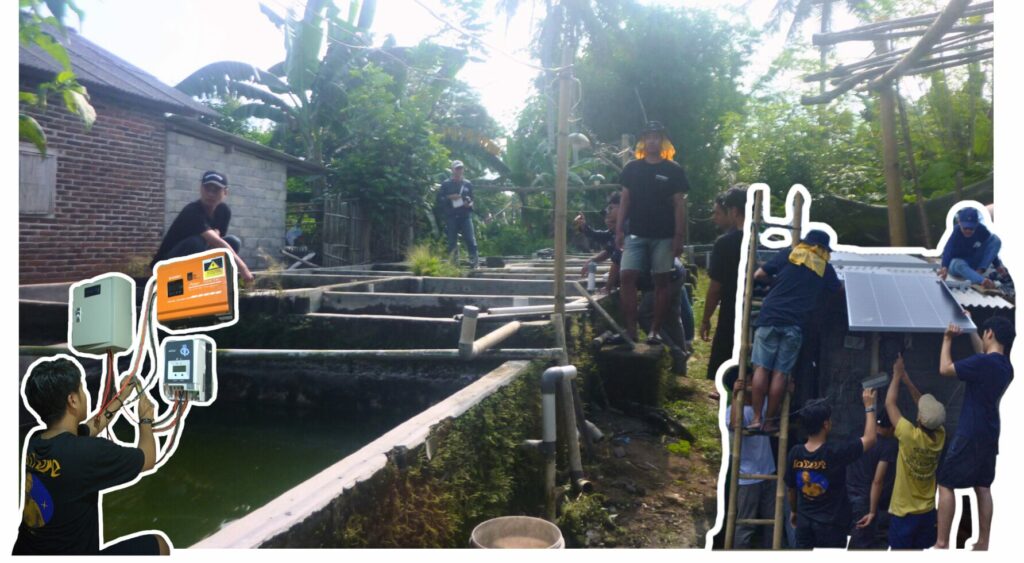
The assembly and implementation process were not without challenges. Andika recalled that several components had to be reconfigured midway due to differences between the initial design and field conditions.
“We had to adjust some wiring over the weekend before heading to the site. Once there, we also modified the placement of the solar panel to match the pond’s layout,” he recounted.
Despite these challenges, the experience became a valuable learning opportunity for the students to directly apply their classroom knowledge.
“Through this ABMAS program, we were able to understand real community problems and contribute with practical solutions,” Andreas shared.
Andika added that the activity taught them the importance of teamwork and adaptability when facing real-world conditions.
Dr. Vita further emphasized that community service activities are meaningful platforms for both lecturers and students to learn from real societal challenges. As Head of LIPIST, she expressed her vision for future ABMAS initiatives to focus not only on developing new innovations but also on maintaining and improving previous projects.
“It would be unfortunate if our efforts ended after a single activity. We aim to establish a continuous ABMAS framework that supports our existing partners so the tools can keep functioning and providing long-term benefits,” she concluded.
Watch the full documentation of the LIPIST KKN ABMAS activities in Banyuwangi via the following link:
Smart Aerator Innovation by LIPIST ELECTICS ITS Community Service Team – YouTube