


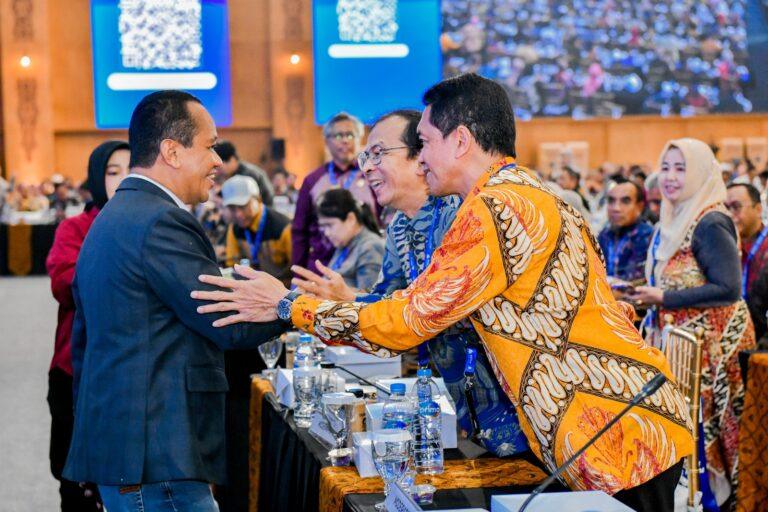
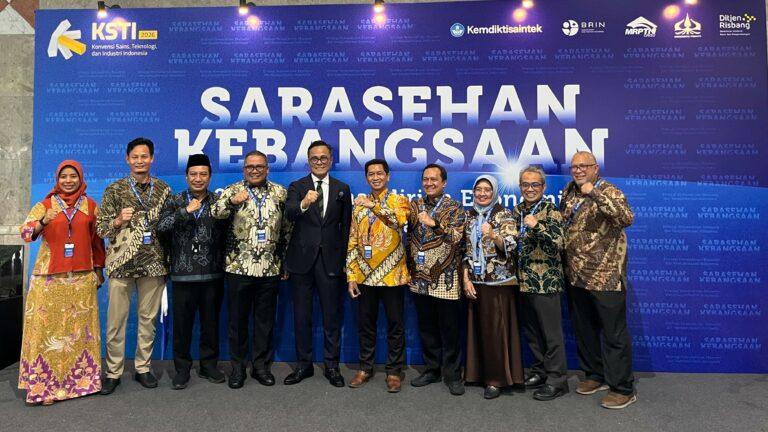
ITS Campus, ITS News — Institut Teknologi Sepuluh Nopember (ITS) has declared its readiness to transform academic research into tangible innovation in support of the national strategy for economic, energy, and food independence. This commitment was made in response to directives from the President of the Republic of Indonesia and members of the cabinet during the National Gathering Convention on Science, Technology, and Industry (KSTI) 2026, held in Jakarta on Thursday, 27 June.
During the gathering, the President urged higher education institutions to serve as the primary driving force in addressing various developmental challenges. This call was grounded in the assessment that universities hold a strategic position to generate knowledge-based solutions for the benefit of society.
Through its strategic plan, ITS has aligned its institutional direction to support the nation’s aspirations. The Rector of ITS, Prof. Dr. (HC) Ir. Bambang Pramujati, S.T., M.Sc.Eng., Ph.D., stated that university research must not remain confined to academic prestige within laboratories. “Every innovation developed must yield concrete economic impact that serves the interests of the people,” he explained.
This alignment is intended to strengthen Indonesia’s capacity to navigate global geopolitical dynamics. Indonesia is obliged to reinforce national resilience through the mastery of technology and the enhancement of domestic resource productivity in a self-reliant manner.
The Vice Rector II for Planning, Finance, and Facilities and Infrastructure at ITS, Dr. Machsus, S.T., M.T., observed that ITS has been preparing itself to support national independence. The energy sector constitutes one of the primary focal points in realizing national sovereignty through the cessation of raw commodity exports. “At ITS, we have developed various energy-related innovations, including the recent innovation of gasoline derived from crude palm oil, which we refer to as Benwit,” Machsus elaborated.
This aligns with the presentation by the Minister of Energy and Mineral Resources, Bahlil Lahadalia, who outlined the B50 program based on palm oil and the E20 program based on sugarcane, aimed at significantly reducing fuel imports. In addition, the government is optimising the utilisation of domestic natural gas and the downstream processing of nickel to generate substantial added value for the manufacturing sector.
The strengthening of the economy is fully supported by investment policies directed towards equitable development beyond the island of Java. The Minister of Investment and Down-streaming, concurrently CEO of Danantara Indonesia, Rosan P. Roeslani, added that the national investment target for the 2025–2029 period has been set at Rp 13,032 trillion. The success of down-streaming is also being expanded to non-mineral sectors, including agriculture and fisheries, in order to create more inclusive employment opportunities.
The government is also providing special fiscal incentives for companies that actively collaborate with universities in research activities. This measure aims to bridge the gap between campus research outcomes and commercial production, ensuring that they do not remain merely as scientific publications but instead evolve into marketable products. Close collaboration between academia and industry is deemed essential to enhancing Indonesia’s global competitiveness.
In line with this agenda, BPI Danantara has invited universities to engage directly in the down streaming process through the mastery of design and manufacturing engineering. The Chief Technology Officer of Danantara, Dr. Sigit Puji Santoso, encouraged the adoption of the Technology Readiness Level approach to ensure that laboratory prototypes are ready for mass production. To accelerate the industrialization process, Danantara introduced the concept of “triangle offense,” which synergies the strategic roles of universities, financing institutions, and the industrial sector.
Currently, Danantara has established five national priority sectors, encompassing energy, food, minerals, transportation, and defense. The development of semiconductor technology and artificial intelligence constitutes an urgent agenda that requires the support of exceptional talent from universities. Higher education institutions are expected to be involved from the early stages of national strategic projects, ranging from feasibility studies to the implementation of technology in the field.
Meanwhile, the Head of the BUMN Supervisory Board and COO of Danantara, Dony Oskaria, underscored the importance of transforming state-owned enterprises in an integrated manner with national food security. The establishment of Village Cooperatives is being optimis as distribution center, providers of seedlings, and facilitators of affordable capital access for farmers, in order to eliminate exploitative supply chains. This transformation is further enhanced through the improvement of human resource quality via nutrition fulfilment programs and quality education.
In response to these strategic policy directions, ITS has expressed its full readiness to serve as a primary technology partner in guiding national industrialization. Through this robust cross-sectoral synergy, innovations from the “Campus of Struggle” are expected to make a meaningful global contribution to Indonesia’s independence. “ITS is prepared to transform research into innovation in support of industrial sovereignty and the welfare of the people,” concluded Machsus, as one of ITS’s delegates. (*)
Reporter: Syifa Rahmadina
Editor: Syahidan Nur Habibie Ash-shidieq