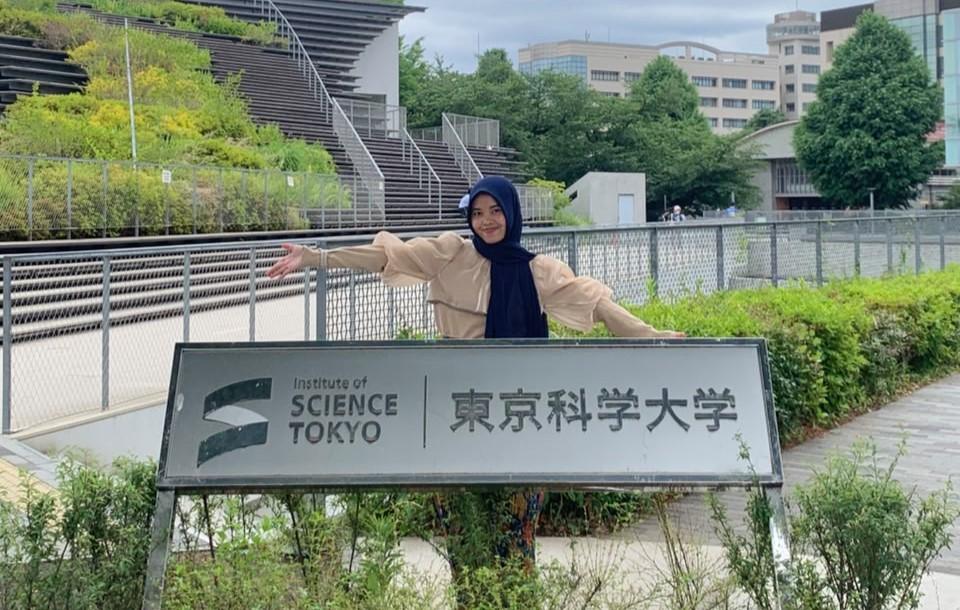
ITS Campus — Participating in a research exchange program abroad demands high academic resilience and adaptability. This is demonstrated by Lydia Fitri Nur Istiadji, an undergraduate student of the Mathematics Department from the Modeling and Simulation Laboratory at Institut Teknologi Sepuluh Nopember (ITS). Through the ITS Overseas Mobility Scholarship (IOMS) scheme, she had the opportunity to hone her research instincts at the Institute of Science Tokyo, Japan.
Lydia chose a challenging research focus: power flow in large-scale systems. She shared that the research approach at her host university was highly rigorous. Her supervising professor (sensei) continuously tested the depth of the students’ fundamental knowledge as well as the research’s relevance to actual needs in the industry.
The peak of her academic dedication was evident when she had to present her research progress. “The day came when I presented my work progress by delivering around 17 pages of mathematical analytical proofs. These proofs discussed the relationship of several methods based on stability, variational equivalence, and fold bifurcation,” Lydia explained.
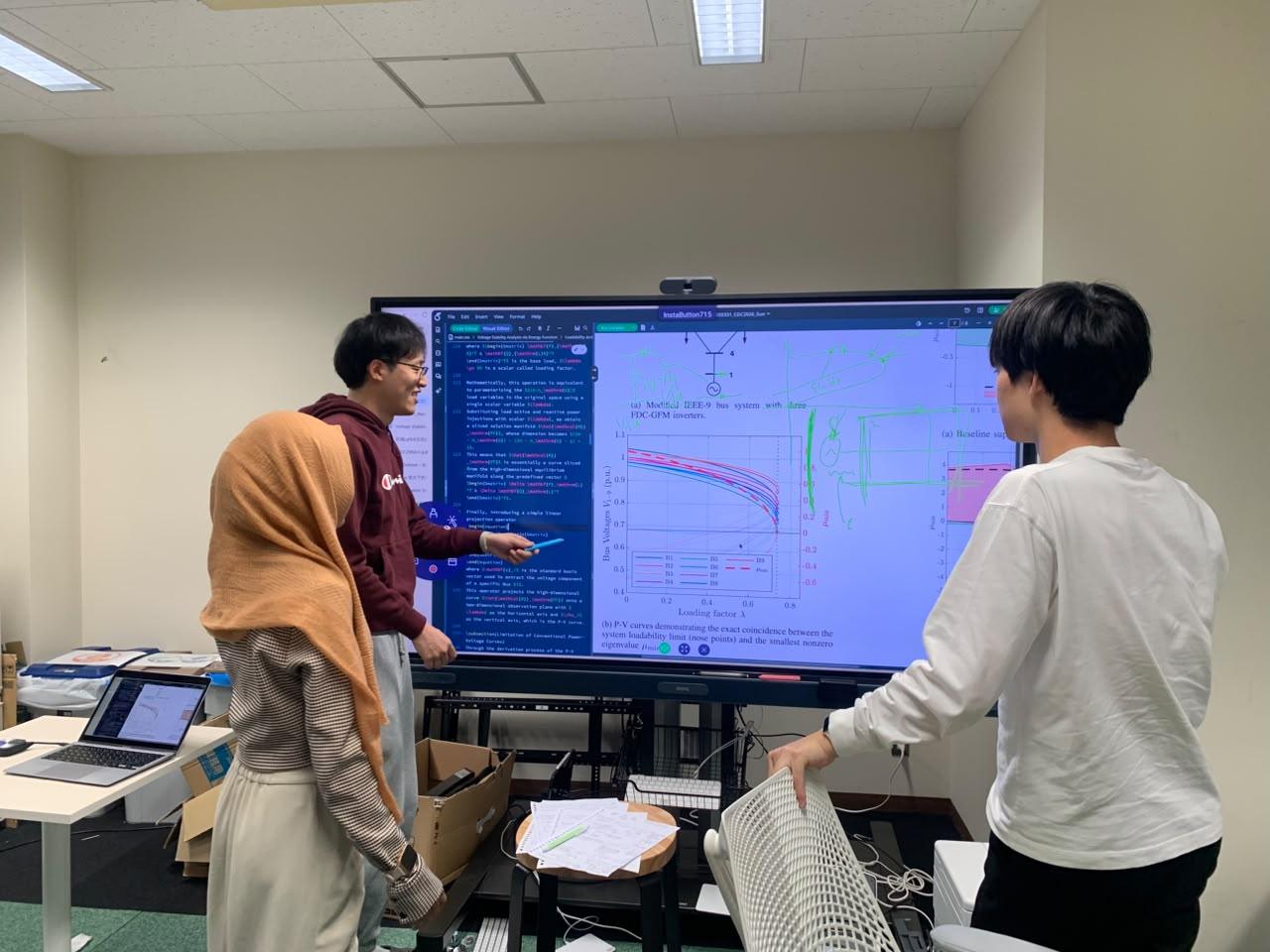
This hard work was intertwined with in-depth discussions that often lasted late into the night. As a testament to her commitment, she even held a fun fact of being the second to last person to leave the laboratory. From this intense routine, Lydia realized an essential truth: the value of research lies not only in the complexity of formulas but in how its essence can be understood and practically applied to solve problems.
The challenges for Lydia did not stop in the academic realm. The laboratory environment, filled with international students from the master’s to postdoctoral levels, was heavily dominated by the use of the Japanese language. Instead of surrendering to communication barriers, this situation actually spurred her to grow. After successfully passing a placement test, she immediately enrolled in a Japanese Course to facilitate her interactions and collaborations.
“This experience slowly shaped my new perspective as a researcher. Growing is not just about what is learned, but also how we adapt and give meaning to every process,” concluded the student who departed during the Spring 2026 period.
Lydia’s inspiring story is a tangible manifestation of the success of the IOMS program, fully supported by the EQUITY World Class University program and the Indonesia Endowment Fund for Education (LPDP). This international mobility ecosystem not only contributes to achieving the Sustainable Development Goals (SDGs) Goal 4 (Quality Education) but also successfully produces resilient and adaptive young ITS researchers ready to provide concrete solutions to global challenges.
Reporter : Vidian Ade Mauludi