


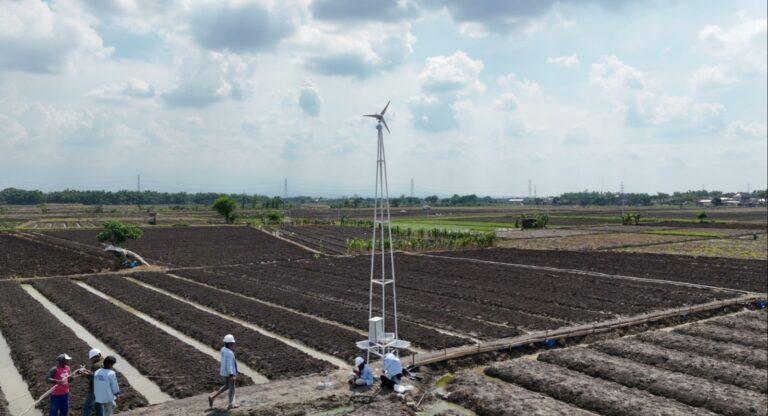
ITS Campus, ITS News — The constant threat of pests, a major cause of crop failure, has driven students at the Sepuluh Nopember Institute of Technology (ITS) to develop an innovative renewable energy solution. This initiative aims to address the underutilization of local natural resources, particularly wind and solar energy. The resulting technological solution is an eco-friendly wind turbine system named “Terang dan Angin” (Terangin).
Muhammad Hanif, Chief Executive Officer (CEO) and Founder of Terangin, explained that the origin of this innovation stemmed from research aimed at creating a competitive platform. Its conceptual framework was inspired by the significant wind potential in Nganjuk Regency, a region known as a corridor of strong winds as well as a major center for shallot cultivation in East Java. “The initial research was indeed intended for a competition; however, after receiving market demand and purchase inquiries, we realized the importance of establishing a formal business entity (PT) to ensure legal validity and operational sustainability,” he explained.
From a technical standpoint, the development of Terangin introduces a unique microgrid system architecture that synergistically integrates wind and solar energy to power automatic insect traps. The system’s design philosophy prioritizes operational simplicity, thereby ensuring accessibility and ease of use for farmers. This approach deliberately avoids complex technological interfaces that could hinder practical implementation in the field.
A notable technical breakthrough lies in the application of a non-permanent modular foundation system. This innovation results in cost savings of up to eight times compared to conventional cast-in-place concrete foundations. This design paradigm allows for the disassembly and reassembly of the turbine, providing significant operational flexibility for placement on leased farmland or in scenarios requiring equipment relocation.
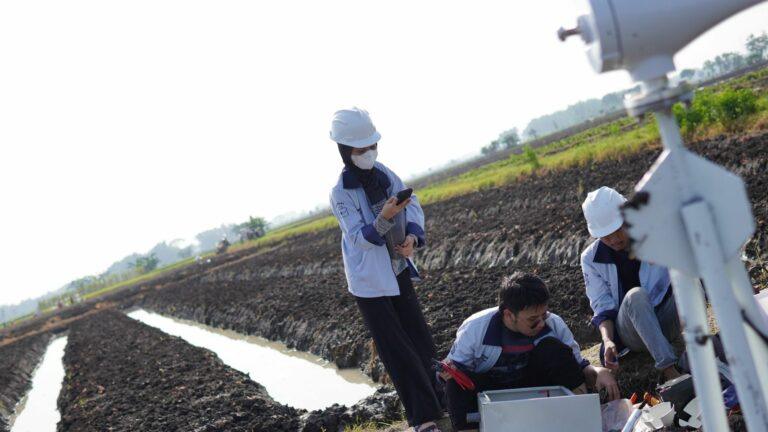
Additionally, the Terangin research team has designed an autonomous braking mechanism called the “wind brake.” This device operates entirely without electrical input or electronic sensors. This mechanism utilizes the wind’s intrinsic force to slow the turbine’s rotation independently, thereby achieving higher energy efficiency while minimizing maintenance requirements. “The braking system we designed requires no electrical power, is far more cost-effective, and operates completely autonomously, unlike alternative systems that require regular monitoring,” explained Hanif.
To address the logistical challenges of equipment maintenance across vast agricultural areas, the team has implemented drone technology as a modern, non-invasive diagnostic method. Through systematic remote aerial monitoring, potential structural or mechanical anomalies can be identified early on, enabling faster, more effective, and safer repairs, as they do not require the physical disassembly of the turbines.
Hanif, a 2024 student in the Department of Mechanical Engineering at ITS, stated that this system has an energy generation capacity of 2.1 kWh per daily cycle. This energy output is not only allocated for the pest trap lighting system; it has also proven applicable to other agricultural operations, including irrigation and power supply for plant watering systems. “Implementing this system allows farmers to significantly reduce pesticide use while increasing crop yields,” he emphasized.
This Surabaya-based innovator further explained that the implementation of the Terangin system enables significant cost savings for farmers, estimated at tens of millions of rupiah per hectare per growing season. At the same time, the risk of crop failure due to pest attacks, which previously reached around 50 percent, has been significantly reduced. “The significant reduction in pesticide use also has a restorative effect on soil fertility, thereby increasing agricultural production,” he added.

The development of the Terangin project was carried out under Hanif’s leadership with the integral collaboration of four core team members from various disciplines. The principal investigators include Rafi Pradana (Mechanical Engineering), Diah Ayu Nur Fadillah (Statistics), Rafi S Lamikan (Mechanical Engineering), and Anindya Khoirunnisya (Business Management), supported by a group of other supporting members.
Thanks to the team’s persistent and dedicated efforts, Terangin has won numerous prestigious awards in various national and international competitions. The most recent and notable achievement is the project’s selection as one of the top six finalists in the prestigious 2026 Fowler Global Innovation Challenge, held at the University of San Diego, United States, on Saturday, May 2. The team was also awarded a cash prize of 3,000 USD. Looking ahead, Terangin’s strategic roadmap includes expanding the use of wind energy to coastal regions. “We aspire for this innovation to spread even further, all the way to the global stage,” Hanif concluded optimistically.
Beyond its conceptual and competitive origins, Terangin has successfully grown into a viable startup, generating substantial revenue amounting to hundreds of millions of rupiah. This financial turnover was achieved through product commercialization and the acquisition of competitive grants. “This trajectory proves that our innovation does not stop at the competition phase, but generates real and sustainable social impact,” he said.
This innovation is a tangible manifestation of ITS’s institutional commitment to advancing research-based technological development that delivers tangible benefits to society. This effort aligns with the United Nations Sustainable Development Goals (SDGs), specifically Goal 7 (Affordable and Clean Energy), Goal 9 (Industry, Innovation, and Infrastructure), and Goal 12 (Responsible Consumption and Production). (ITS Public Relations)
Reporter: Iffah Najwa Ulya