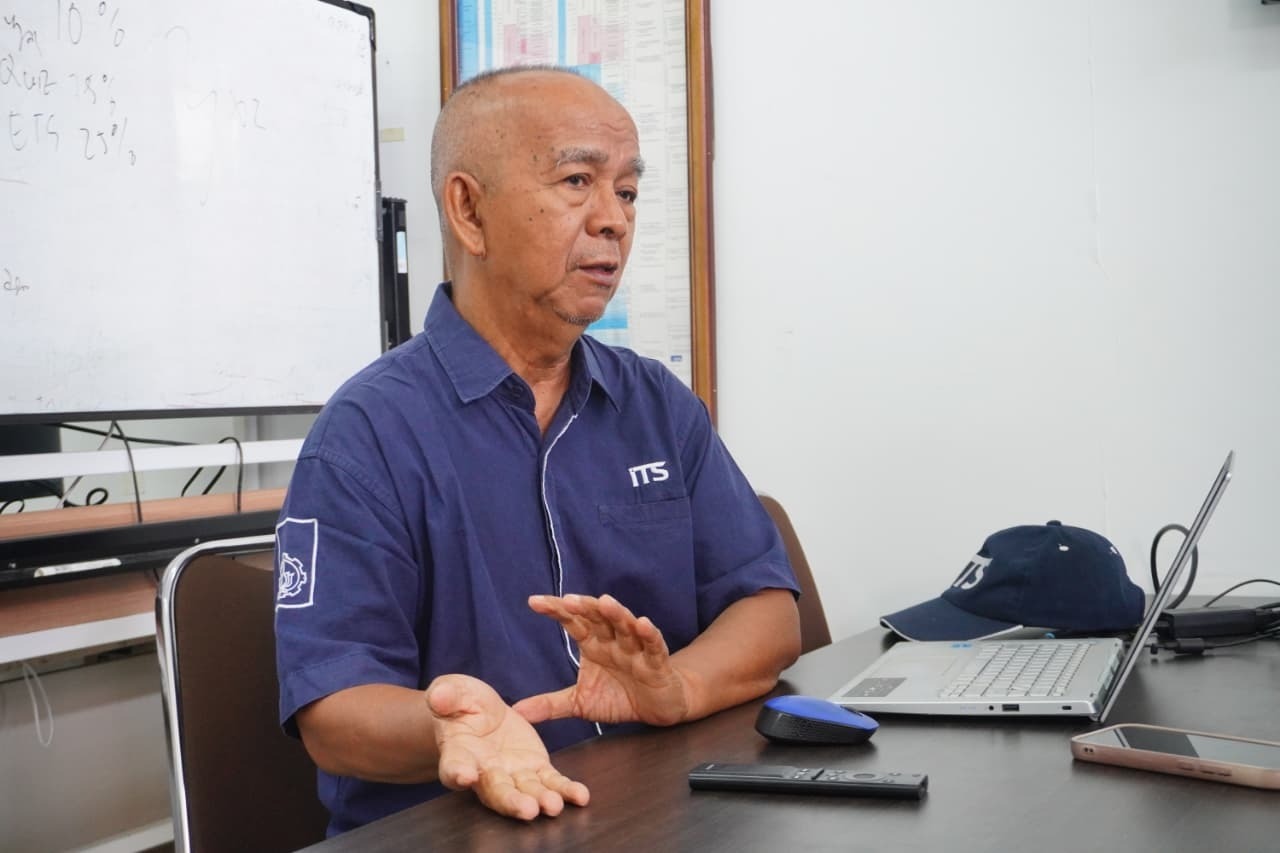
ITS Disaster Mitigation Expert Dr Ir Amien Widodo explained that the fault line in the viral video, which passes through Surabaya, Sidoarjo, and Bangkalan, does exist but has not been actively verified.
ITS Campus, ITS News —Information about the existence of an active fault in Surabaya is currently being widely discussed on various social media platforms. Responding to the news, geologist and adjunct lecturer in the Department of Geophysical Engineering at the Sepuluh Nopember Institute of Technology (ITS), Dr. Ir. Amien Widodo, MSi., urged the public not to panic over unverified information.
The issue surfaced after an Instagram account posted a video about the existence of a fault that allegedly crosses Surabaya. Uploaded seven days ago, the video has been viewed 476,000 times, liked 15.1,000 times, and received 1,081 comments. “Did you know Surabaya has a new active fault? This is the area it crosses,” the account wrote in the video’s caption.
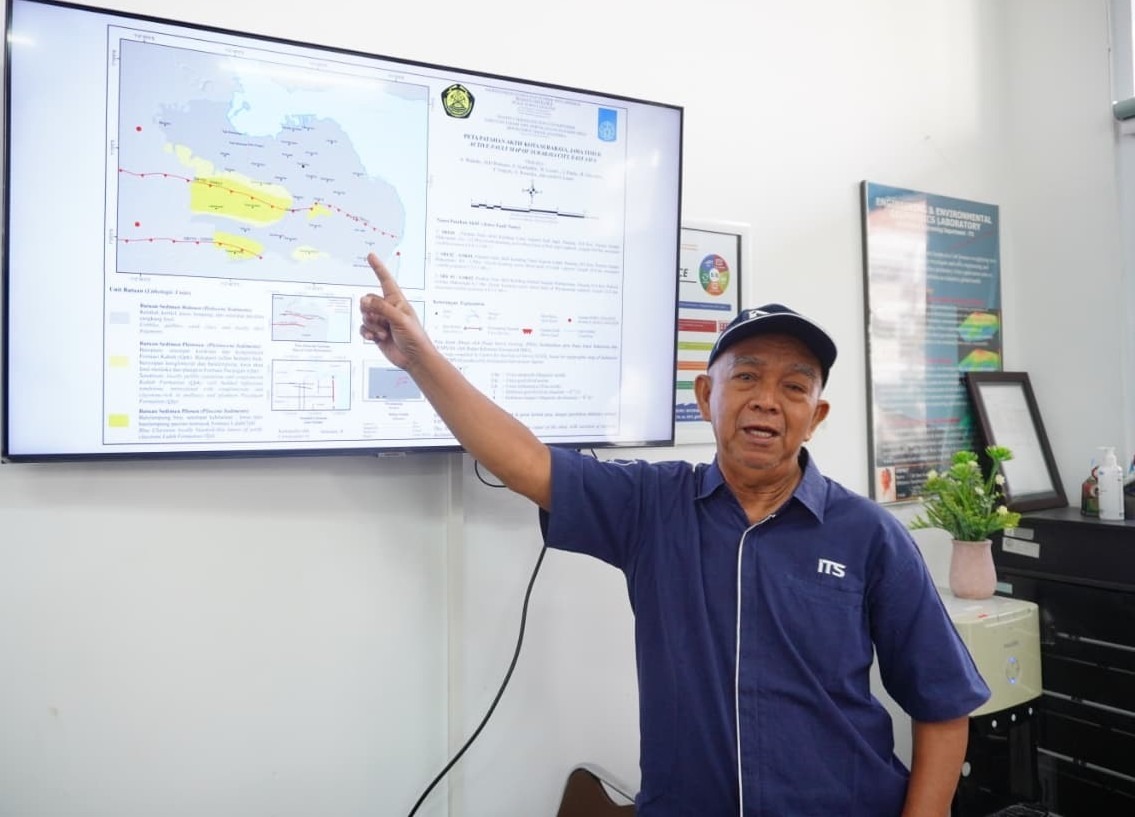
Responding to the viral information, Amien explained that the existence of faults in the Surabaya area had indeed been part of previous research. ITS, together with the Geological Survey Center – Geological Agency of the Indonesian Ministry of Energy and Mineral Resources (ESDM), conducted research on fault maps in East Java, which was published in 2024. “The results of that research showed two faults: the Surabaya fault and the Waru fault,” he said.
According to Amien, both faults are potentially active and have experienced movement. The research findings also align with the fault map in Indonesia compiled by the National Earthquake Study Center (Pusgen) in 2024. “The fault that runs through Surabaya, Sidoarjo, and Bangkalan does exist, but it hasn’t been verified as active,” he explained.
ITS Geology Expert Dr Ir Amien Widodo MSi appealed to the public not to worry and to be more critical in responding to disaster information circulating on social media.
Amien emphasized that the presence of a fault does not automatically categorize it as an active fault. Further research is needed to confirm the activity of a fault based on scientific evidence and studies. “We must understand that there are active and inactive faults. To call it an active fault, further research is needed,” he explained.
Therefore, Amien urged the public to be more critical in responding to disaster information circulating on social media. He emphasized that information that has not been scientifically verified should not be used to incite panic.
On the other hand, Amien believes that local governments still need to improve their preparedness for potential earthquakes. In this regard, the Surabaya City Government (Pemkot) can prepare ground movement or shift detection equipment as part of monitoring and mitigation efforts.
In addition to monitoring, compiling maps of earthquake-prone areas is also considered crucial as a basis for determining development policies. The government can ensure that buildings in at-risk areas meet earthquake-resistant building standards, thereby minimizing the potential impacts of an earthquake. These mitigation measures are crucial so that information about faults doesn’t just lead to anxiety but also promotes disaster preparedness.
These mitigation strengthening efforts align with ITS’s commitment to supporting the achievement of the Sustainable Development Goals (SDGs), particularly point 11 on Sustainable Cities and Settlements, to create a more resilient urban environment prepared to face various potential disaster risks. (ITS Public Relations)