Published on
Friday, 13 November 2026
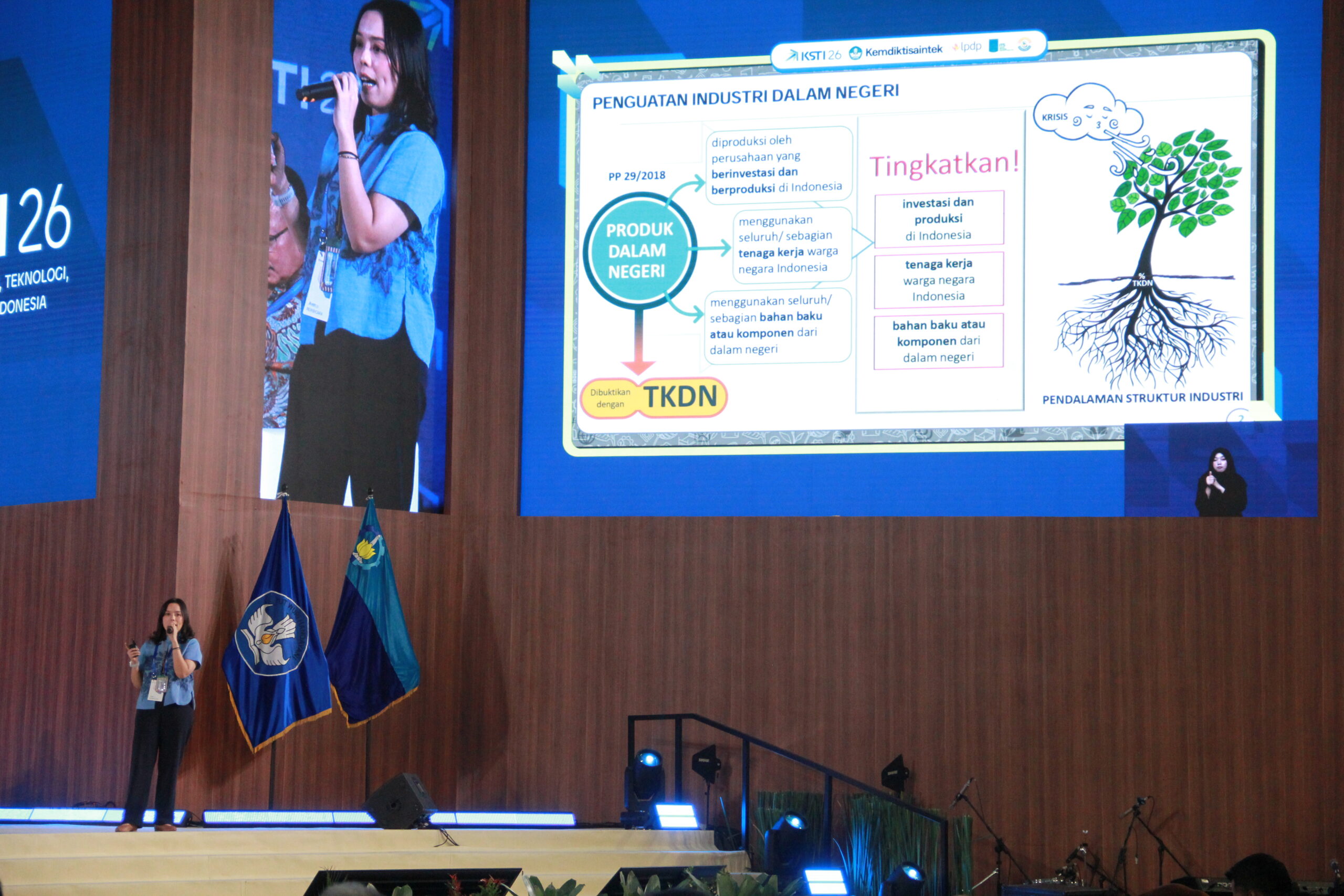
ITS Campus, ITS News – The 2026 Indonesian Science, Technology, and Industry Convention (KSTI), held by the Ministry of Higher Education, Science, and Technology (Kemdiktisaintek) at the Sepuluh Nopember Institute of Technology (ITS), presented innovations and research from innovators and universities. Concurrently with the event, the Indonesian Ministry of Industry (Kemenperin) presented the program to Increase the Use of Domestic Products (P3DN) on Thursday (12/11).
The P3DN design is emphasized as an instrument to accelerate the downstreaming and commercialization of national innovations in line with the Impactful Diktisaintek Policy Direction echoed by the Ministry of Education and Technology.
The Head of the Implementation and Business Meeting Team at the P3DN Center, Dessy Lusyana Br Lubis, explained that P3DN is a government policy that aims to increase the use of domestically produced products.
“This policy was created because it relates to the Domestic Component Level (TKDN) as an instrument for measuring the local content of a product to encourage the use of products resulting from national innovation,” said Dessy.
Furthermore, Dessy, a representative from the Ministry of Industry, stated that several criteria must be met to be classified as a domestic product. According to Government Regulation (PP) No. 29 of 2018, these criteria range from production by companies investing and operating in Indonesia to Indonesian workers.
“Raw materials or components must also be from Indonesia to be categorized as a domestic product,” said Dessy.

Dessy also explained how the TKDN policy is aimed at encouraging national industries to process raw materials domestically. This measure aims to reduce international trade barriers and increase investment. Thus, this policy will create a more favorable climate for businesses.
Furthermore, this policy is also expected to support the utilization of domestic research and innovation, particularly in higher education. One example is the collaborative development of ventilators during the pandemic, which demonstrates the potential of local innovation to meet national needs.
“Through the implementation of P3DN, research and innovation products in Indonesia are expected to be able to increase the domestic workforce,” Dessy hoped.
Going forward, optimizing P3DN is expected to expand the utilization of national innovations while strengthening domestic industrial capacity. This effort aligns with SDG 9, which addresses Industry, Innovation, and Infrastructure, through technological development and increased national industrial competitiveness.
More information: