Published on
Monday, 9 November 2026

Amsterdam, ITS News — An educational technology innovation based on Artificial Intelligence (AI) has once again brought a student team from Institut Teknologi Sepuluh Nopember (ITS) to the international stage. Through the EduVent digital learning platform, two ITS students advanced to the HackaSTONE 2026 Grand Final at Vrije Universiteit Amsterdam (VU), the Netherlands, while earning their team mentor the Mentor Award.
The two students from the ITS Department of Information Systems are Aldiez Rizkia Centrinova and Dinny Maria Pical, members of the ITS EduVent Team. They had the opportunity to present their innovation titled EduVent: An AI-Integrated Adventure Learning Management System for Project-Based Learning in late October. This international competition was organized by the Association of Global AI Technomics Education & Exchange (GATEE) under the theme Agentic AI for Education.
HackaSTONE 2026 brought together around 150 teams from more than 50 universities across 20 countries. Participants were challenged to develop AI agents to address various educational issues, ranging from primary and secondary education to higher and vocational education. As one of the finalists, the ITS EduVent Team participated in a series of activities held as part of the Dutch Conference on AI for Education, including presentations before international judges, project exhibitions via demonstration booths, and networking sessions with academics and participants from various countries.
Aldiez, as Team Leader, explained that EduVent is a digital learning platform that integrates AI, Adventure-Based Learning, gamification, and digital portfolios. This innovation was developed to address challenges in conventional learning, such as low student engagement, limited learning personalization, and the high administrative burden on educators in monitoring student progress.
Unlike conventional Learning Management Systems (LMS), Aldiez continued, EduVent offers a digital adventure-based learning approach through a system of quests and challenges. This approach encourages students to act as digital explorers who actively complete projects and collaborate. “Every learning process is also automatically documented into a digital portfolio and learning CV as a track record of student competencies,” he explained.
According to Aldiez, the platform is also equipped with five AI-based features: AI Mentor Twin, AI Feedback Assistant, Reflective Writer, Engagement Predictor, and Adaptive Quest Recommender. Through these features, students receive more adaptive learning guidance and recommendations. Meanwhile, educators can utilize a monitoring dashboard, automated assignment management, and student progress analytics to support learning evaluation.
To date, according to Aldiez, EduVent has been implemented at SMPN 9 Madiun, SMP Islam Al Azhar 13 Surabaya, and the ITS Digital Innovation Study Program, serving more than 450 active users. Initial implementation results show an increase in student engagement of up to 70 percent, an 80 percent portfolio documentation success rate, and a reduction in educator administrative time of up to 40 percent.
In its evaluation process, HackaSTONE 2026 applied four main criteria: Innovation and Novelty, Technical Readiness Level, Commercial Viability, and Educational Significance and Applicability. These four aspects measure the novelty of the innovation, technological readiness, product sustainability potential, and its contribution to improving educational quality and applicability in real learning environments.

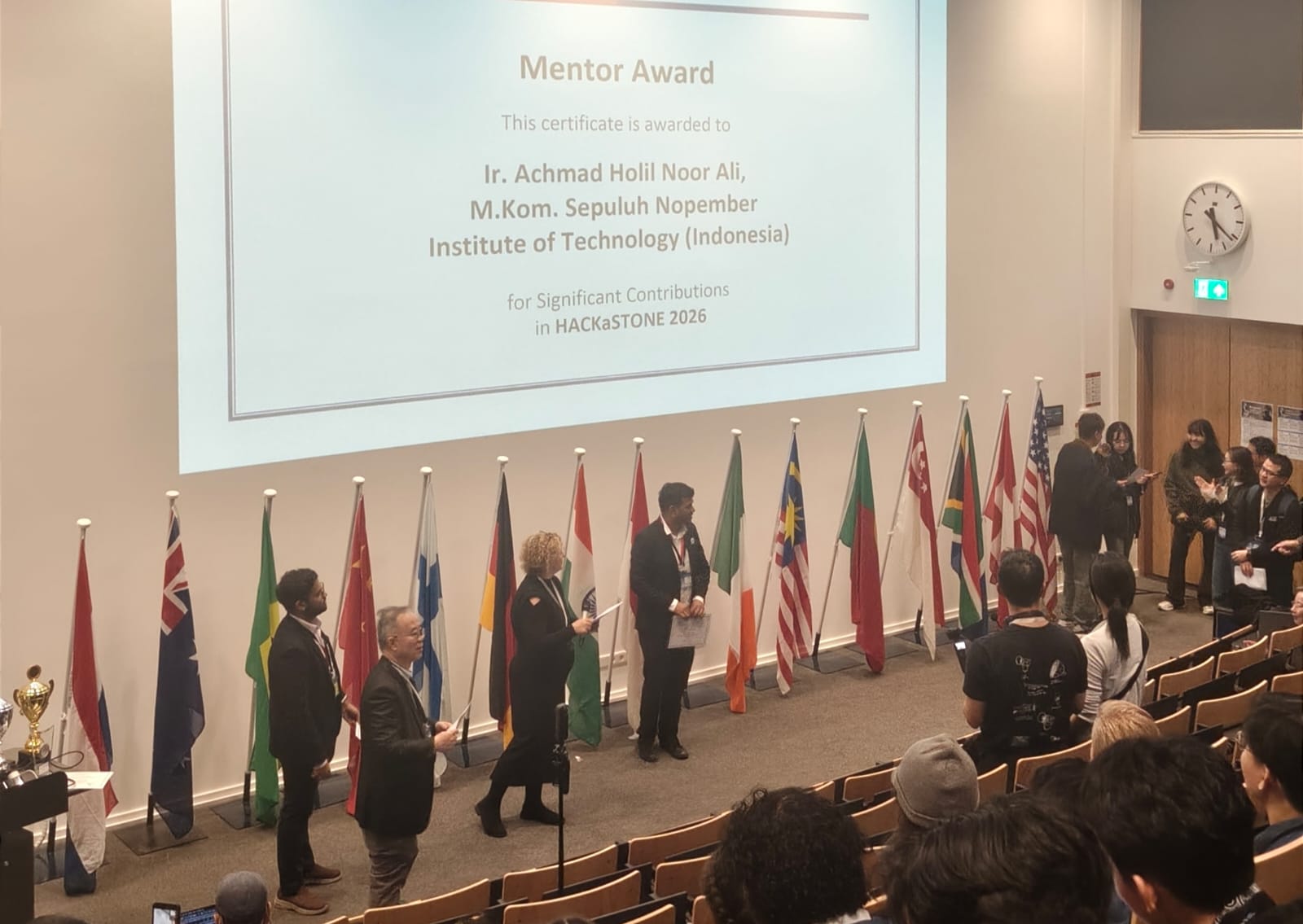
This achievement also earned Ir Achmad Holil Noor Ali MKom, a member of the ITS EduVent Team, the Mentor Award at the HackaSTONE 2026 Grand Final. The award recognizes his contribution in mentoring and guiding the development of AI innovations in education.
The lecturer, commonly known as Holil, stated that students possess great potential to drive change through innovation. According to him, a mentor’s role is not only to help develop ideas, but also to encourage students to turn those ideas into solutions that deliver tangible benefits. “I have always believed that students have immense potential to create change through innovation,” he said.
Behind this accomplishment, the ITS EduVent Team’s journey to the Grand Final was not without challenges. Competing against leading global universities—such as Nanyang Technological University (NTU), National University of Singapore (NUS), and Tsinghua University—required the team to continuously refine their innovation so it was ready to be presented and demonstrated before international judges.
Meanwhile, Dinny encouraged students not to treat perfection as a prerequisite to start creating. According to her, the willingness to keep learning and complement one another is an essential part of developing innovation. “Start with what we have, keep learning, complement each other, and never stop growing because every process and difficulty is always part of the journey toward greater achievements,” she advised.
Through this achievement, ITS continues to strengthen its commitment to advancing the development and downstreaming of science and technology, particularly the application of AI in education. This innovation by the ITS academic community also supports the achievement of the Sustainable Development Goals (SDGs), specifically Goal 4 on Quality Education, Goal 9 on Industry, Innovation, and Infrastructure, and Goal 17 on Partnerships for the Goals. (HUMAS ITS)