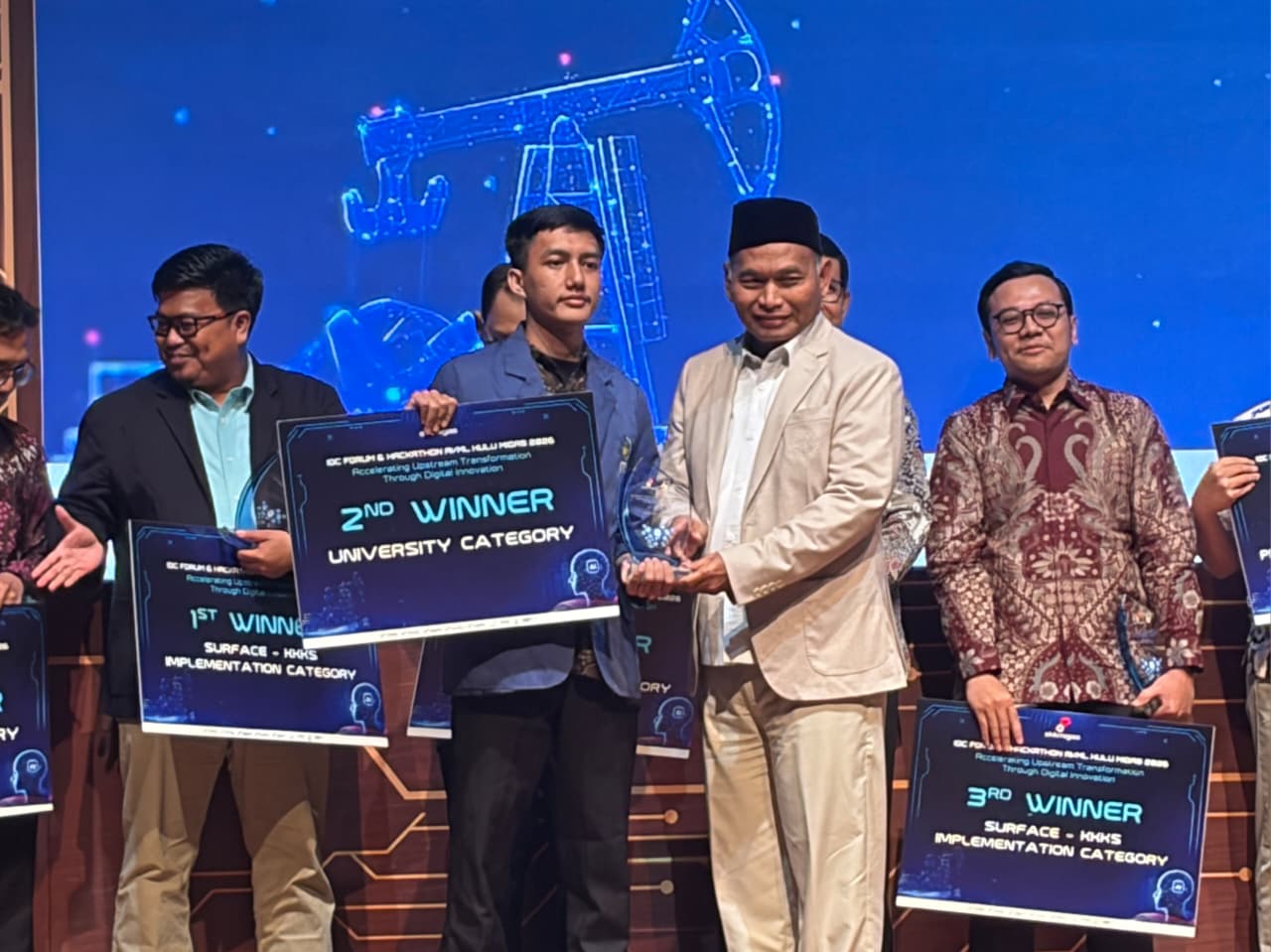
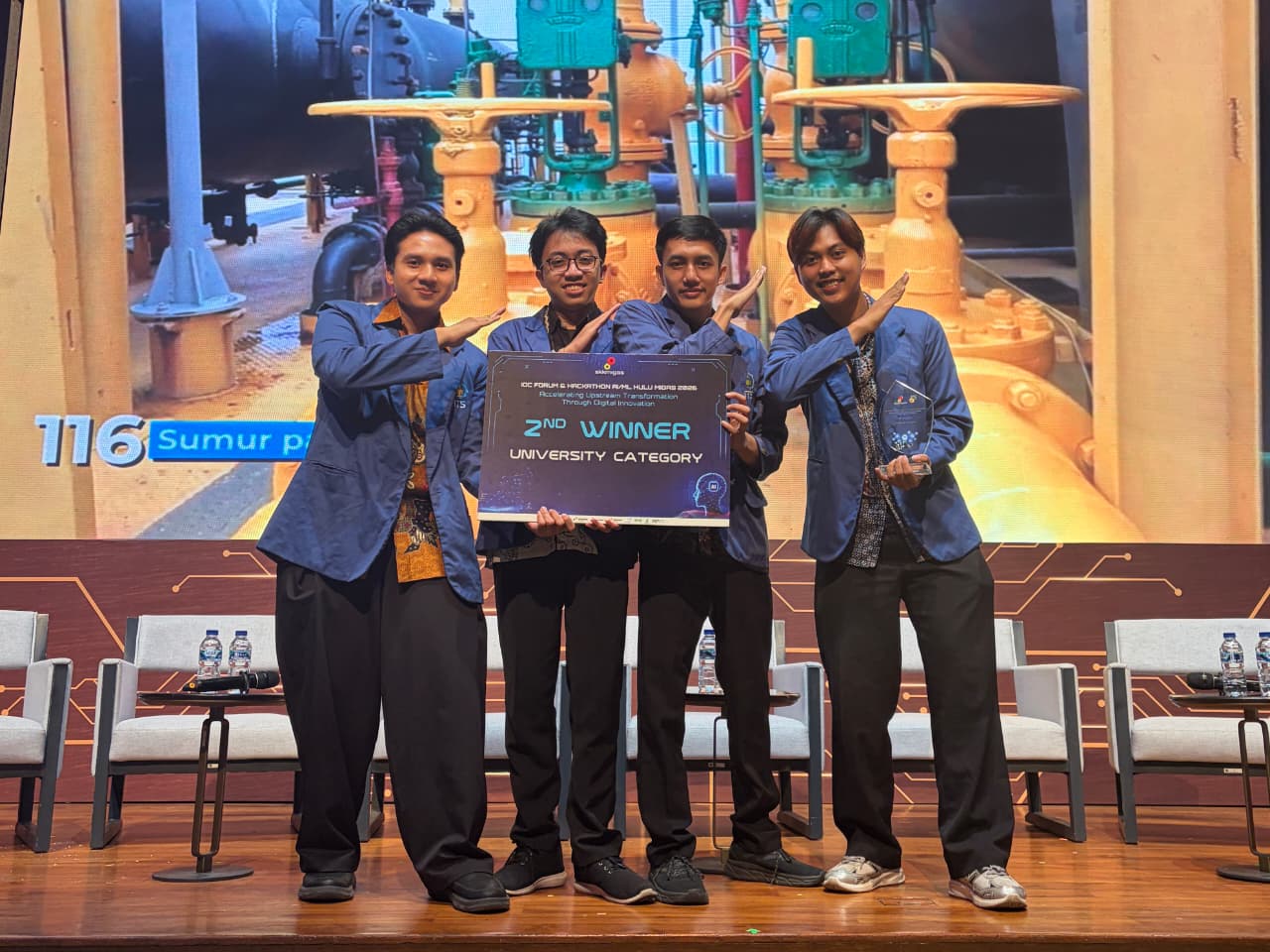
The ITS Hasta Team won second place in the university category at the 2026 IOC Forum & AI/ML Upstream Oil and Gas Hackathon, organized by SKK Migas
ITS Campus, ITS News — More good news has come from the academic community at Institut Teknologi Sepuluh Nopember (ITS). This time, the Hasta team from the ITS Department of Informatics Engineering won second place in the University category at the 2026 IOC Forum & AI/ML Upstream Oil and Gas Hackathon, organized by SKK Migas in Jakarta recently.
Explaining further, Avin said that the oil and gas industry follows a routine maintenance schedule that often temporarily halts the entire production process. Creating this schedule manually can take 40 to 80 hours, due to thousands of interdependent tasks that must follow various operational rules. “As a result, rule violations often go unnoticed by planners,” he said.
The Hasta Team from the Department of Computer Engineering at ITS, which won first place at the 2026 IOC Forum & AI/ML Upstream Oil and Gas Hackathon
Recognizing this gap, the Hasta team developed TAROS, which can automatically generate schedules while adhering to resource capacities and job sequences. The team combined Deep Reinforcement Learning (DRL), Graph Neural Networks (GNN), and the Serial Schedule Generation Scheme (SSGS). Avin explained that the method had originally been used for maintenance scheduling in the fertilizer industry, and his team later adapted it for the oil and gas sector.
As a result, testing using real maintenance data comprising 5,000 tasks and 39 types of resources produced strong results. TAROS was able to reduce scheduling time to approximately five hours and identify violations that had been overlooked in manual planning. The system also accelerated schedule completion by up to one day in cases where further optimization was possible.
Furthermore, the Hasta team also conducted a simulation to illustrate the potential benefits. Based on data from Pertamina Hulu Rokan’s (PHR) Pinang East Field in December 2024, the team assumed that a single field could produce 2.350 barrels of oil per day. Implementing TAROS across PHR’s 80 active fields is estimated to prevent production losses of up to Rp 3,2 billion per maintenance cycle. “These figures are purely based on simulations and have not yet been tested directly at PHR’s fields,” explained the head of the Hasta team.
This achievement in AI-based automation further strengthens ITS’s support for the Sustainable Development Goals (SDGs), including Goal 8 on Decent Work and Economic Growth, Goal 9 on Industry, Innovation, and Infrastructure, and Goal 12 on Responsible Consumption and Production. (ITS Public Relations)