
Published on
Friday, 7 August 2026
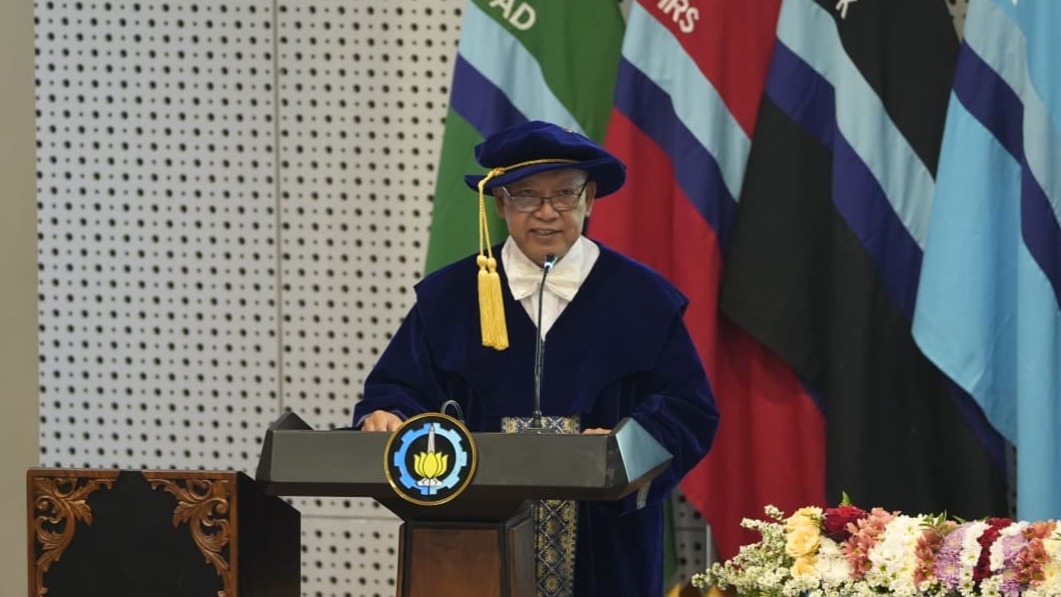
ITS Campus, ITS News – Indonesia’s tropical and disaster-prone geography demands reliable communication systems in a variety of conditions. In response, Prof. Dr. Ir. Achmad Mauludiyanto, MT, the 255th Professor at the Sepuluh Nopember Institute of Technology (ITS), developed radio wave modeling for various telecommunications applications.
The Professor from the ITS Department of Electrical Engineering explained that understanding the characteristics of radio waves in Indonesia is key to designing optimal telecommunications systems. Through accurate modeling, service quality can be improved while reducing implementation costs. “This modeling will ultimately reduce implementation costs and improve service quality,” he said.
In a scientific speech titled “Radio Wave Modeling for Various Telecommunication Applications ,” the man known as Maulud presented several pieces of his research in the development of modern communications technology. This research included modeling rain attenuation, developing emergency communications systems, and technology for smart hospitals.
One of his research projects focuses on modeling tropical rainfall attenuation at the rain-sensitive 28 GHz frequency using the Auto-Regressive Integrated Moving Average (ARIMA) model. Simply put, ARIMA is a time series statistical method used to understand and predict future data behavior based on patterns in past data. “This ARIMA(0,1,1) modeling enables the development of a more stable 5G network in urban areas that is resilient to extreme weather,” he said.
Furthermore, the lecturer in the ITS Telecommunications Engineering Study Program highlighted the importance of emergency communications using a High Frequency (HF) communication system in the 3–30 MHz band. This system enables long-distance communication through ionospheric reflections and is easy to implement. These advantages make it a potential communication alternative for remote areas and areas affected by telecommunications network disruptions.
Maulud explained that one of the methods used is Near Vertical Incidence Skywave (NVIS) to eliminate satellite-dependent communications during emergencies. As HF waves propagate through the ionosphere, they naturally split into ordinary (O) and extraordinary (X) waves. This characteristic was then exploited to develop a Multiple-Input Multiple-Output (MIMO) system to increase communication capacity.
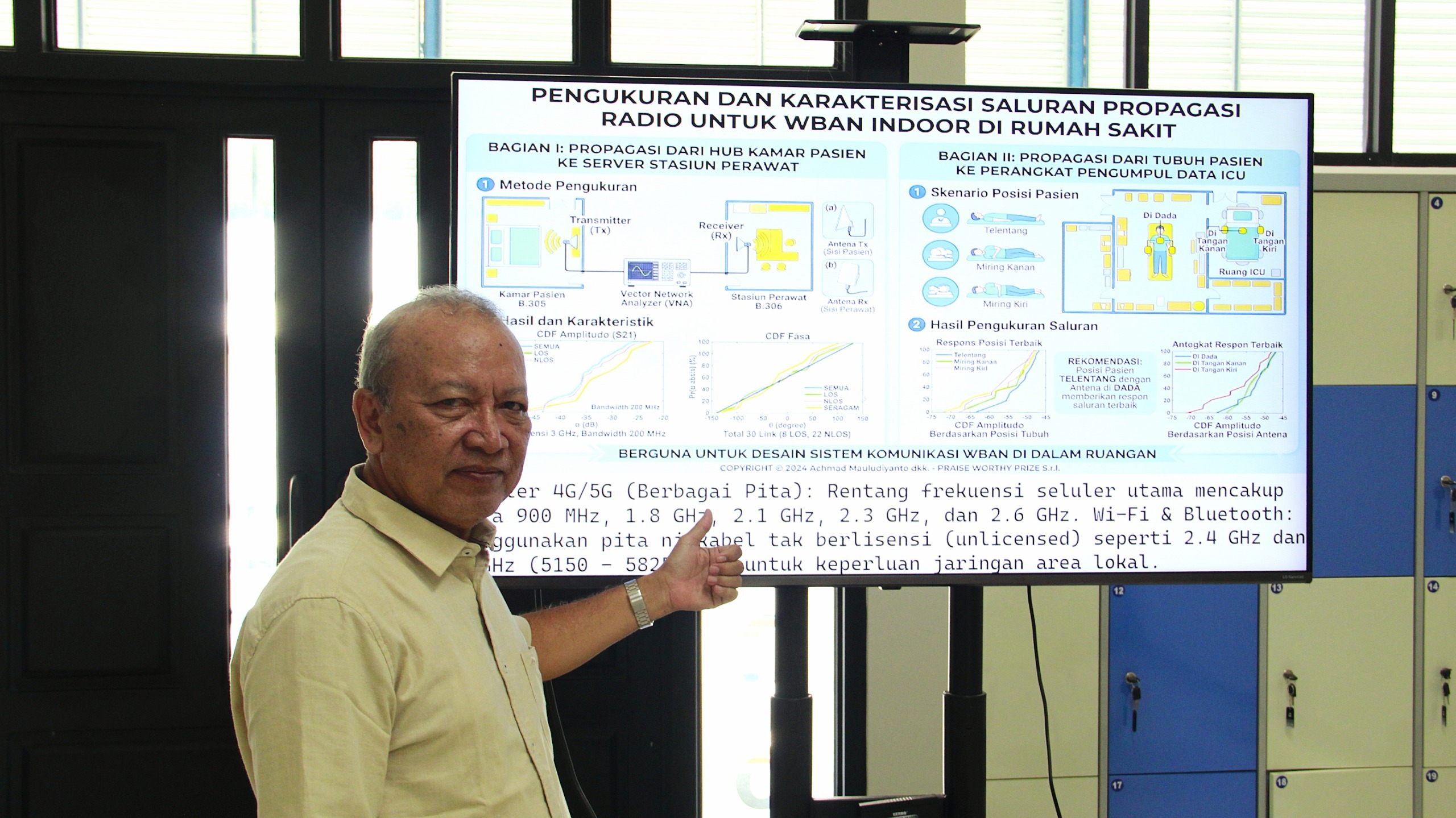
Furthermore, the man born in Sampang on September 3, 1961, is also developing communications technology for the healthcare sector through Wireless Body Area Networks (WBAN). This technology is a wireless sensor network for monitoring the condition of the human body, thus supporting the development of smart hospitals in Indonesia.
In this latest research, measurements were conducted taking into account several factors, including patient position, sensor placement, and room conditions. The results showed that these factors influence the quality of the received signal, thus providing the basis for developing a more reliable patient monitoring system for smart hospitals. “This research was conducted to support the development of smart hospitals,” he said.
Going forward, the ITS doctoral alumnus hopes that research on radio wave propagation will continue to develop and address technological challenges in Indonesia. He believes that research results must provide tangible benefits to society while supporting improvements in the quality of more robust communications technology. “Hopefully, this research can be implemented for the community and continue to be developed according to needs,” he concluded hopefully.
Maulud’s efforts to develop radio wave modeling for various telecommunications applications are a strategic step towards the nation’s technological independence. This supports the achievement of the Sustainable Development Goals (SDGs), particularly point 9 on Industry, Innovation, and Infrastructure, through the development of communications technology, emergency communications, and efforts to support the development of smart hospitals. (ITS Public Relations)
Reporter: Ahmad Maulana