ITS Supports Scientific Contribution in Post-Disaster Rehabilitation Consortium
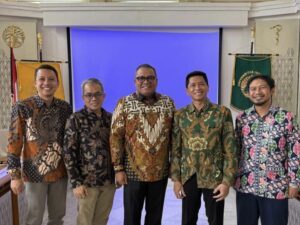
Chair of MRPTNI Prof. Dr. Ir. Eduart Wolok, S.T., M.T. (center) together with the Rector and ITS leadership after the Higher Education consortium event at Universitas Indonesia
ITS Campus, ITS News — Institut Teknologi Sepuluh Nopember (ITS) takes part in the Higher Education Consortium for Post-Disaster Rehabilitation and Reconstruction. This involvement serves as a form of ITS’s commitment in presenting real contributions that have a direct impact on the wider community in Indonesia.
ITS Rector Prof. Dr. (HC) Ir. Bambang Pramujati, S.T., M.Sc.Eng., Ph.D., stated that this higher education consortium was formed as a response to the complexity of hydrometeorological disasters, specifically floods and landslides that struck the Aceh region and other parts of Sumatra. He explained that these disasters have a systemic impact on settlements, infrastructure, the local economy, and social resilience. “Many higher education institutions have moved to help, but to produce a greater impact, joint synergy is needed,” he added.
In line with that, the Ministry of Higher Education, Science, and Technology (Kemendiktisaintek) together with the Council of Rectors of Indonesian State Universities (MRPTNI) initiated the formation of the Higher Education Consortium for Post-Disaster Rehabilitation and Reconstruction. In this consortium, the Directorate General of Research and Development (Risbang) of Kemendiktisaintek acts as a strategic driver that facilitates the formation of the consortium, coordinates the role of higher education institutions, and encourages research results and community service to support recovery program policies.
In this consortium, Bambang stated that ITS is entrusted as the Coordinator of the Geospatial Working Group (Pokja) as well as the Sub-coordinator of the Housing and Settlement Working Group. Furthermore, ITS also provides its contribution in various other working groups, such as health and psychosocial, disaster education and literacy, infrastructure, economic and social recovery, risk management, and spatial planning.
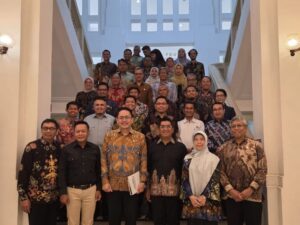
Director General of Research and Development of Kemendiktisaintek Dr. M. Fauzan Adziman, S.T., M.Eng. (third from the front left) together with Rectors of Indonesian Higher Education Institutions at UI
As part of that role, the doctoral graduate from the University of New Brunswick, Canada, revealed that ITS contributes in the geospatial field through high-resolution mapping to identify damage levels, vulnerability zoning, and post-disaster landscape changes. “Spatial data becomes an important basis in recovery planning so that it can be done right on target and based on risk,” explained this ITS Mechanical Engineering Professor.
Furthermore, in the housing and settlement sector, Bambang elaborated on ITS’s role in developing settlement assessment systems as well as risk-based temporary shelter (huntara) and permanent shelter (huntap) designs integrated with spatial data and spatial planning. This approach continues the active role of the ITS Humanitarian Task Force led by Prof. Dr. Nurul Jadid, S.Si., M.Sc., which has gone directly into the field in Aceh and Sumatra since last December 2025.
Through this consortium, the 13th Rector of ITS explained that ITS targets concrete and applicable outputs in the working groups that are ITS’s responsibility. The planned outputs are integrated risk maps, rehabilitation and reconstruction monitoring dashboards, technical recommendations for housing and infrastructure, and policy briefs for the central and regional governments as a basis for decision-making. “All outputs will later be compiled based on science to ensure the utilization of the disaster recovery budget is effective and sustainable,” said Bambang.
He stated that the steps taken are in line with ITS’s commitment in disaster handling, starting from the 2004 Aceh tsunami, 2018 Lombok earthquake, Semeru eruption, to various recent hydrometeorological disasters. With strength in the field of engineering combined with social and humanitarian approaches, ITS is optimistic about being able to play an active role in providing impactful contributions through the comprehensive capacity possessed to support post-disaster rehabilitation and reconstruction.
Going forward, Bambang also expressed his hope that this higher education consortium can become a long-term collaboration platform between higher education institutions in national disaster risk management. Not only that, the efforts made by ITS through this consortium are also expected to be able to support the achievement of Sustainable Development Goals (SDGs). Specifically SDG 9 regarding Industry, Innovation, and Infrastructure, SDG 11 regarding Sustainable Cities and Communities, SDG 13 regarding Climate Action, and SDG 17 regarding Partnerships for the Goals. (ITS PUBLIC RELATIONS)
Reporter: Aulia Okta Wijaya
Related News
-
ITS Supports Scientific Contribution in Post-Disaster Rehabilitation Consortium
ITS Campus, ITS News — Institut Teknologi Sepuluh Nopember (ITS) takes part in the Higher Education Consortium for Post-Disaster Rehabilitation
January 21, 2026 00:01 -
ITS Becomes One of the Top Recipients of the Hitachi Innovation Awards
ITS Campus, ITS News — Institut Teknologi Sepuluh Nopember (ITS) continues to demonstrate its commitment to strengthening research and innovation.
January 21, 2026 00:01 -
Strengthening the Role of Higher Education Institutions, ITS Attends the Briefing of the President of the Republic of Indonesia
Jakarta, ITS News — Institut Teknologi Sepuluh Nopember (ITS) never stops continuously being involved in the development of the
January 21, 2026 00:01 -
ITS Facilitates Aid for 34 ITS Students Who Are Victims of Sumatra Floods
ITS Campus, ITS News — Institut Teknologi Sepuluh Nopember (ITS) continues to show its concern for students affected by
January 21, 2026 00:01