Microplastic Rain Phenomenon: ITS Experts Remind of the Importance of Waste Management
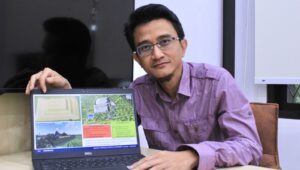
Professor of the Department of Environmental Engineering, ITS, Prof. Arseto Yekti Bagastyo ST MT MPhil PhD, showing a picture of the TPA planning in waste management.
ITS Campus, ITS News — The National Research and Innovation Agency (BRIN) last October reported findings of microplastic rain in Jakarta, followed by similar findings in several other areas. In response, environmental experts from the Environmental Engineering Department of the Sepuluh Nopember Institute of Technology (ITS) highlighted the weak management of waste, particularly plastic waste, in Indonesia as one of the causes of this phenomenon.
Discussing rain containing microplastics, Prof. Arseto Yekti Bagastyo, ST, MT, MPhil, PhD, stated that this condition indicates an escalation in the presence of microplastics. This phenomenon occurs due to atmospheric deposition, the process by which particles and substances from the atmosphere fall to the Earth’s surface. “Microplastics in rainwater also indicate the movement of microplastic pollutants in the air,” he added.
Arseto also explained the process by which secondary microplastics form in rainwater. It begins with the degradation of macroplastics, which produce microplastics measuring less than 5 millimeters. The release of these plastic particles into the environment can be caused by direct exposure to wind, heat, ultraviolet (UV) rays from the sun, changes in weather, and human activity.
This process of microplastic rain can give rise to a variety of new problems, forming a chain. Microplastics, originating in the air and falling through rain, can be carried back to rivers and oceans, where they are absorbed by the soil. Furthermore, microorganisms and various biota can also absorb them, indirectly accumulating in the human body, which can cause health problems.
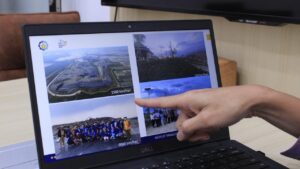
Prof. Arseto Yekti Bagastyo ST MT MPhil PhD shows the current waste management at the Final Processing Site (TPA)
Furthermore, the bespectacled lecturer highlighted the presence of plastic as a primary object that has become deeply embedded in today’s lifestyles. Its use, not accompanied by proper waste management, has created new, increasingly intractable problems. “This is also related to waste generation restrictions and management, which are still ineffective and inefficient,” he concluded.
This graduate of the University of Queensland, Australia, also revealed that many final processing sites (TPA) in Indonesia currently still operate as open dumping sites. Less than 50 percent of TPAs actually implement sanitary landfills, or controlled waste disposal. This professor in the field of waste management also revealed that this has served as a warning to local governments.
However, Arseto didn’t deny that the high operational costs of waste management, coupled with a lack of public awareness regarding waste sorting, are the main obstacles currently facing. The Surabaya native encouraged synergy and contributions from various parties, encouraging them to work together rather than relying on each other. “Waste management requires integration from upstream to downstream, involving all parties,” he said.
Ultimately, Arseto added that the current situation is a wake-up call from nature, one that he hopes will open everyone’s eyes. Efforts to address this issue can help achieve the Sustainable Development Goals (SDGs) , including point 12 on Responsible Consumption and Production and point 13 on Climate Change Management. “We hope that the efforts and roles of each party can be further enhanced,” Arseto concluded. (ITS Public Relations)
Reporter: Bella Ramadhani
Related News
-
ITS Supports Scientific Contribution in Post-Disaster Rehabilitation Consortium
ITS Campus, ITS News — Institut Teknologi Sepuluh Nopember (ITS) takes part in the Higher Education Consortium for Post-Disaster Rehabilitation
November 27, 2025 10:11 -
ITS Becomes One of the Top Recipients of the Hitachi Innovation Awards
ITS Campus, ITS News — Institut Teknologi Sepuluh Nopember (ITS) continues to demonstrate its commitment to strengthening research and innovation.
November 27, 2025 10:11 -
Strengthening the Role of Higher Education Institutions, ITS Attends the Briefing of the President of the Republic of Indonesia
Jakarta, ITS News — Institut Teknologi Sepuluh Nopember (ITS) never stops continuously being involved in the development of the
November 27, 2025 10:11 -
ITS Facilitates Aid for 34 ITS Students Who Are Victims of Sumatra Floods
ITS Campus, ITS News — Institut Teknologi Sepuluh Nopember (ITS) continues to show its concern for students affected by
November 27, 2025 10:11