ITS Professor Promotes Social Dimension as Key to Construction Project Success
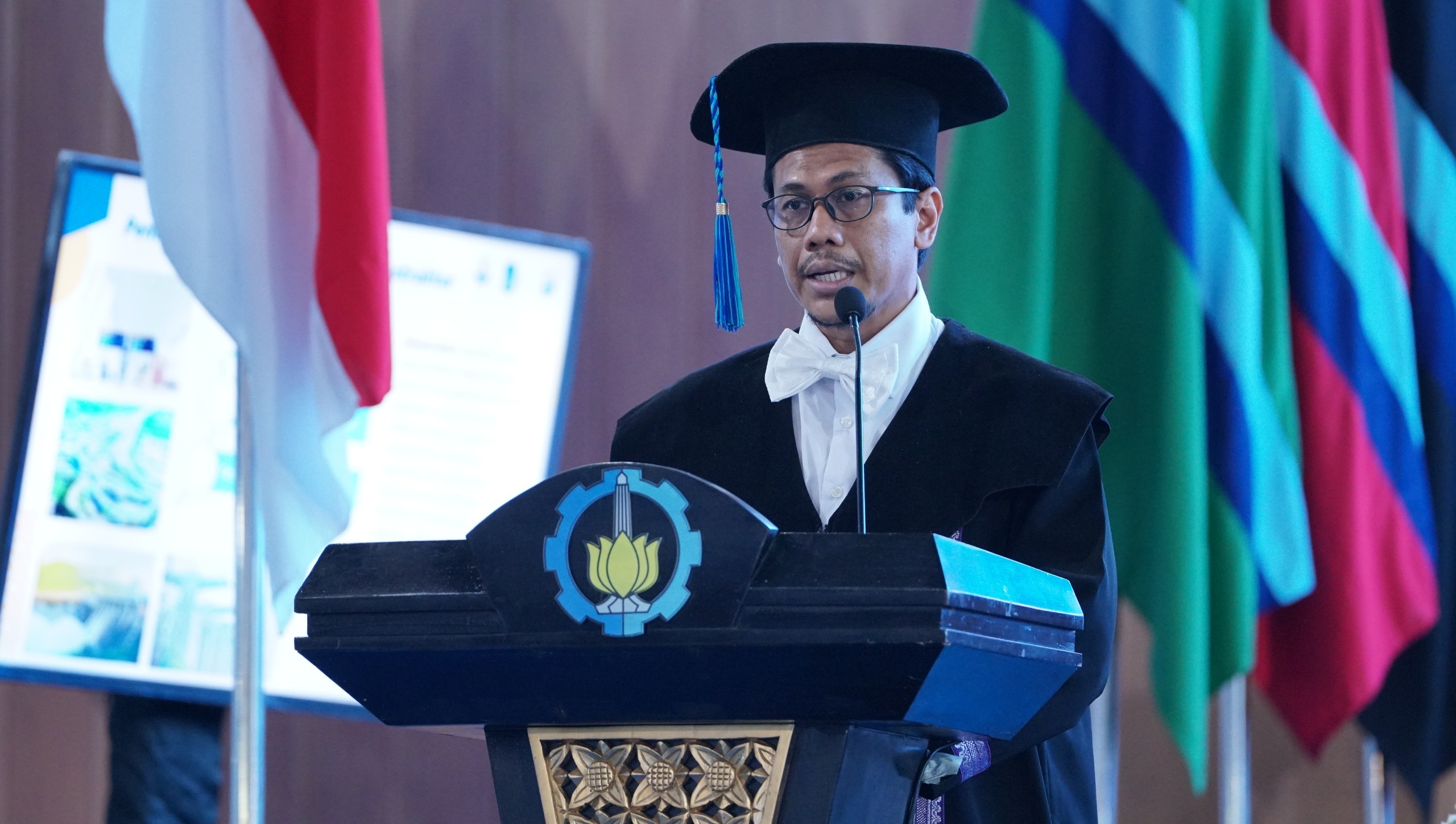
The 236th Professor of ITS, Prof. Ir. Mohammad Arif Rohman, ST, MSc, PhD, delivered his scientific oration at the Open Session for the Inauguration of ITS Professors at the ITS Sepuluh Nopember Building.
ITS Campus, ITS News — Construction projects are often perceived as merely technical matters, yet every piece of infrastructure carries a story for its surrounding environment. Recognizing this reality, the 236th Professor of the Sepuluh Nopember Institute of Technology (ITS), Prof. Ir. Mohammad Arif Rohman, ST., MSc., PhD., proposed a new idea in his scientific oration on the social dimensions that need to be considered in the construction world.
In his inaugural scientific speech as an ITS Professor, entitled Strengthening the Social Dimension in the Concept of Sustainable Infrastructure to Achieve Long-Term Success of Construction Projects in Indonesia , the man familiarly known as Arif highlighted the importance of strengthening the rarely discussed social dimension in infrastructure development. “Development is not only measured by short-term technical achievements, but also by the extent to which its benefits are truly felt by the community as users,” he said.
At the beginning of his speech, the professor from the ITS Civil Engineering Department explained a concept called the Triple Bottom Line (TBL). This concept emphasizes the importance of balanced integration in implementing the three main pillars of sustainable infrastructure: economic, environmental, and social. “However, in practice, attention is dominated by the economic dimension, with little emphasis on the environmental, and the social dimension is often neglected,” he said.
Based on this, the ITS Civil Engineering undergraduate alumnus proposed a breakthrough called Project Social Benefit (PSB). With a quantitative approach, PSB allows a project’s social benefits to be measured, monitored, and controlled more systematically, rather than simply being a mere slogan. “This approach provides a new perspective that infrastructure is truly there for people, not just a series of investment numbers,” emphasized the doctoral alumnus of Construction Management from the University of Melbourne, Australia.
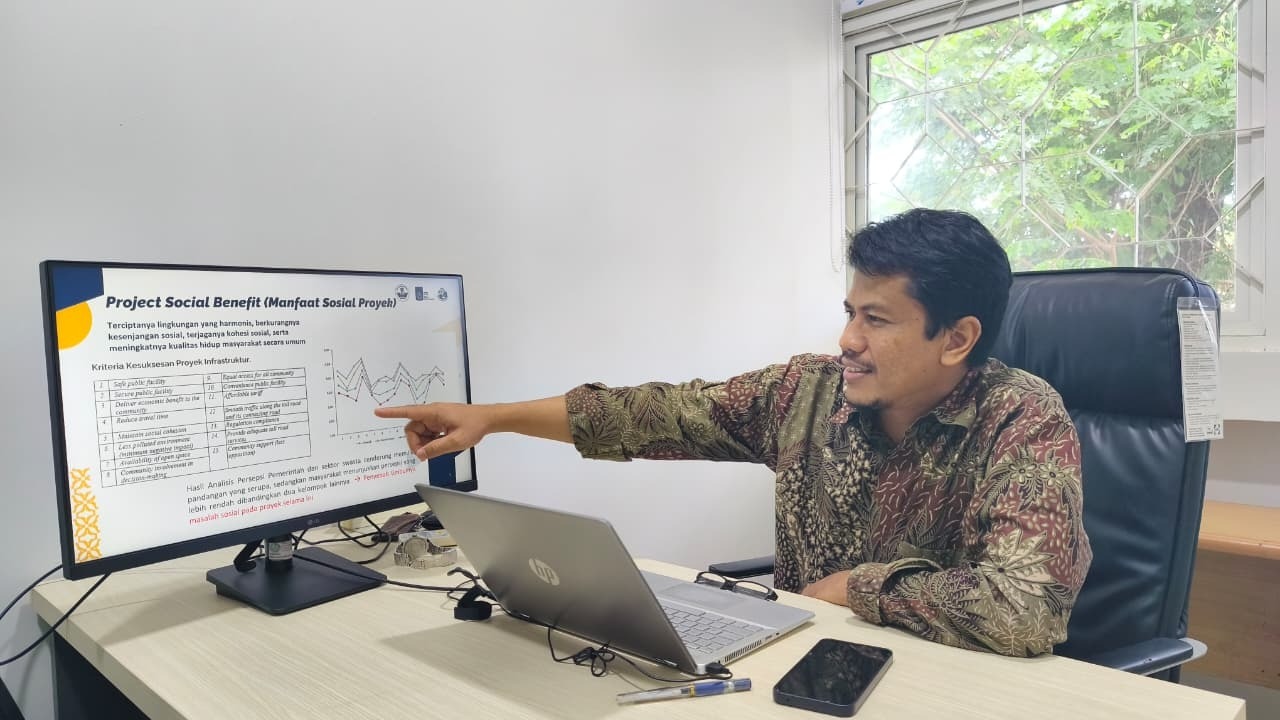
Prof Ir Mohammad Arif Rohman ST MSc PhD while explaining the perception graph of the success criteria for infrastructure projects from the government, private sector and the community.
To support his idea, the Sidoarjo-born professor presented his relevant research on eight toll road sections in Indonesia, where he found a gap between public expectations and the perceptions of project organizers. The public wants safe and comfortable facilities, equal access, maintained social cohesion, and the preservation of local culture. However, both the government and the private sector often prioritize technical solutions and short-term interests, focusing on cost, time, and quality.
However, Arif highlighted the main challenge in implementing the concept of social sustainability in Indonesia: limited awareness among stakeholders and the public about the importance of the social dimension. According to Arif, efforts to increase this understanding are crucial to directing development beyond short-term focus and toward long-term positive impacts, thus justifying the substantial costs incurred.
As a solution, the Head of the Program Planning and Budget Subdirectorate at the ITS Strategic Planning and Development Directorate (DPPS) is pushing for the implementation of the Public Private People Partnership (4P) concept. This concept is a refinement of the Public Private Partnership (PPP), which previously tended to involve only the government and the private sector. “By adding the people or community element, development is expected to be more inclusive and oriented towards the public interest,” he said.
Finally, Arif is optimistic that his research can be further developed to become a comprehensive tool for decision-makers. He even believes his contribution can help achieve Sustainable Development Goals (SDGs), point 9 on Industry, Innovation, and Infrastructure, and point 11 on Sustainable Cities and Communities. (ITS PUBLIC RELATIONS)
Reporter: Aulia Okta Wijaya
Translator: Devinka Mutianeira
Related News
-
ITS Supports Scientific Contribution in Post-Disaster Rehabilitation Consortium
ITS Campus, ITS News — Institut Teknologi Sepuluh Nopember (ITS) takes part in the Higher Education Consortium for Post-Disaster Rehabilitation
October 24, 2025 10:10 -
ITS Becomes One of the Top Recipients of the Hitachi Innovation Awards
ITS Campus, ITS News — Institut Teknologi Sepuluh Nopember (ITS) continues to demonstrate its commitment to strengthening research and innovation.
October 24, 2025 10:10 -
Strengthening the Role of Higher Education Institutions, ITS Attends the Briefing of the President of the Republic of Indonesia
Jakarta, ITS News — Institut Teknologi Sepuluh Nopember (ITS) never stops continuously being involved in the development of the
October 24, 2025 10:10 -
ITS Facilitates Aid for 34 ITS Students Who Are Victims of Sumatra Floods
ITS Campus, ITS News — Institut Teknologi Sepuluh Nopember (ITS) continues to show its concern for students affected by
October 24, 2025 10:10