ITS Professor Initiates Optimization of Natural Resource Management towards Indonesia Emas 2045
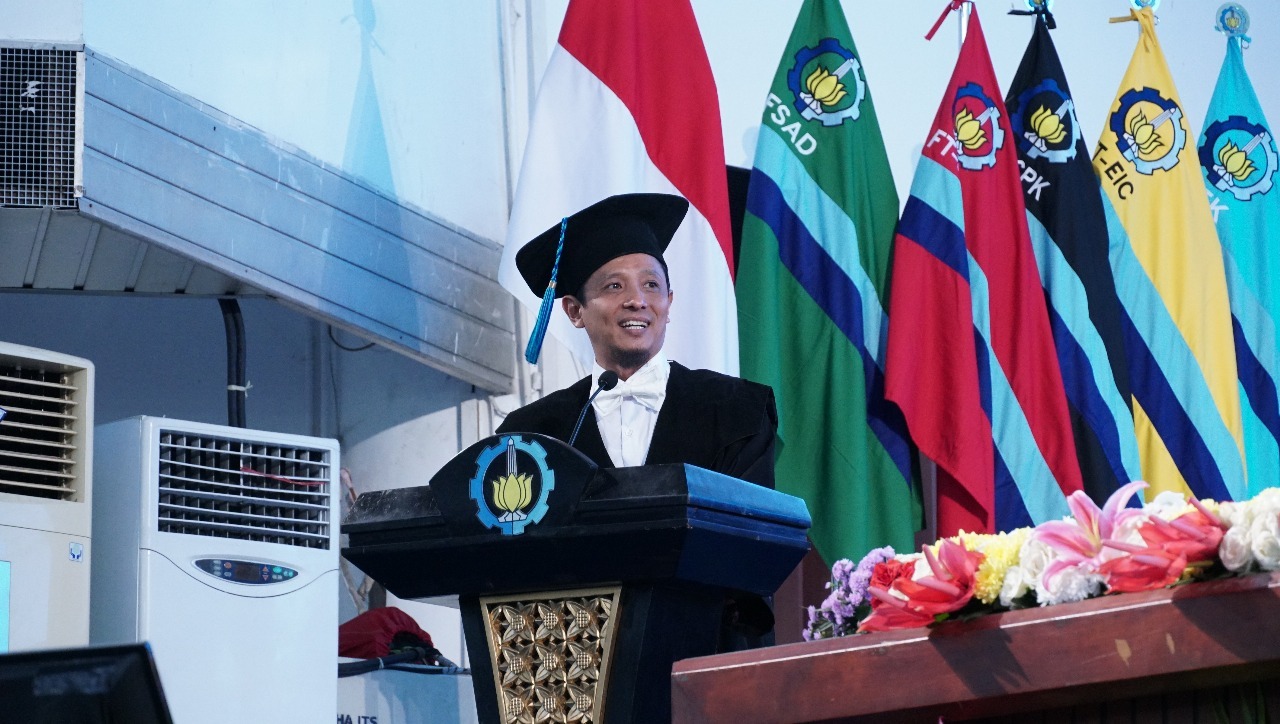
The 222nd Professor of ITS, Prof Sigit Tri Wicaksono SSi MSi PhD, from the Department of Materials and Metallurgical Engineering at ITS, delivered a scientific speech at the ITS Professor Inauguration Ceremony
ITS Campus, ITS News — The abundance of natural resources in Indonesia presents both opportunities and challenges for achieving Indonesia Emas 2045. Addressing these challenges, the 222nd Professor of the Institut Teknologi Sepuluh Nopember (ITS), Prof Sigit Tri Wicaksono SSi MSi PhD, examined the optimization of natural resource management for national independence towards Indonesia Emas 2045.
Sigit explained that Indonesia possesses diverse natural wealth in the form of abundant flora and fauna with a unique combination in Asia-Africa. Moreover, in 2024, Indonesia’s nickel production reached 2.2 million tons, equivalent to 59.46 percent of global nickel production. “This figure demonstrates the immense natural wealth Indonesia possesses,” he stated.
In his scientific speech, Sigit said that there are three keys in the scientific field he specializes in. Namely, natural materials as scientific objects, then functionality as a process of increasing added value, and finally engineering as a systematic step in the functional process. “These three keys, if done optimally, will increase the selling value to be highly competitive,” said the Professor in the field of natural material functional engineering.
For the optimization of highly competitive raw materials, the Professor from the Department of Materials and Metallurgical Engineering at ITS explained that two processes can be carried out, namely synthesizing/refining and functionalization. “These two scientific innovations can help the community in managing natural resources in Indonesia,” he said.
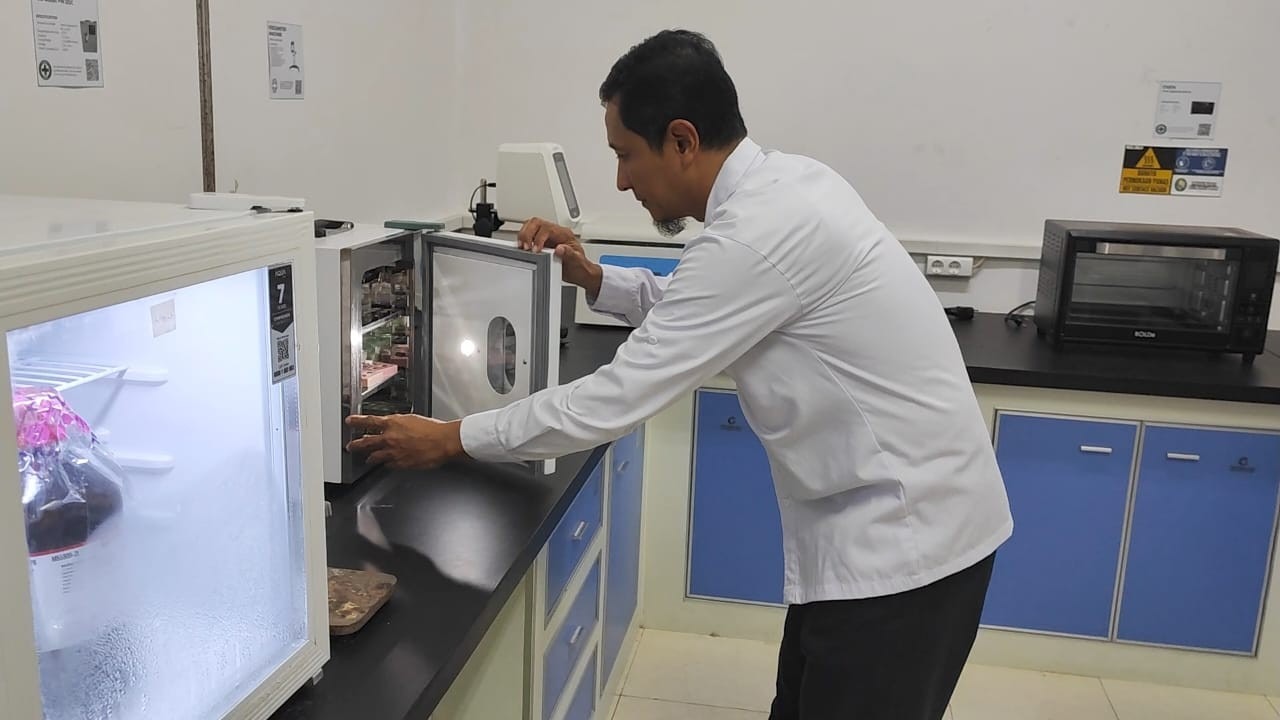
Prof Sigit Tri Wicaksono SSi MSi PhD, researching the optimization of natural resource management in Indonesia
Furthermore, synthesizing/refining is divided into two more processes, namely co-precipitation, which involves chemical and physical processes, and electrolysis, which involves electrical, chemical, and physical processes. In the principle of co-precipitation, the chemical reaction process involves dissolution, such as ionization or decomposition of materials into cations and anions, followed by recomposition into new controlled compounds, followed by a physical process of precipitation.
Continuing his explanation, Sigit explained that electrolysis is a decomposition process that uses an electric current. Next is recomposition, which is a process of forming new compounds in a controlled manner through precipitation and filtration. “The difference between the two processes lies in the use of electric current in the process series,” he said.
In addition to synthesizing/refining, functional scientific innovation is also divided into two processes, namely compositing and doping. Compositing itself is the process of combining two or more materials to produce a new material with properties different from the previous materials. “This process makes one material a binder but another material a reinforcement,” explained the ITS Physics alumnus.
Unlike compositing, doping is the addition of additional materials to the primary material without changing the structure of the main material. He said that the process must be carried out systematically to obtain results that meet a wider range of needs. “This process can be called engineering,” he said.
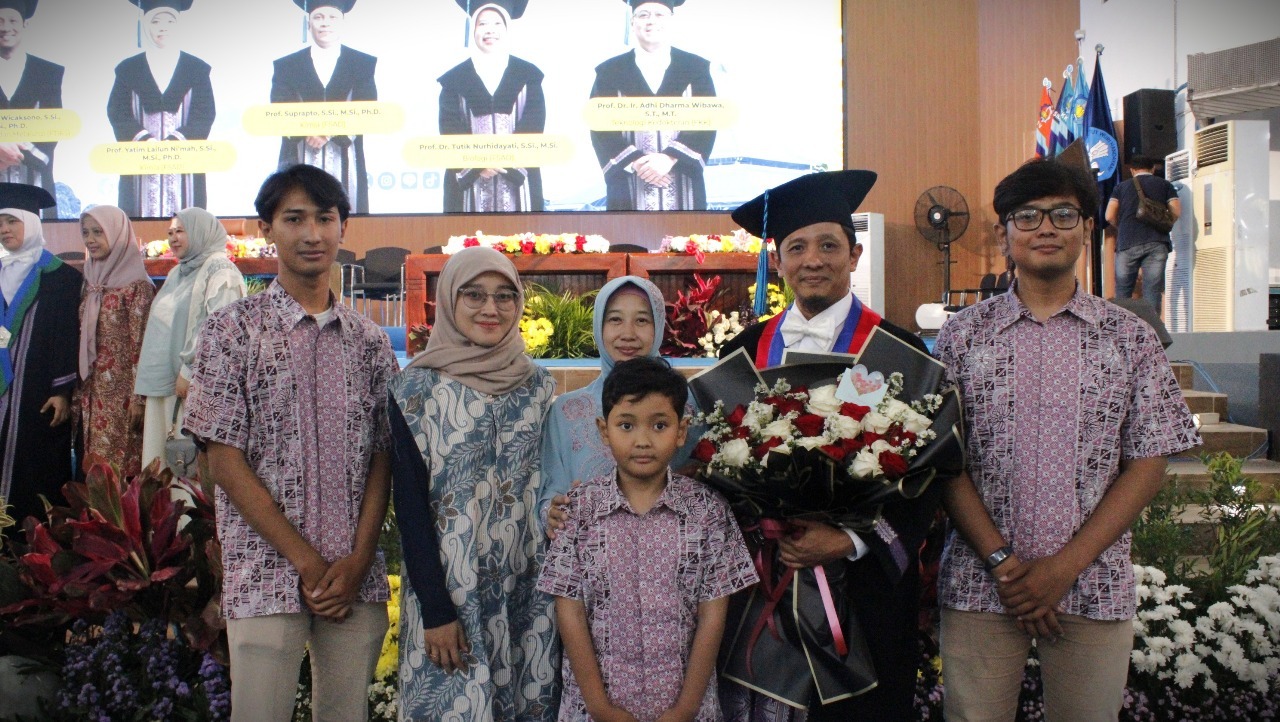
Prof Sigit Tri Wicaksono SSi MSi PhD (second from right) with his family after the ITS Professor Inauguration Ceremony at Graha Sepuluh Nopember ITS
The man born in 1978 explained that scientific innovation has been applied to produce Fe3O4 or magnetite using natural iron sand obtained from the southern coast of Java Island and several rivers in the mountains of Malang. “By utilizing an electric current of approximately 108 watts, I successfully extracted Fe3O4,” he explained.
According to Sigit, the usefulness of this scientific innovation can be a reference for scientists and researchers in the field of optimal utilization of natural materials, as well as practitioners of natural resource utilization in Indonesia, to improve the performance of domestic products. This is in line with Sustainable Development Goals (SDGs) point nine on infrastructure, industry, and innovation, and point 11 on sustainable cities and communities.
Concluding his scientific speech, the man from Pasuruan emphasized that functional engineering of natural materials is a tangible manifestation of the contribution of science to national independence. Through this approach, Indonesia is not only able to manage its natural resources wisely and sustainably, but also move towards achieving Indonesia Emas 2045, which is sovereign, independent, and highly competitive in the global arena. (ITS Public Relations)
Reporter: Muhammad Rafi Ardiansyah
Translator: Lael Soebakir
Related News
-
ITS Formulates Inclusive Education System Policy for Students with Disabilities
ITS Campus, ITS News — The Sepuluh Nopember Institute of Technology (ITS) has once again demonstrated its commitment to
August 20, 2025 16:08 -
ITS Develops Andal App, a Solution for MSMEs to Manage Inventory
ITS Campus, ITS News — Amidst rapid technological advancements, many Micro, Small, and Medium Enterprises (MSMEs) still rely on
August 20, 2025 16:08 -
Consolink, an Automatic Soil Consolidation Testing Solution Created by ITS Students
ITS Campus, ITS News — A collaboration between a team of students and lecturers from the Sepuluh Nopember Institute
August 20, 2025 16:08 -
Supporting Economic Empowerment, ITS Signs MOU with BSI
ITS Campus, ITS News — The Sepuluh Nopember Institute of Technology (ITS) continues to strengthen its tangible and sustainable
August 20, 2025 16:08