Completion of Doctoral Studies, ITS International Student Achieves 7 Reputable Publications
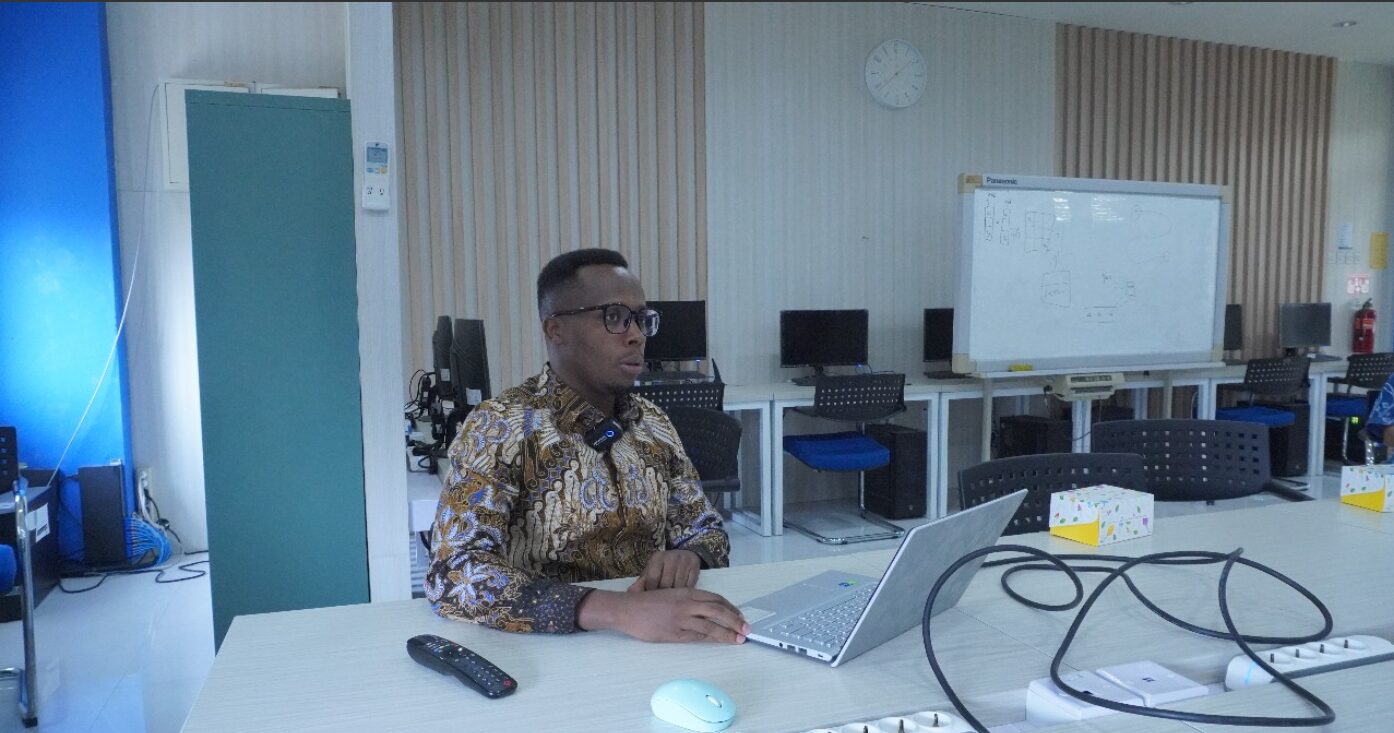
International student Ntivuguruzwa Jean De La Croix is a candidate for graduation in the 132nd graduation ceremony of the Doctor of Computer Science (S-3) program, Department of Informatics, Institut Teknologi Sepuluh Nopember (ITS)
ITS Campus, ITS News — Completing studies abroad demands high academic perseverance and personal resilience. However, these challenges did not prevent Ntivuguruzwa Jean De La Croix from Rwanda from completing his Doctoral program in Computer Science at the Department of Informatics, Institut Teknologi Sepuluh Nopember (ITS) with seven reputable Quartile 1 (Q1) Scopus publications.
Jean, as he is commonly known, revealed that he obtained the golden opportunity to study at ITS through the Developing Countries Partnership (KNB) scholarship from the Ministry of Higher Education, Science, and Technology of the Republic of Indonesia (Kemdiktisaintek RI). His decision to choose ITS was based on ITS’s strong reputation as a research and technology institution. “The academic environment at ITS provides me with ample space to develop ideas in the field of internet security,” he said.
Furthermore, Jean shared that his research focuses on digital information security. According to him, in the current era, digital data transmission has increased rapidly, and many people use social media, so there is a lot of data that needs to be kept confidential. Through this research, he is trying to create a better security system to protect personal data and sensitive information on various digital platforms.
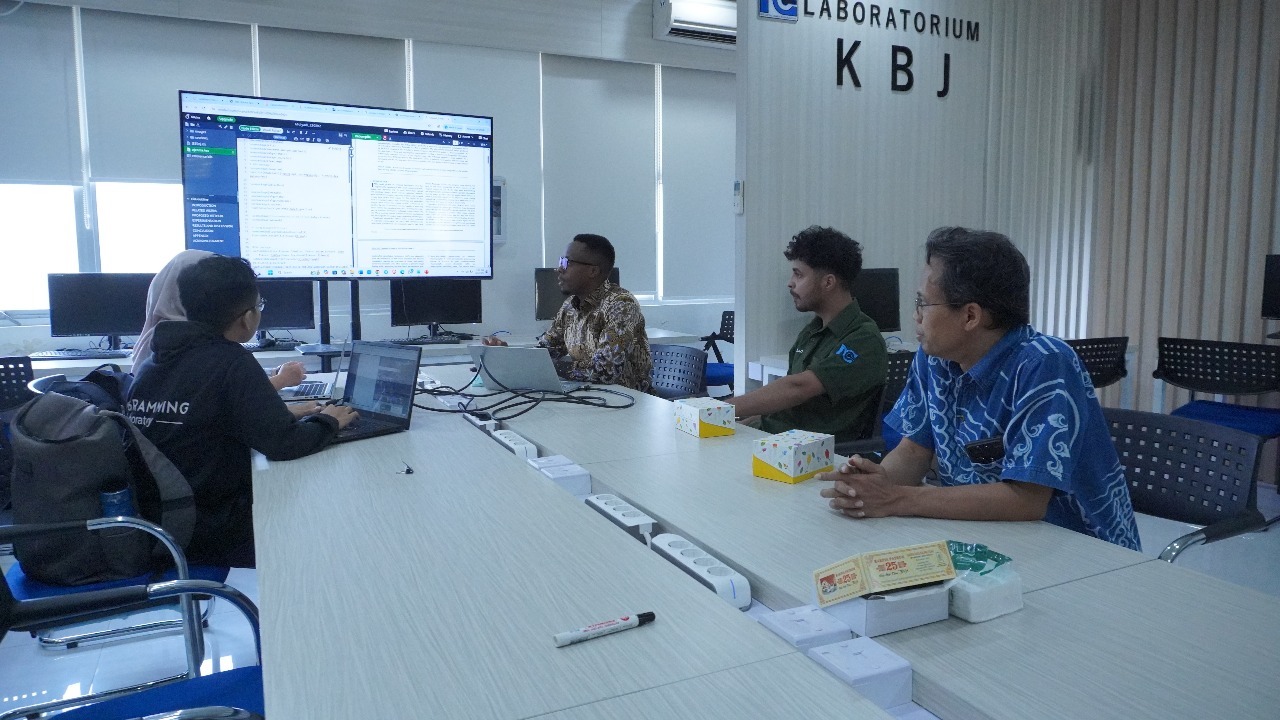
Ntivuguruzwa Jean De La Croix (third from right) with his research group during a discussion with Prof Tohari Ahmad SKom MIT PhD
Continuing his story, Jean presented his first publication entitled A Convolutional Neural Network to Detect Possible Hidden Data in Spatial Domain Images. This research proposes a new Convolutional Neural Network (CNN) architecture that can improve the accuracy of hidden data detection while improving network training stability. “The process involves three main stages, namely pre-processing, feature extraction, and classification,” he explained.
Jean explained that in the pre-processing stage, a spatial rich model filter is used to amplify noise. Next, feature extraction is performed with two-dimensional separable convolution to enhance the signal and capture local features. Finally, in the classification stage, multi-scale pooling and three fully connected layers are used to produce more accurate predictions while speeding up training time. “The results show that training time is accelerated by up to 30.81 percent,” he explained.
Apart from the academic aspect, Jean also shared his experiences about his campus life at ITS during those three years. He revealed that the ITS International Office greatly helped him, primarily through the Buddy Department program, which made it easier for him to adapt and get to know the academic and social culture on campus. “If there was something I didn’t understand, I would usually ask the volunteers directly,” he said.
Finally, through his proud achievements, this student, under the guidance of Prof Tohari Ahmad SKom MIT PhD, has successfully become one of the graduates at the upcoming 132nd ITS Graduation Ceremony. Jean’s story contributes to the achievement of the Sustainable Development Goals (SDGs), particularly point four on quality education and point 9 on industry, innovation, and infrastructure. (ITS Public Relations)
Reporter: Khaila Bening Amanda Putri
Translator: Lael Soebakir
Related News
-
ITS Formulates Inclusive Education System Policy for Students with Disabilities
ITS Campus, ITS News — The Sepuluh Nopember Institute of Technology (ITS) has once again demonstrated its commitment to
August 11, 2025 16:08 -
ITS Develops Andal App, a Solution for MSMEs to Manage Inventory
ITS Campus, ITS News — Amidst rapid technological advancements, many Micro, Small, and Medium Enterprises (MSMEs) still rely on
August 11, 2025 16:08 -
Consolink, an Automatic Soil Consolidation Testing Solution Created by ITS Students
ITS Campus, ITS News — A collaboration between a team of students and lecturers from the Sepuluh Nopember Institute
August 11, 2025 16:08 -
Supporting Economic Empowerment, ITS Signs MOU with BSI
ITS Campus, ITS News — The Sepuluh Nopember Institute of Technology (ITS) continues to strengthen its tangible and sustainable
August 11, 2025 16:08