Achieving a Doctorate at the Age of 25, Almas Records 35 Publications and International Contributions
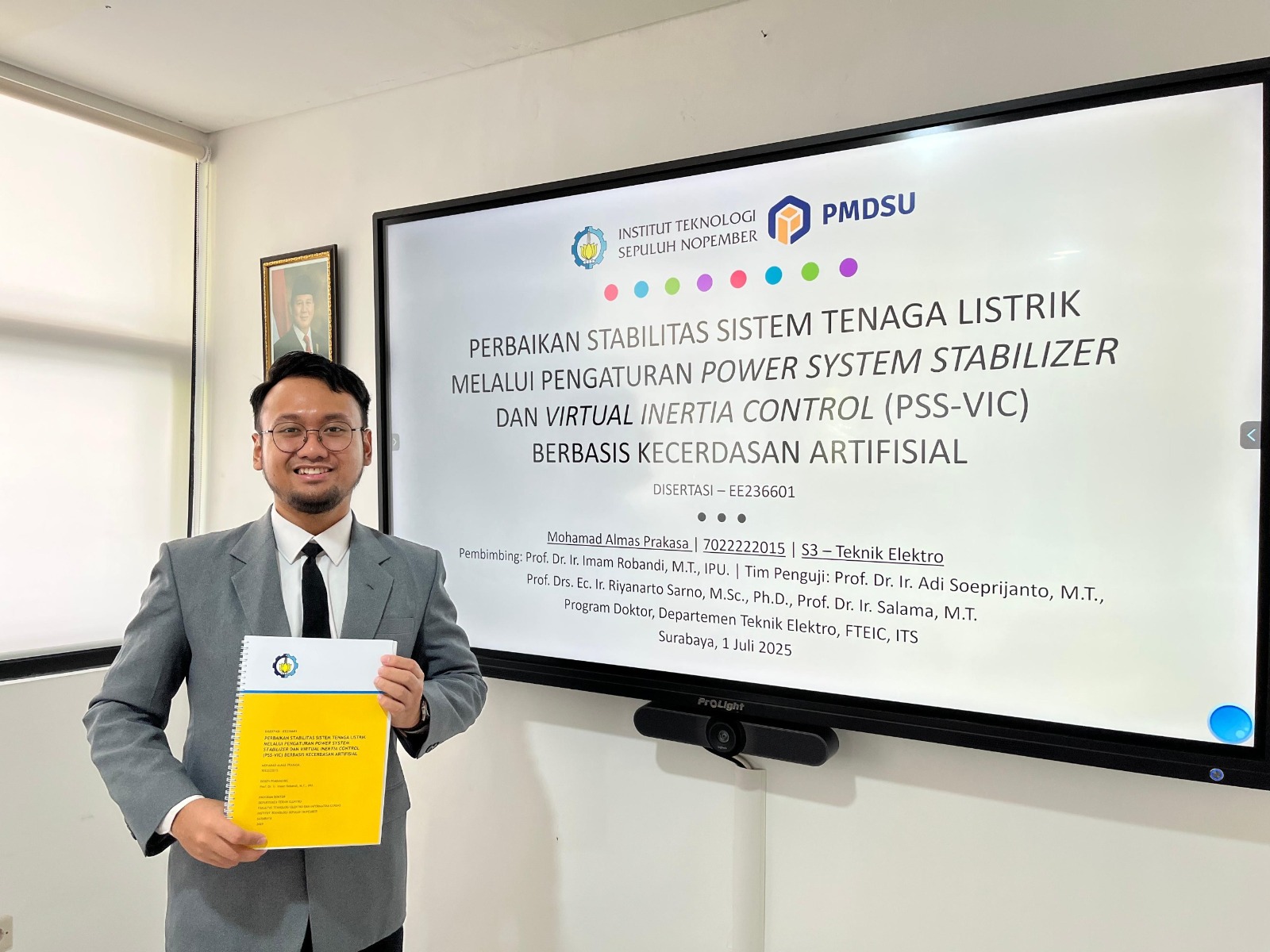
Dr Mohamad Almas Prakasa ST MT after presenting the results of his dissertation at the Doctoral Promotion Session in the ITS Department of Electrical Engineering
ITS Campus, ITS News — Institut Teknologi Sepuluh Nopember (ITS) has once again produced a young graduate with brilliant academic achievements. This time, Dr Mohamad Almas Prakasa ST MT from the Department of Electrical Engineering ITS successfully earned the title of doctor at the age of 25 with a multitude of achievements on national and international stages.
The doctoral student, familiarly called Almas, not only earned a doctoral degree at a young age but also solidified his academic contributions on the global stage through his internationally reputable publications. The publications he produced total 35, consisting of nine international journal articles in Quartile 1 (Q1), seven articles in Q2, two articles in Q3, and more than a dozen others in reputable national and international journals and conferences.
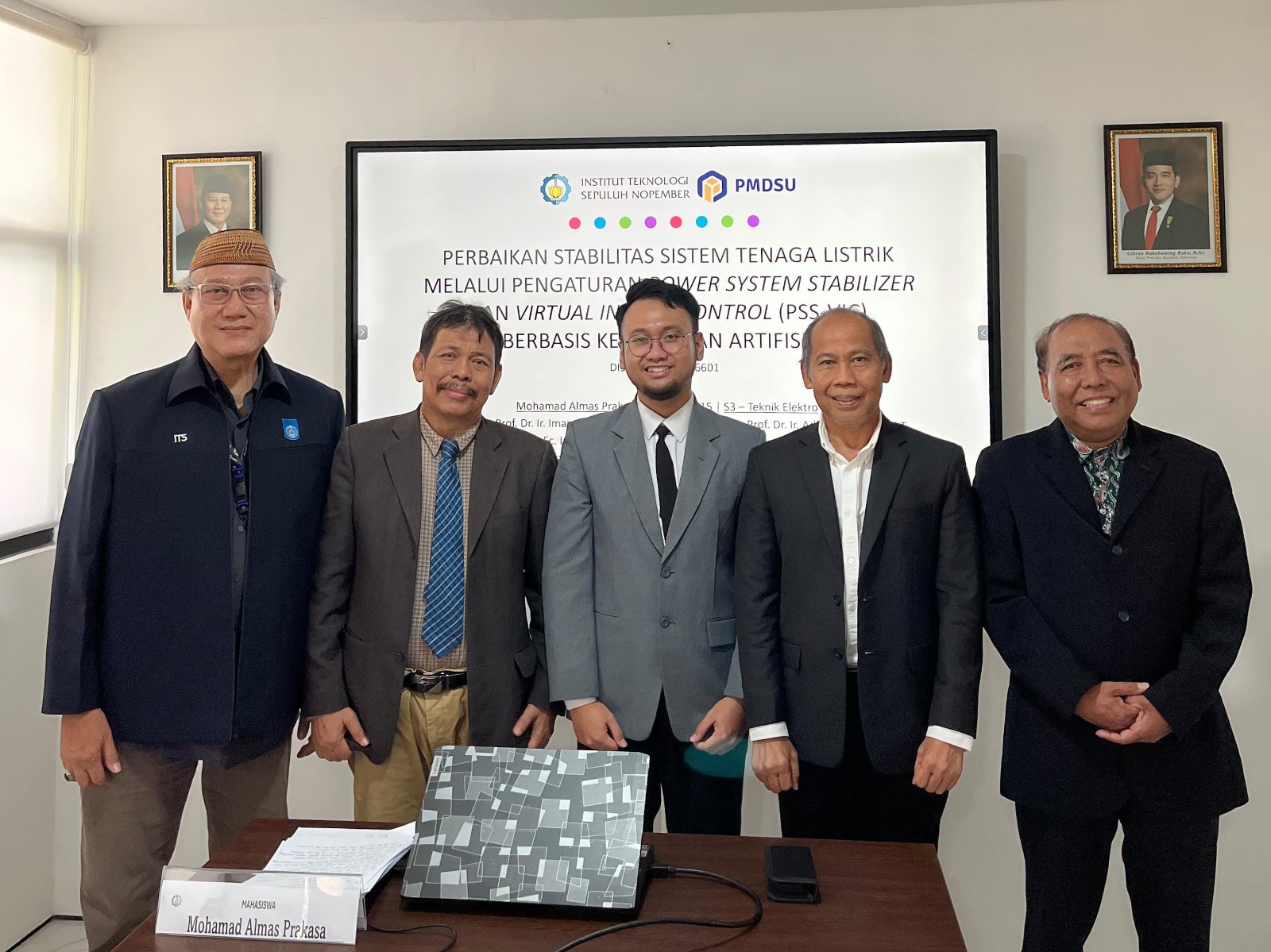
Dr Mohamad Almas Prakasa ST MT (center) with his advisor and examiners after the Doctoral Promotion Session in the ITS Department of Electrical Engineering
The international contributions of the doctor, who was declared to have passed his closed defense on Tuesday (7/1), began when he participated in the Master’s to Doctoral Education Program for Outstanding Graduates (PMDSU). This program from the Ministry of Education, Culture, Research, and Technology (Kemdikbudristek) of Indonesia allows participants to pursue master’s and doctoral degrees in a fast-track manner within just four years. Additionally, receiving the International Publication Quality Improvement (PKPI) scholarship from the Ministry of Higher Education, Science, and Technology (Kemdiktisaintek) of Indonesia became an important milestone in his academic journey.
While undergoing the PMDSU program, the eldest of three siblings was not only active in 15 research and community service grant schemes but also established global research collaborations with professors from Japan, Italy, and Taiwan. These research collaborations were conducted with Prof Shigemasa Takai from Osaka University, Japan; Prof Alberto Borghetti from the University of Bologna, Italy; and Prof Nien-Che Yang from the National Taiwan University of Science and Technology (NTUST), Taiwan.
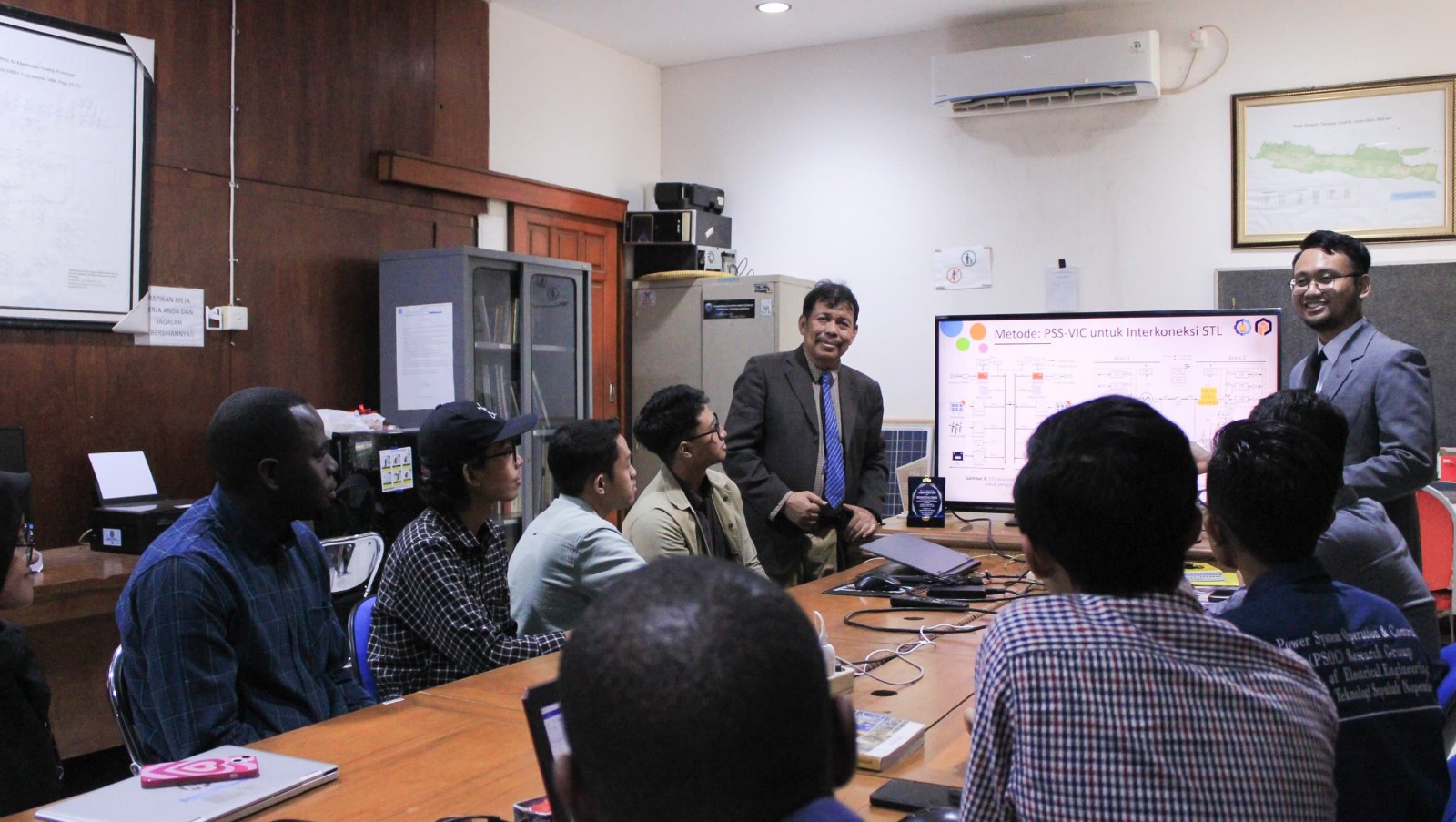
Dr Mohamad Almas Prakasa ST MT (standing right) and the Power System Operation and Control (PSOC) research team during a guidance session with Prof Dr Ir Imam Robandi (standing left)
Meanwhile, during the PKPI program, the alumnus of the Bachelor’s in Electrical Engineering from Semarang State University (Unnes) also conducted research collaboration for four months in the laboratory of Dr Ryo Nishimura at Tottori University, Japan. Currently, he is still actively expanding his global network by submitting research proposals with professors to several universities in Luxembourg and Uzbekistan, with the assistance of his advisor, Prof Dr Ir Imam Robandi MT IPU.
One of the topics Almas explored during his studies was the stability of large-scale Electrical Power Systems (STL). In this research, Almas successfully formulated a new concept to improve the stability of large-scale STL through coordinated regulation of the Power System Stabilizer (PSS) and Virtual Inertia Control (VIC) based on artificial intelligence. This concept was studied to be more effective, scalable, and compliant with grid codes, as well as supporting efforts toward a reliable and sustainable energy system in line with Sustainable Development Goals (SDGs) point 7 on affordable and clean energy.
Additionally, Almas, who completed his bachelor’s degree in 3.5 years, also successfully formulated a modified new algorithm, namely the Harris Hawk Optimization (HHO) algorithm with a Memory Storage Strategy (MSS). This HHO-MSS is considered to have a better balance in exploration, exploitation, accuracy, and consistency compared to other contemporary algorithms. “This algorithm has been proven to have higher accuracy and consistency than other algorithms,” he explained.
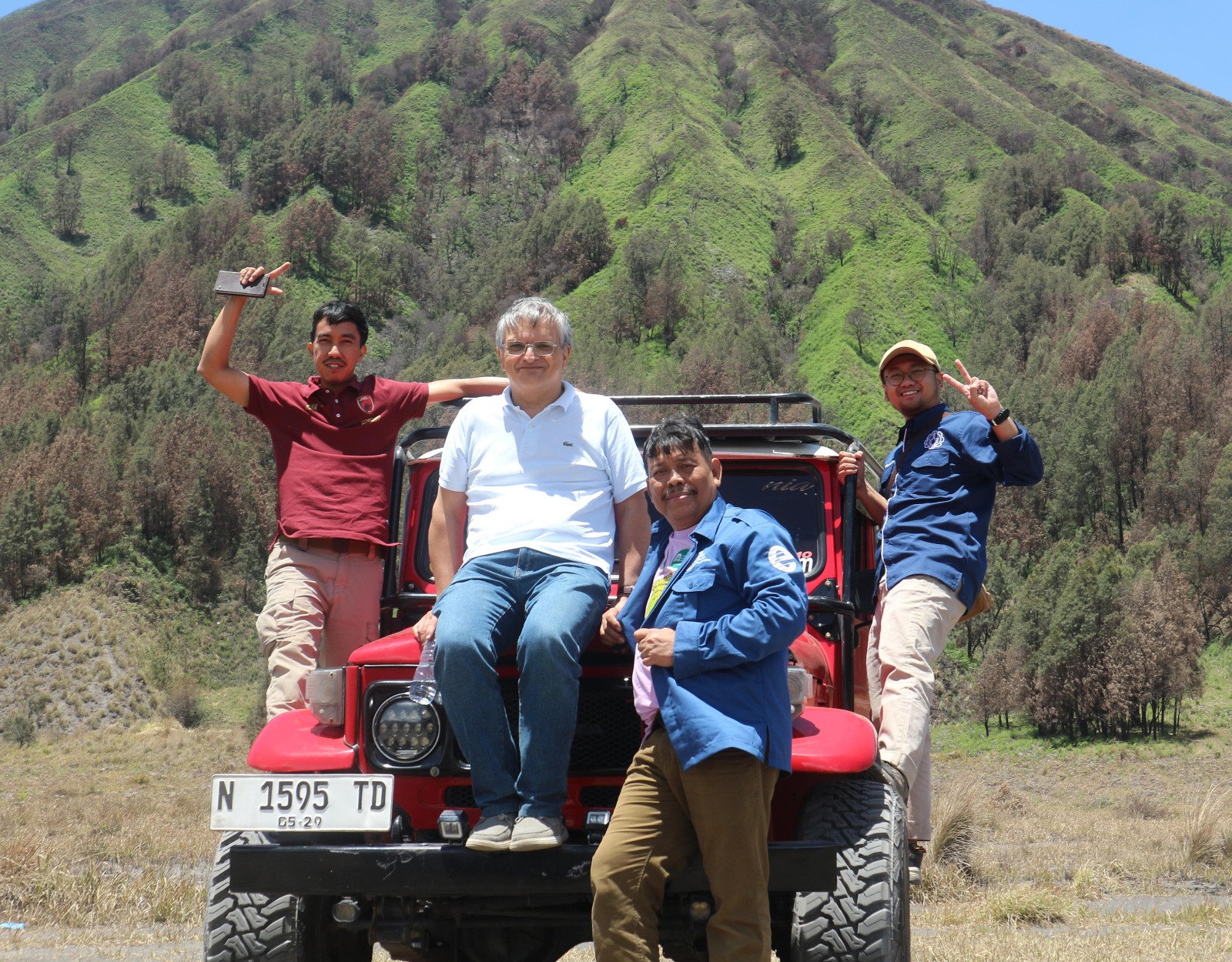
(from left) Dr Muhammad Ruswandi Djalal SST MT, Prof Alberto Borghetti, Prof Dr Ir Imam Robandi MT, Dr Mohamad Almas Prakasa ST MT during a joint trip
Almas revealed that his achievements were inseparable from the intensive and supportive academic atmosphere in the Power System Operation and Control (PSOC) research group and the Power System Simulation Laboratory (PSSL). In this group, he was also entrusted to be an assistant advisor for undergraduate and master’s students, including two international students from Tanzania. “The atmosphere in the lab is very supportive; I even discussed with my advisor more than three times a week,” explained the son of Moh Surya Prakasa and Mariana Eka Lestari.
Besides providing academic guidance, the man from Brebes, Central Java, explained that Prof Imam Robandi also built emotional bonds through togetherness outside the campus, such as eating and traveling together. This closeness made the transfer of knowledge more relaxed. “Prof Imam Robandi not only guided me academically but also built a personal bond that boosted my enthusiasm,” said the bespectacled man.
The doctor, born on September 1, 1999, also shared his message to students to not hesitate to pursue doctoral studies. According to him, pursuing a PhD is not about who is the smartest but about how to strategize learning. Additionally, he expressed his hope to continue serving as a researcher and lecturer at ITS. “ITS has given me extraordinary space and support. I want to keep contributing here,” he concluded enthusiastically. (ITS PUBLIC RELATIONS)
Reporter: Aulia Okta Wijaya
Related News
-
ITS Supports Scientific Contribution in Post-Disaster Rehabilitation Consortium
ITS Campus, ITS News — Institut Teknologi Sepuluh Nopember (ITS) takes part in the Higher Education Consortium for Post-Disaster Rehabilitation
July 03, 2025 14:07 -
ITS Becomes One of the Top Recipients of the Hitachi Innovation Awards
ITS Campus, ITS News — Institut Teknologi Sepuluh Nopember (ITS) continues to demonstrate its commitment to strengthening research and innovation.
July 03, 2025 14:07 -
Strengthening the Role of Higher Education Institutions, ITS Attends the Briefing of the President of the Republic of Indonesia
Jakarta, ITS News — Institut Teknologi Sepuluh Nopember (ITS) never stops continuously being involved in the development of the
July 03, 2025 14:07 -
ITS Facilitates Aid for 34 ITS Students Who Are Victims of Sumatra Floods
ITS Campus, ITS News — Institut Teknologi Sepuluh Nopember (ITS) continues to show its concern for students affected by
July 03, 2025 14:07