ITS Mathematics Alumnus Creates EEG-Based Brain Research Technology
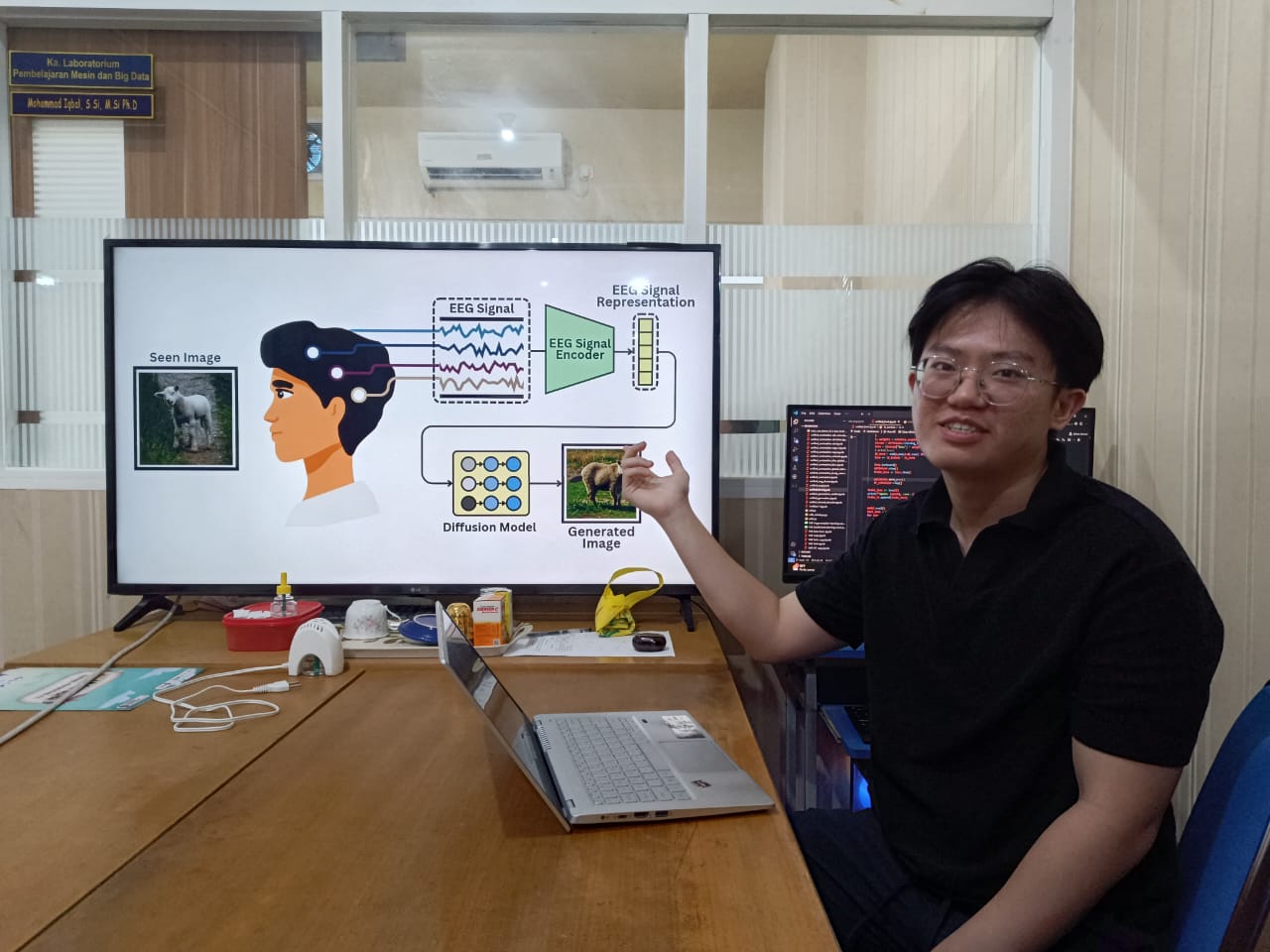
Felix Anthony, an ITS Mathematics alumnus, technically explaining the generalization of the human brain’s thinking power
ITS Campus, ITS News — One of the graduates of the Institut Teknologi Sepuluh Nopember (ITS) has succeeded in making an extraordinary innovation through the development of Electroencephalography (EEG) technology in probing brain memory. This innovation becomes a significant and impressive development as a supporting tool for issues in human activity.
The young man named Felix Anthony explained that the brain research innovation he developed began from the need for quick decisions in solving problems. Not only decisions when handling health issues, but also problems regarding forensics, politics, and life patterns can be addressed. “The human brain is the heart of the flow of life and this can be utilized to harvest solutions to all problems,” he said.
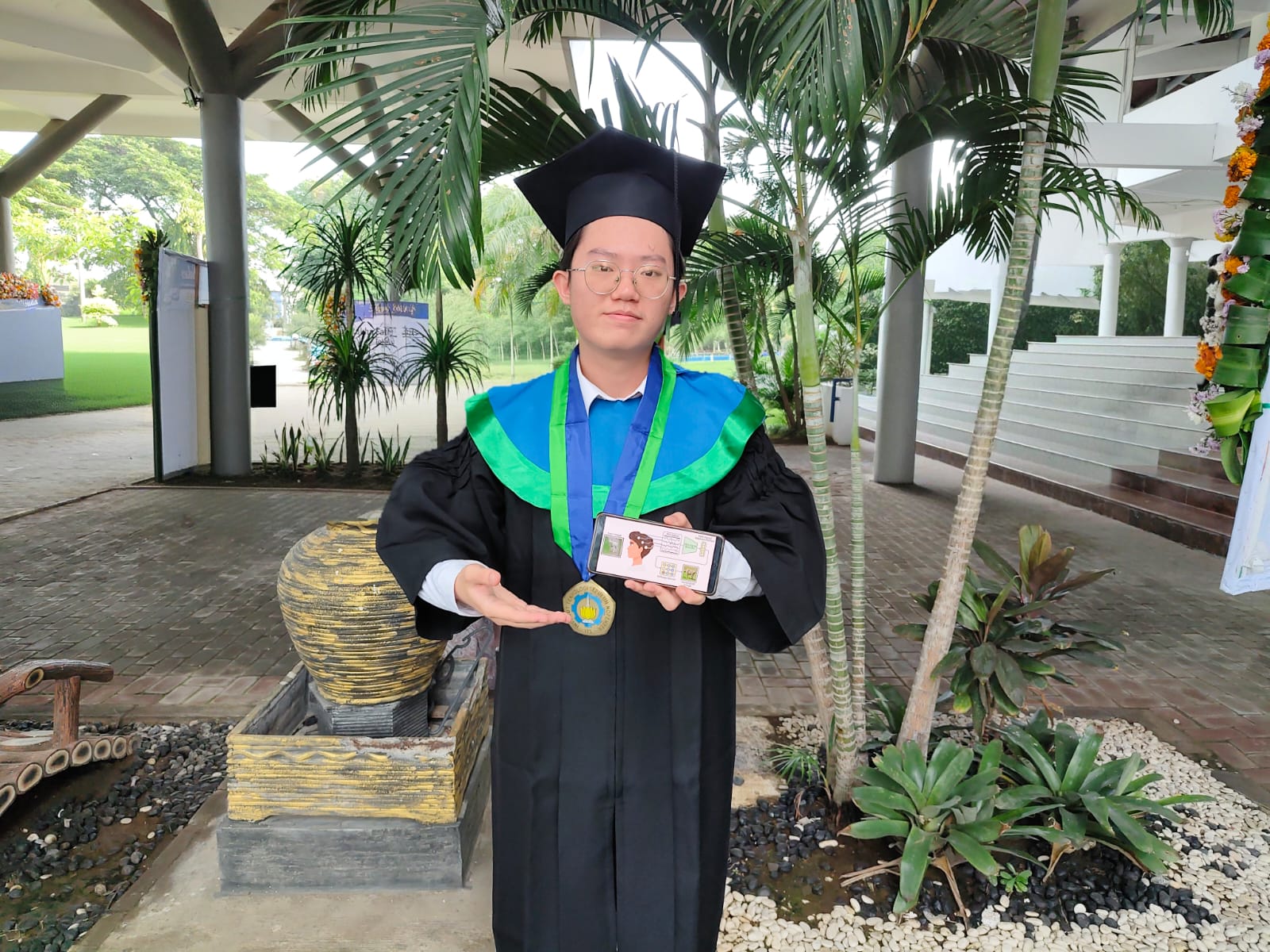
Felix Anthony after attending the 131st ITS Graduation ceremony and was confirmed as the second best bachelor graduate
For that reason, this alumnus of the Department of Mathematics, Faculty of Science and Data Analytics (Scientics) ITS developed technology that utilizes the brain’s thinking power as its main ammunition. This technology will provide details of the brain’s algorithm when viewing an object, so that it can be visualized what is thought from what is seen. “The resulting visualization will be represented as a real image that can be analyzed to determine its originality and meaning within,” he explained.
Furthermore, Felix added, the main technology used in his innovation is EEG, which acts as the initiator in the generalization of the brain’s visual stimulus. According to the bespectacled young man, the recorded EEG signals will go through preprocessing stages such as noise filtering and artifact removal, which are then extracted into dominant frequency features. “Next, the analysis of the generalized image uses a deep learning model to connect the object results and the algorithm,” he added.

ITS Mathematics Alumnus Felix Anthony demonstrating the making of EEG signal representation code
Technically, Felix continued, the image or memory thought in the brain will be signaled by the EEG signal and stored in an encoder. After that, the encoder will process the recording by turning it into a vector that will become the input for a generative model. That input is then reprocessed into a diffusion model which produces the generalized image. “What is most important is that the coding in the configuration toward the diffusion model must be correct so that it is well visualized,” he explained.
Nevertheless, the second-best bachelor graduate at ITS’s 131st Commencement, last mid-April, revealed that this technology—which is being massively launched—has weaknesses that need to be addressed. Approaches to the innovation must be carried out further in order to produce implementation for existing problems optimally. External requirements, such as compatible computers, must be upgraded in order to maintain consistent and smooth technological improvements without hindrance.
Thus, he hopes that this image-generation technology through EEG signals can support Sustainable Development Goals (SDGs) point 9 on innovation and sustainable technological infrastructure. This innovation is also expected to become capital for collaboration between academics, industry, and government in creating more integrated research. “With the variety of technological fragments created, I hope they can become motivation and continue existing innovations for the sustainability of this country’s development,” he concluded. (ITS PUBLIC RELATIONS)
Reporter: Mohammad Fariz Irwansyah
Related News
-
ITS Supports Scientific Contribution in Post-Disaster Rehabilitation Consortium
ITS Campus, ITS News — Institut Teknologi Sepuluh Nopember (ITS) takes part in the Higher Education Consortium for Post-Disaster Rehabilitation
May 07, 2025 08:05 -
ITS Becomes One of the Top Recipients of the Hitachi Innovation Awards
ITS Campus, ITS News — Institut Teknologi Sepuluh Nopember (ITS) continues to demonstrate its commitment to strengthening research and innovation.
May 07, 2025 08:05 -
Strengthening the Role of Higher Education Institutions, ITS Attends the Briefing of the President of the Republic of Indonesia
Jakarta, ITS News — Institut Teknologi Sepuluh Nopember (ITS) never stops continuously being involved in the development of the
May 07, 2025 08:05 -
ITS Facilitates Aid for 34 ITS Students Who Are Victims of Sumatra Floods
ITS Campus, ITS News — Institut Teknologi Sepuluh Nopember (ITS) continues to show its concern for students affected by
May 07, 2025 08:05